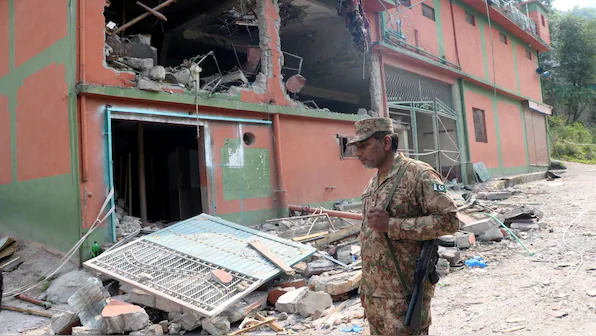
In the early hours of May 7, 2025, India launched Operation Sindoor, its largest and most coordinated military strike since the Balakot airstrikes in 2019. This was a direct response to the Pahalgam terror attack that took place on April 22, where 26 civilians, including an Indian Navy officer and a Nepali national, were killed. Operation Sindoor involved the Indian Army, Navy, and Air Force conducting precision strikes on terror infrastructure deep within Pakistan and Pakistan-occupied Kashmir (PoK), marking a significant escalation in India’s counter-terrorism strategy.
A Shift from Conventional Wars to Precision Strikes
India has a long history of military operations against Pakistan, spanning several decades and multiple wars. From large-scale conflicts to targeted strikes, the nature of these operations has evolved significantly. Operation Sindoor stands as a testimony to India’s shift from traditional warfare to more refined, strategic, and targeted precision strikes. Let’s examine the evolution of India’s military operations against Pakistan over the years.
Indo-Pak War of 1947-48 (First Kashmir War) and Operation Gulmarg
India’s first military response to Pakistani aggression came shortly after independence when tribal militias and Pakistani forces infiltrated Jammu and Kashmir in October 1947. Pakistan’s Operation Gulmarg led India to launch an emergency military airlift to Srinagar. The ensuing conflict ended with a UN-brokered ceasefire, and India retained about two-thirds of Jammu and Kashmir while Pakistan occupied the remaining area (now PoK).
Indo-Pak War of 1965: Operations Riddle and Blaze
During the Indo-Pak War of 1965, India’s naval operation ‘Operation Riddle’ focused on defending the western coast, while the Indian Army launched ‘Operation Blaze’ in the Kargil sector, responding to Pakistani artillery shelling. These limited strikes were a prelude to the broader conflict, which ended with the Tashkent Agreement in 1966. Pakistan’s operations during this time, namely Operation Gibraltar and Operation Grand Slam, sought to infiltrate Kashmir and capture key strategic locations.
Indo-Pak War of 1971: Operations Cactus Lily, Trident, and Python
The Indo-Pak War of 1971, which led to the creation of Bangladesh, saw multiple successful Indian operations. Operation Cactus Lily focused on the western front, while Operation Trident, a surprise naval attack on Karachi port, marked India’s first use of anti-ship missiles. Operation Python further crippled Pakistan’s naval logistics. These operations collectively resulted in Pakistan’s defeat and the eventual surrender of over 90,000 Pakistani troops.
Operation Meghdoot (1984): Preemptive Occupation of Siachen Glacier
Though not directly aimed at Pakistan, Operation Meghdoot marked a significant moment in India’s military history. It involved the preemptive occupation of the Siachen Glacier in 1984 by Indian forces, preventing Pakistan from asserting control over the region. This operation remains one of the highest-altitude military engagements and solidified India’s strategic control over Siachen.
Kargil War (1999): Operation Vijay and Operation Safed Sagar
During the Kargil War of 1999, India launched ‘Operation Vijay’ to evict Pakistani intruders from Indian territory in Ladakh. With significant air support under ‘Operation Safed Sagar’, India recaptured key peaks and ridges. This operation became one of the most intense high-altitude warfare operations, marking India’s military prowess. It also helped elevate the profile of the Indian Armed Forces.
Operation Parakram (2001-2002): Massive Mobilisation After Parliament Attack
In response to the 2001 Indian Parliament attack, India launched ‘Operation Parakram’, a massive mobilisation of troops along the Pakistan border. While the operation did not escalate into full-scale war, it served as one of the largest deployments since 1971, marking a shift in India’s military strategy.
Surgical Strikes (2016): Operation X
In response to the Uri terror attack in which 19 Indian soldiers were killed, India carried out surgical strikes across the Line of Control on September 29, 2016. This marked a new era of cross-border retaliation, with Indian commandos infiltrating PoK and targeting terrorist launch pads. The operation showcased India’s new strategy of targeted military action against terrorist infrastructure.
Balakot Air Strikes (2019): Operation Bandar
Following the Pulwama terror attack, in which 40 CRPF personnel were killed, India launched airstrikes on the Jaish-e-Mohammed (JeM) camp in Balakot, Pakistan, on February 26, 2019. Dubbed ‘Operation Bandar’, this was the first airstrike across the international border since 1971 and sent a strong message to Pakistan regarding India’s zero-tolerance policy toward cross-border terrorism.
Operation Sindoor (2025): The Latest in a Long Line of Strikes
The latest operation, ‘Operation Sindoor’, marks a significant evolution in India’s military strategy. It was launched in retaliation for the Pahalgam attack and targeted nine terrorist sites across Pakistan and PoK. With the use of cutting-edge weapons such as SCALP missiles, HAMMER bombs, and loitering munitions, Operation Sindoor reflects India’s growing precision-strike capabilities. Unlike previous strikes, which focused on limited targets, Operation Sindoor expanded its scope, striking multiple locations linked to major terror outfits like Lashkar-e-Taiba (LeT) and Jaish-e-Mohammed (JeM).
The Evolution of India’s Counter-Terrorism Strategy
India’s military operations against Pakistan have evolved from large-scale wars to more targeted and strategic precision strikes. Each operation has been a response to increasing threats from Pakistan-based terror groups. While past operations like ‘Operation Vijay’ and ‘Operation Parakram’ focused on military confrontations, newer operations like ‘Operation Sindoor’ and ‘Operation Bandar’ demonstrate India’s shift toward more surgical and technologically advanced strategies.
With Operation Sindoor, India has once again demonstrated its commitment to confronting cross-border terrorism while ensuring minimal collateral damage. This shift reflects India’s evolving military doctrine — one that prioritizes precision, strategic restraint, and maintaining escalation control while sending a clear message of deterrence.
As tensions continue to simmer between India and Pakistan, Operation Sindoor stands as a significant milestone in India’s counter-terrorism efforts, reinforcing its resolve to hold Pakistan accountable for the terror emanating from its soil.