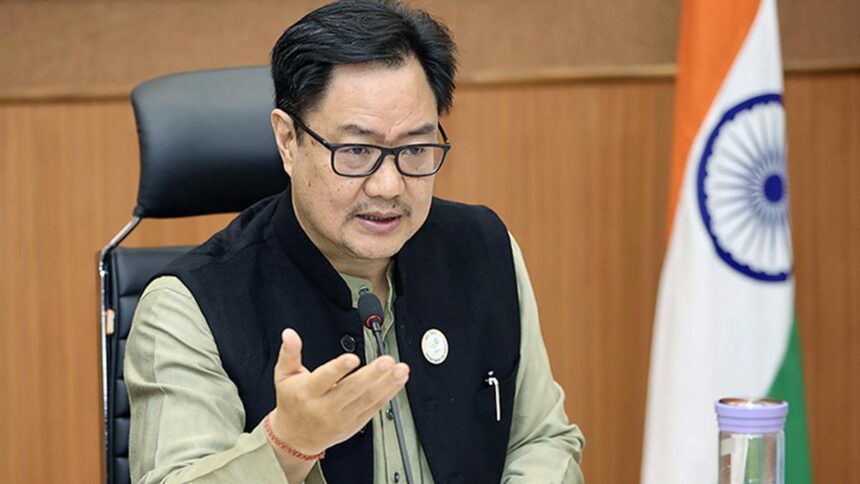
In a significant clarification on one of the most debated subjects in Indian legal and political discourse, Union Minority Affairs Minister Kiren Rijiju reiterated the government’s stance on the Uniform Civil Code (UCC), assuring that tribal communities across India, including the northeast, will be exempt from its purview. His remarks came during an event in New Delhi organised by the RSS-affiliated Vanvasi Kalyan Ashram, where he underscored that protecting the unique customs and traditions of tribal groups remains a priority for the government. The statement sought to quell growing concerns and dispel misconceptions around the implementation of the UCC, which is being actively discussed nationwide and is under examination by the Law Commission.
Kiren Rijiju’s Assurance on Tribal Autonomy
Speaking to an audience deeply connected with tribal welfare issues, Kiren Rijiju stressed that the government’s proposal to bring a Uniform Civil Code is firmly rooted in the vision of the Constitution, aiming to create uniformity in civil laws across the country just as criminal law is applied equally to all citizens. However, he pointed out that this uniformity must not come at the cost of erasing India’s indigenous diversity. The exemption granted to tribals, he argued, reflects an acknowledgement of the vital role that customs, traditions, and community laws play in shaping the identity and continuity of tribal societies.
Kiren Rijiju said, “Our government and party (BJP) think about bringing a Uniform Civil Code in the country as per the Constitution. When criminal law is equal for all, why should civil law not be equal for everyone?” His words reaffirmed the principle of legal equality that lies at the core of the UCC, while simultaneously highlighting the careful balance being sought between national uniformity and cultural preservation.
The minister also took note of misinformation circulating on social media regarding the government’s intentions, dismissing it as an attempt to create unnecessary fear. While refraining from naming individuals or groups, Kiren Rijiju emphasised that such false narratives distort the broader purpose of the UCC. The core idea, he explained, is not to diminish any religious or cultural identity but to ensure fairness and consistency in civil matters like marriage, inheritance, adoption, and divorce.
Crucially, Kiren Rijiju’s statement drew attention to the unique position of the northeast, where tribal populations form a substantial portion of society and continue to follow customary practices that have governed them for centuries. He clarified that the UCC will not be implemented in the regions covered under the Fifth and Sixth Schedules of the Constitution, nor in tribal areas outside the northeast. This declaration carried weight, as it reassured communities who feared that their traditions might be overridden by a blanket law. “Let adivasis be given freedom to live in their own way,” Kiren Rijiju said, encapsulating the spirit of the exemption.
The remarks also came at a time when debates around the UCC have intensified, especially after Uttarakhand became the first state in India to pass and implement a Uniform Civil Code earlier this year. Kiren Rijiju’s assurance served as a reminder that while the UCC represents a major reform in India’s civil legal framework, it will be applied with sensitivity to regional and cultural realities.
The Broader Debate Around the UCC
The Uniform Civil Code has long been a subject of political, legal, and social debate in India. Its roots lie in the Directive Principles of State Policy outlined in the Indian Constitution, which envision the creation of a single civil law for all citizens, transcending the diverse personal laws based on religion. The central idea is to establish uniformity and equality in civil matters such as marriage, divorce, inheritance, adoption, and maintenance, thereby promoting gender justice and eliminating discriminatory practices entrenched in personal laws.
At present, India functions under a plural system of personal laws, where different religious communities are governed by their own codes in civil matters. For example, Hindus, Muslims, Christians, and Parsis all have separate legal frameworks regulating family and inheritance issues. This plurality has been defended by many as a reflection of India’s multicultural ethos, but it has also been criticised for perpetuating inequality, especially in matters affecting women’s rights.
The UCC has historically been at the centre of ideological contention between advocates of legal uniformity and defenders of religious and cultural autonomy. Supporters argue that a common civil code is essential to ensure equality before the law and to strengthen national integration. They point to practices such as triple talaq, halala, iddat, and gender-based inheritance rules as examples of laws that disadvantage women and violate constitutional principles of equality.
Opponents, however, maintain that the imposition of a uniform law risks undermining India’s pluralistic identity, where communities have thrived for centuries under distinct traditions. The exemption granted to tribals in Kiren Rijiju’s statement illustrates an attempt to bridge these conflicting perspectives by recognising that uniformity cannot be absolute in a country as diverse as India. By exempting tribal societies, the government has acknowledged that the preservation of indigenous traditions is not only a matter of cultural pride but also a constitutional responsibility.
The Law Commission is currently examining the UCC, weighing the complexities of implementing such a wide-ranging reform in a society marked by vast cultural, linguistic, and religious diversity. The draft UCC prepared by a five-member expert committee, headed by retired Justice Ranjana Prakash Desai, was submitted to the Uttarakhand government in February 2024. The document, which spans 392 sections across seven schedules, forms one of the most comprehensive frameworks yet for a uniform civil law. Uttarakhand’s swift approval of the draft has been hailed as a milestone in Indian legal history, setting a precedent for other states to follow.
Among its provisions, the Uttarakhand UCC bans practices like halala, iddat, and talaq under Muslim personal law, establishing a uniform code that applies equally across communities in the state. It also addresses issues of adoption, maintenance, and inheritance, areas where disparities between different personal laws have historically led to legal and social inequities. The bold move by Uttarakhand has reignited national debates, with supporters celebrating it as a step toward justice and opponents cautioning against the erasure of cultural diversity.
Kiren Rijiju’s clarification carries even greater importance. It reflects an attempt to chart a middle course, ensuring that the UCC can move forward without alienating tribal and indigenous groups who see their customs as central to their way of life. His remarks highlight the challenge of implementing a reform that is both transformative and inclusive, one that upholds the principle of equality while respecting the mosaic of traditions that make up the Indian nation.