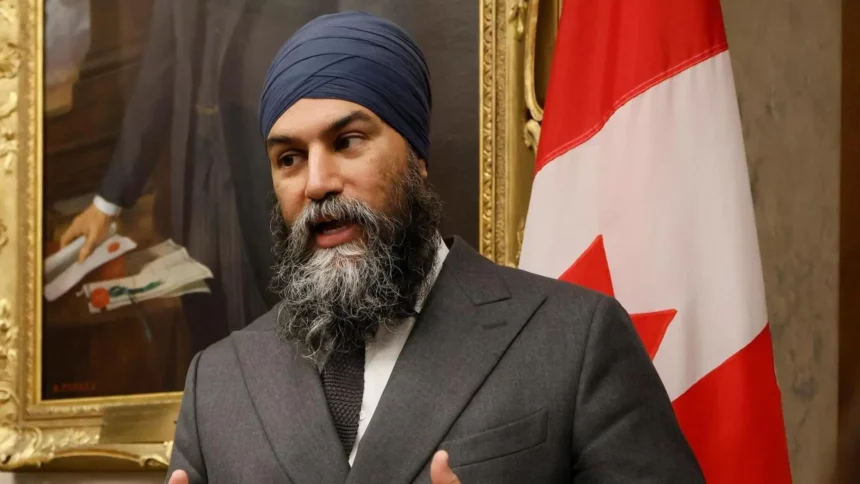
Jagmeet Singh, leader of the New Democratic Party (NDP) in Canada, rose to political prominence in 2022 when he played a pivotal role in supporting Prime Minister Justin Trudeau’s government. His party secured a significant position in the Canadian federal elections that year, helping Trudeau to form a government. Many analysts believed that Singh would continue to wield significant influence in future elections. However, the situation has drastically changed, and Singh recently announced his resignation as NDP leader after losing his seat in Burnaby Central. The NDP is also at risk of losing its national party status, as parties in Canada need a minimum of 12 seats in the House of Commons to retain this designation.
Singh’s Rise in Politics
Born in Scarborough, Ontario, to Indian immigrants from Punjab, Jagmeet Singh’s journey into politics was marked by his pursuit of higher education, earning a degree in biology from the University of Western Ontario and a law degree from York University’s Osgoode Hall Law School. Before entering politics, Singh worked as a criminal defense attorney. His first major foray into politics was in 2011 when he ran for a provincial seat in Ontario. In 2019, he made a breakthrough when he won a seat in Canada’s federal parliament in a by-election in Burnaby, British Columbia.
Singh’s appearance and charisma helped him rise in Canadian politics. He became known for his sharp, well-tailored suits, and was even dubbed by Buzzfeed as the “most stylish politician in Canada by like a million kilometers.” However, his political rise wasn’t without controversy, as Singh became a vocal supporter of Khalistani movements, which led to some friction with India, especially when he publicly supported the 1984 Sikh riots as “genocide.”
Singh’s Role in Canadian Politics and Controversies
In 2022, Singh’s NDP entered into a strategic agreement with Justin Trudeau’s government, which granted the NDP several significant policy wins, including commitments for a national dental care program and a framework for pharma care. Despite these successes, Singh’s stance on foreign relations, particularly his pro-Khalistan views, generated significant tension, especially as Canada’s relationship with India soured following the assassination of Sikh leader Hardeep Singh Nijjar in 2023.
Singh’s vocal support for actions like the expulsion of Indian diplomats over the Nijjar incident and his stance on the ongoing conflict in Kashmir further deepened divisions with India, which led to criticism of his leadership on the international stage.
Singh’s Downfall in the 2024 Elections
Singh’s downfall became apparent during the 2024 Canadian federal elections, where his NDP party suffered a crushing defeat. Singh not only lost his own seat in Burnaby Central to Liberal candidate Wade Chang but also saw his party’s seat count plummet to just seven, far below the 12 seats required to retain national party status. This represented a drastic fall from the 24 seats the NDP secured in the previous election.
Singh, who had hoped for a third consecutive win, received only 27% of the vote in his riding, with his opponent securing over 40%. The loss was a major blow to his leadership, and he later announced that he would step down as the party leader, though he promised to stay on in the interim until a new leader is elected.
The NDP’s poor performance in the 2024 elections can be attributed to several factors, including the polarization of the electorate, a divided political landscape, and dissatisfaction with Singh’s leadership. While Singh’s campaign had inspired many, it failed to resonate with a majority of voters, who ultimately turned to other political parties. Additionally, the NDP faced significant challenges in addressing the needs of the electorate, and voters seemed to have abandoned the party in favor of other options.
Former NDP national director Anne McGrath acknowledged the party’s defeat but maintained that Singh’s campaign was inspiring. However, she recognized that the challenges of the campaign—particularly the polarized nature of the election—played a significant role in the party’s losses.
Looking Ahead: The Future of NDP and Singh
In the aftermath of this electoral setback, NDP leaders are calling for an internal review of the party’s strategy. There are discussions about what went wrong and how the party can rebuild, though many are uncertain about the road ahead. Some analysts believe that while Singh’s resignation marks the end of an era for the NDP, it could also open the door for new leadership and a fresh direction for the party.
Singh’s legacy in Canadian politics remains mixed. While he played a key role in the 2022 agreement with the Trudeau government and brought attention to important social issues, his controversial stances on foreign policy, especially regarding India, may have undermined his credibility with some voters.
As the NDP looks to the future, the party’s leaders must navigate the challenges of rebuilding its image and broadening its appeal to voters across the country. Whether Singh’s departure marks the beginning of a new chapter for the NDP or the end of its relevance in Canadian politics will depend on the decisions made by the party’s leadership in the coming months.
Jagmeet Singh’s rise and fall in Canadian politics serve as a reminder of the complex interplay between domestic policy, international relations, and leadership. While Singh’s initial success in the 2022 elections positioned him as a key player in Canada’s political landscape, his inability to maintain support, both within his party and from voters, ultimately led to his downfall. As the NDP seeks to rebuild, the question remains whether Singh’s departure will be the catalyst for a new beginning or the beginning of the end for the party’s political influence.