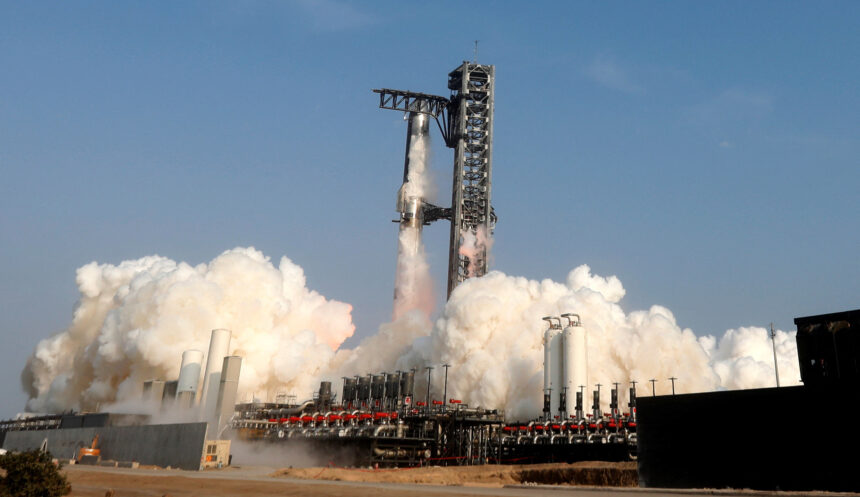
SpaceX’s recent attempt to prove the capabilities of its massive Starship rocket—central to Elon Musk’s dream of human missions to Mars—ended in failure once again. The launch from SpaceX’s Starbase in Texas marked the ninth integrated flight test of the Starship-Super Heavy system but fell short of several critical mission goals.
Mission Overview and Failures
The mission aimed to deploy eight Starlink satellite simulators, perform an in-space engine restart, and achieve a controlled reentry and splashdown in the Indian Ocean. Although the rocket surpassed previous distance records, trouble emerged soon after liftoff.
The Super Heavy booster, responsible for lifting the upper stage out of Earth’s atmosphere, failed its planned splashdown in the Gulf of Mexico and broke apart mid-descent. Meanwhile, the upper-stage Starship entered suborbital space but suffered fuel leaks, spiraled out of control, and lost communication.
One key malfunction occurred 18 minutes into the flight when the mechanism for deploying Starlink simulators failed, leading to mission cancellation. SpaceX described the event as a “rapid unscheduled disassembly,” their term for in-flight explosions.
Starship’s Role in Musk’s Mars Vision
Elon Musk’s ambition to make humanity a “multi-planetary species” depends heavily on Starship’s success. The fully reusable rocket is designed to carry crew and cargo to the Moon, Mars, and beyond. Despite redesigns and system improvements, setbacks continue to challenge the program.
Notably, this test used a previously flown Super Heavy booster, part of SpaceX’s effort to achieve rapid and low-cost reusability. However, intentional stress tests and descent angles contributed to the booster’s destruction. Starship’s flight covered more distance than before but did not reach its intended splashdown near Australia. About 45 minutes into the mission, the vehicle disintegrated after activating fuel venting protocols.
Musk attributed the failure to a leak in the main fuel tank but highlighted that the data collected will guide future improvements. He remains committed to increasing launch frequency to every 3–4 weeks.
Implications for NASA and Future Missions
NASA is relying on a modified Starship variant for its Artemis program to return astronauts to the Moon. The plan involves using NASA’s Space Launch System and Orion capsule to reach lunar orbit, where Starship will shuttle astronauts to the surface. Artemis 3, the first landing mission, is planned for no earlier than 2027 but now faces increased uncertainty.
Political debates around Artemis and NASA’s direction add complexity. The previous U.S. administration suggested reevaluating or even canceling core components of the program. Musk himself has questioned lunar missions, advocating for prioritizing Mars exploration.
Challenges Ahead and SpaceX’s Approach
Despite the repeated failures, SpaceX adheres to a “fail fast, learn fast” methodology that has driven its commercial success. Musk’s public confidence remains intact.
The launch attracted enthusiasts who valued the data gathered from the attempt. In parallel, SpaceX continues to advance in other areas, such as successfully catching boosters with robotic arms—critical for rapid reuse.
Regulators have recently approved increased launch rates, even as environmental concerns persist about impacts on local wildlife near launch sites.
Musk faces the dual challenge of managing technical hurdles alongside his broader business and political activities, including support for U.S. President Donald Trump.
While the latest Starship test was a setback, SpaceX’s ambitious vision for Mars exploration remains active. The path forward involves balancing technical innovation, regulatory compliance, and ambitious scheduling. The coming months will be critical in determining if Musk’s dream of making humanity a multi-planetary species can overcome these challenges.