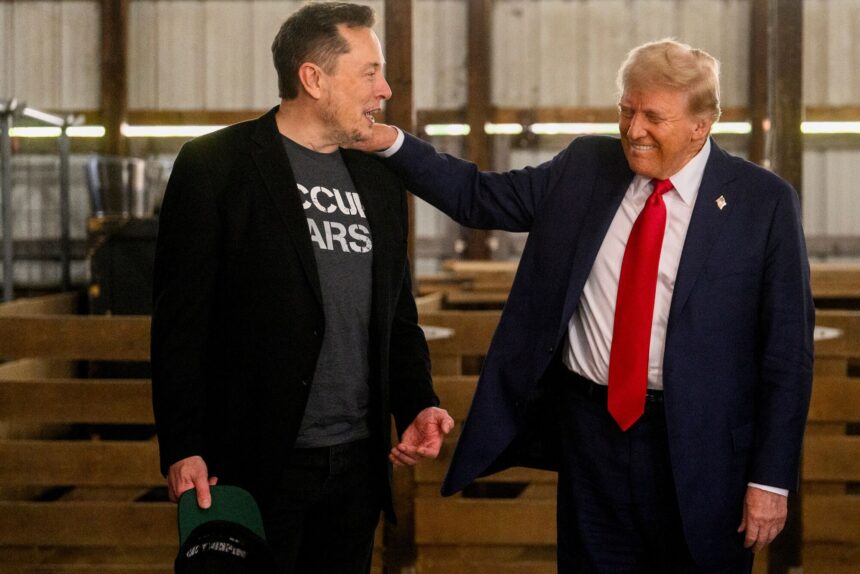
In a gathering meant to celebrate the titans of the technology industry, Elon Musk, the high-profile CEO of Tesla and SpaceX, was notably absent from a dinner hosted by US President Donald Trump. The dinner, designed to bring together leading figures in artificial intelligence, computing, and aerospace, drew heavy media attention not only because of the stature of the attendees but also due to Elon Musk’s conspicuous absence. While the likes of OpenAI CEO Sam Altman, Apple’s Tim Cook, Meta’s Mark Zuckerberg, Microsoft’s Satya Nadella, and Google co-founder Sergey Brin were in attendance, Elon Musk’s decision to miss the event has fueled widespread speculation about the evolving dynamics between the billionaire entrepreneur and the former president. This absence comes against the backdrop of a complex relationship marked by camaraderie, collaboration, and recent public spats, leaving observers questioning whether it was a deliberate snub, scheduling conflict, or a strategic avoidance.
The Dinner and the Guest List Highlight Industry Power Dynamics
Originally planned for an outdoor setting at Donald Trump’s Mar-a-Lago Club in Palm Beach, Florida, the dinner had to be relocated to the White House State Dining Room due to inclement weather. Despite the venue change, the guest list remained star-studded, featuring many of the most influential figures in technology today. Alongside Sam Altman, Mark Zuckerberg, Tim Cook, Satya Nadella, and Sergey Brin, other notable attendees included Bill Gates, OpenAI founder Greg Brockman, Oracle CEO Safra Catz, Micron CEO Sanjay Mehrotra, TIBCO Software chairman Vivek Ranadive, Palantir executive Shyam Sankar, Scale AI founder Alexandr Wang, Blue Origin CEO David Limp, and Shift4 Payments CEO Jared Isaacman. Isaacman, a Elon Musk ally and entrepreneur chosen by Donald Trump to lead NASA, had his nomination withdrawn due to political affiliations, highlighting the intricate interplay of business, politics, and personal relationships shaping the gathering.
While Elon Musk’s absence was apparent, he later confirmed via social media that he had been invited but was unable to attend, adding that a representative would be present on his behalf. This statement, however, seemed to contradict a White House official’s assertion that Elon Musk was not on the official invitee list. The inconsistency has only fueled further speculation about the real reasons behind Elon Musk’s absence, leaving commentators and industry watchers to debate whether it was a personal decision, a political statement, or the result of lingering tensions between the two high-profile figures. Elon Musk’s complicated relationship with Donald Trump, which has shifted from endorsement to advisory roles and ultimately to public disagreement, adds layers of intrigue to what might otherwise have been a standard networking dinner.
The inclusion of Sam Altman, one of Elon Musk’s main rivals in the AI space, further intensified discussions around Elon Musk’s decision not to attend. Altman’s presence underscored the shifting landscape of influence within the technology sector, highlighting the growing prominence of AI leaders independent of Elon Musk’s direct involvement. The dinner, therefore, was not only a platform for political engagement but also an opportunity for CEOs and industry leaders to signal their strategic positions in rapidly evolving technological domains.
Donald Trump-Elon Musk Relationship: From Alliance to Public Spat
Elon Musk’s relationship with Donald Trump has been far from straightforward. Initially, their alliance was marked by public support and collaboration. In July of the previous year, Elon Musk endorsed Donald Trump following an assassination attempt on the former president in Pennsylvania. Elon Musk subsequently contributed substantial funds to Donald Trump’s presidential campaign, quickly earning a reputation as a key ally. Recognizing his influence, Donald Trump appointed Elon Musk as an unpaid presidential advisor under the “special government employee” category and later made him co-chair of the newly formed Department of Government Efficiency (DOGE), a role that further solidified Elon Musk’s political and advisory involvement.
Despite the early camaraderie, the relationship began to fray over policy disagreements, particularly surrounding Donald Trump’s spending initiatives. Elon Musk publicly criticized the administration’s “Big Beautiful Bill,” arguing that it would expand the federal deficit and undermine the efforts of DOGE. Tensions escalated over the bill’s removal of electric vehicle tax credits, a change Elon Musk viewed as detrimental to Tesla’s interests. Donald Trump, in turn, accused Elon Musk of attempting to sabotage the legislation. This disagreement marked the beginning of a very public fallout, characterized by social media exchanges and pointed comments that strained what was once a close professional and personal bond.
The resulting feud led Elon Musk to step down from his role as DOGE chief, choosing instead to focus on Tesla and his other enterprises. The public nature of the disagreement has made their relationship a subject of intense scrutiny, with analysts noting that the interplay between Elon Musk’s business interests, personal ambitions, and political affiliations creates an unpredictable dynamic. While Donald Trump continued to speak about Elon Musk in mixed terms—acknowledging his genius but pointing out perceived flaws—the dinner’s absence highlights the unresolved tension between the two influential figures.
Even amidst this discord, Donald Trump has maintained a degree of admiration for Elon Musk. In public statements, he described Elon Musk as “80% super genius” while acknowledging certain difficulties that he believes Elon Musk must resolve to reach his full potential. Donald Trump’s nuanced position reflects a complicated mixture of respect, frustration, and strategic calculation, leaving observers to wonder whether Elon Musk’s absence from the dinner represents a subtle snub, a principled avoidance, or simply a scheduling conflict.
Elon Musk’s Broader Context: Industry Positioning and Public Statements
Elon Musk’s absence should also be understood in the broader context of his ongoing interactions with US political figures and his positioning within the technology industry. Earlier in the week, Elon Musk responded to a journalist’s video highlighting a previous snub by President Joe Biden, who allegedly excluded Tesla from the White House EV Summit despite the company being the largest producer of electric vehicles. In this instance, Elon Musk criticized Biden and indicated his reluctance to support him in the upcoming elections. These comments illustrate Elon Musk’s willingness to openly critique political leaders, underscoring his independent approach and willingness to assert influence over policy discussions impacting his industry.
Furthermore, Elon Musk’s public statements convey a strategy of measured engagement: “I try not to start fights, but I do finish them,” he tweeted, signaling both caution and assertiveness. This approach aligns with Elon Musk’s broader business and political philosophy, emphasizing strategic intervention while maintaining operational focus on Tesla, SpaceX, and other ventures. Given this context, his absence from Donald Trump’s dinner may be interpreted as a deliberate decision to avoid public confrontation while ensuring his broader strategic interests remain intact.
The dinner, which featured a diverse range of technology leaders, provided an implicit demonstration of the complex interconnections between business, politics, and personal relationships in shaping the tech landscape. Elon Musk’s decision not to attend contrasts with the presence of Altman and others, highlighting the evolving nature of leadership and influence in emerging technologies, particularly artificial intelligence. Analysts have noted that this shift reflects broader trends in which new leaders, policy positions, and industry priorities increasingly determine strategic alignment and access to influential networks.
In addition to AI leaders, the presence of established figures like Bill Gates, Tim Cook, and Mark Zuckerberg reinforced the ongoing importance of traditional tech giants in policy and industry discussions. Elon Musk’s absence, therefore, was notable not merely because of his prominence but also because it signaled potential recalibration of relationships and priorities within the tech and political spheres. The event highlighted how individual decisions by high-profile figures like Elon Musk can reverberate across industries, influencing collaborations, partnerships, and public perception.
While the exact reasons for Elon Musk’s absence remain unclear, his prior engagement with Donald Trump, public statements, and the presence of industry rivals contribute to a narrative that underscores the complexities of navigating high-level political and technological networks. Observers have speculated that the absence may serve multiple purposes: protecting business interests, avoiding political entanglement, or strategically allowing other figures, such as Altman, to assume greater visibility in the AI space. Each of these interpretations illustrates the layered dynamics shaping interactions between tech CEOs and political leaders, particularly in a context of shifting alliances and public scrutiny.
The dinner itself, hosted amid ongoing debates about US technological dominance, energy policy, and geopolitical strategy, symbolized both the opportunities and tensions inherent in intersections of private enterprise and public governance. Elon Musk’s absence amplified media attention, serving as a reminder that individual decisions in such forums carry weight beyond the immediate event, influencing narratives about influence, loyalty, and strategic positioning.
Moreover, Elon Musk’s approach contrasts with the behaviors of other CEOs at the dinner, who largely maintained cordial relationships with Donald Trump despite political disagreements. This difference further emphasizes Elon Musk’s distinctive strategy of engagement, highlighting his focus on operational priorities, long-term vision, and cautious navigation of political landscapes. It also reflects his awareness of potential conflicts that could arise from direct involvement in politically charged events, suggesting a calculated balance between visibility, influence, and risk management.
The evolving Musk-Donald Trump dynamic remains a subject of intense speculation, particularly regarding potential future interactions. Analysts and media observers continue to debate whether Elon Musk’s absence signals permanent estrangement, temporary avoidance, or an evolving redefinition of their professional and personal ties. The dinner provided a microcosm of these dynamics, illustrating the broader challenges faced by tech leaders operating at the intersection of innovation, politics, and public attention.
In addition to political implications, Elon Musk’s absence highlights ongoing competition within the technology sector, particularly in artificial intelligence. With Sam Altman present and increasingly prominent, Elon Musk’s non-attendance subtly shifts attention and influence toward other emerging leaders. The dinner, therefore, serves as both a networking opportunity and a strategic landscape for observing power dynamics, signaling, and alignment within the tech community.
Overall, Elon Musk’s absence from Donald Trump’s dinner has generated extensive discussion across media outlets, social media platforms, and industry analysis. It underscores the delicate balance tech leaders must maintain between political engagement, public perception, and business priorities. While Elon Musk’s representative attended on his behalf, the decision not to attend personally reflects a strategic calculation influenced by past conflicts, ongoing rivalries, and a careful weighing of risks and benefits.
The dinner and its surrounding narratives exemplify how high-profile interactions in technology and politics are shaped by a mixture of personal relationships, strategic priorities, and public perception. Elon Musk’s choice not to attend, set against a backdrop of a star-studded gathering, offers insights into the evolving nature of influence, alliances, and competition among tech CEOs in the modern era.
The event also provides a lens through which to understand the intersections of politics, technology, and media attention, illustrating how individual choices can reverberate across industries and influence public discourse. Elon Musk’s absence, whether interpreted as a snub, a strategic avoidance, or an unavoidable conflict, continues to be analyzed as part of the broader narrative of his complex relationship with Donald Trump, his rivals, and the tech industry at large.