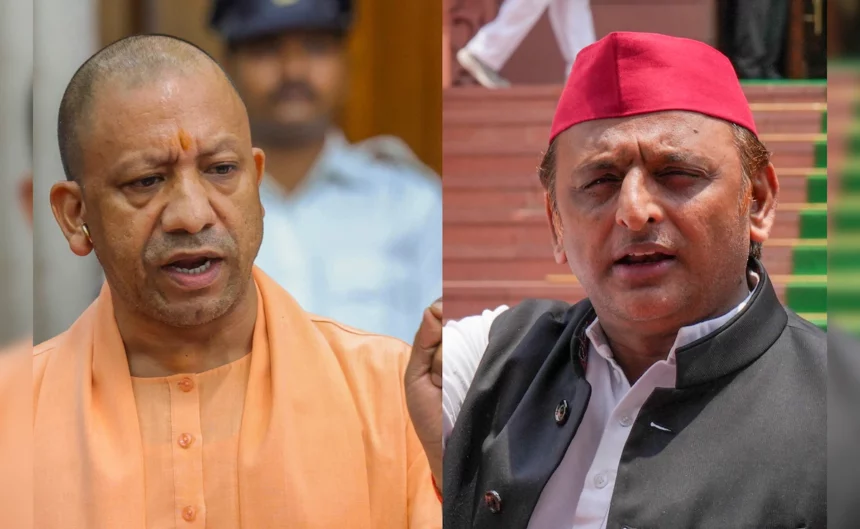
In a sharp political exchange ahead of the high-stakes Bihar Assembly elections, Samajwadi Party chief Akhilesh Yadav countered Uttar Pradesh Chief Minister Yogi Adityanath’s recent derogatory comments about opposition leaders, highlighting the deepening acrimony and intense rhetoric in the run-up to the state polls. Yadav’s remarks came in response to Adityanath’s earlier jibe referring to him, Congress leader Rahul Gandhi, and Rashtriya Janata Dal (RJD) leader Tejashwi Yadav as “three monkeys,” a statement intended to belittle and caricature the opposition while mobilizing voter sentiment in favor of the BJP-led National Democratic Alliance (NDA). The confrontation underscores the increasingly combative nature of electoral campaigning in Bihar, where both sides are striving to capture the electorate’s attention through high-decibel rhetoric, personal attacks, and appeals to identity and governance records.
Akhilesh Yadav’s Sharp Retort to BJP’s Mockery:
While campaigning across Bihar, Akhilesh Yadav dismissed Yogi Adityanath’s “Appu, Pappu, and Tappu” characterization as a diversionary tactic designed to shift attention from pressing issues faced by the public. He mocked the Uttar Pradesh Chief Minister by suggesting that if Adityanath were seated among a group of actual monkeys, no one would be able to identify him, a pointed barb intended to reflect on Adityanath’s own credibility and behavior. Yadav argued that the BJP’s focus on mocking opposition leaders through trivialized comparisons detracts from substantive debates about governance, development, and public welfare, which are crucial for voters to consider during the upcoming polls.
Yadav’s response also highlighted the political strategy of his party and allies to contest the narrative being pushed by the NDA. By using humor and satire, he aimed to portray the BJP as attempting to mask its failures in governance and distract voters from essential concerns such as employment, infrastructure, education, and law and order. The Samajwadi Party chief’s comments drew widespread attention on social media and in political circles, generating debates on the appropriateness of personal attacks in election campaigns while simultaneously energizing his support base.
Furthermore, Akhilesh Yadav’s remark implicitly reinforced the narrative of opposition unity, positioning himself, Tejashwi Yadav, and Rahul Gandhi as leaders standing against a dominant BJP narrative. The exchange reflects the broader pattern of electioneering in India, where political leaders frequently employ symbolic and rhetorical strategies to sway public opinion, project strength, and underscore perceived weaknesses in opponents’ records. By highlighting Adityanath’s controversial comments, Akhilesh Yadav sought to frame the opposition leaders as serious candidates for governance, while portraying the BJP as relying on theatrics rather than policy substance.
Yogi Adityanath’s Criticism of Opposition and Bihar Governance:
Earlier, Yogi Adityanath addressed large crowds in Muzaffarpur, using the metaphor of Mahatma Gandhi’s “three monkeys” who see no evil, hear no evil, and speak no evil, to draw a stark contrast with what he termed the “three monkeys” of Bihar politics: Appu, Pappu, and Tappu. In this instance, he identified the trio as Akhilesh Yadav, Rahul Gandhi, and Tejashwi Yadav, accusing them of lying to the people of Bihar and attempting to resurrect the so-called “jungle raj” that he claims prevailed during previous non-NDA regimes. Adityanath’s rhetoric sought to evoke memories of lawlessness, crime, and misgovernance associated with past RJD-led administrations, emphasizing incidents of murder, loot, and dacoity as examples of administrative failures.
Adityanath’s speech highlighted the NDA’s governance narrative under Nitish Kumar’s leadership in Bihar, emphasizing job creation, infrastructure development, and economic growth as evidence of progress. He warned voters against divisive politics and caste-based mobilization, urging citizens to remain united in supporting the NDA for continued stability and development. Using a combination of cautionary tales and aspirational promises, Adityanath’s address aimed to consolidate the party’s core voter base while persuading undecided voters of the NDA’s superior administrative capabilities.
Additionally, Adityanath’s comments reflect a broader political strategy wherein the BJP positions itself as a bulwark against alleged misrule and corruption, contrasting past and present governance records to influence public perception. By targeting prominent opposition leaders, he aimed to reduce their appeal and project the NDA as the more competent alternative. His public statements also serve to energize party cadres, creating a narrative of moral and administrative superiority, while framing election contests as a choice between stability and disorder.
The Muzaffarpur rally and Adityanath’s comments are also indicative of the high-stakes nature of the Bihar Assembly elections, where multiple political alliances are vying for power. The NDA, comprising the BJP, Janata Dal (United), Lok Janshakti Party (Chirag Paswan faction), and Hindustani Awam Morcha (Secular), faces the Mahagathbandhan coalition led by the RJD, Congress, Left parties, and Vikassheel Insaan Party, led by Mukesh Sahani. The rhetoric, personal attacks, and symbolic jabs reflect the intense competition between these alliances in a politically complex and demographically diverse state.
Electoral Context and Campaign Dynamics:
The Bihar Assembly elections are set against a backdrop of intense political mobilization, with the first phase of polling scheduled for tomorrow and the second on November 11, followed by counting and results on November 14. Both alliances are actively campaigning across the state, attempting to sway voters in key constituencies through a combination of policy promises, identity politics, and targeted messaging. The personal attacks exchanged between Yogi Adityanath and opposition leaders are emblematic of the high-octane campaign environment, where rhetoric often serves as a strategic tool to dominate media coverage and voter attention.
The stakes are particularly high for the NDA, which seeks to retain power and demonstrate governance continuity under the leadership of Chief Minister Nitish Kumar. For the Mahagathbandhan, the elections present an opportunity to capitalize on anti-incumbency sentiments and forge a political comeback through coalition-building and strategic voter outreach. Within this competitive environment, personal jabs, symbolic references, and rhetorical flourishes are increasingly employed to define narratives, shape public perception, and influence electoral outcomes.
The commentary and counter-commentary between Akhilesh Yadav and Yogi Adityanath also reveal the layered strategies in Indian electoral politics, where humor, symbolism, and caricature are integrated into serious discussions about governance, accountability, and development. While critics may dismiss these exchanges as theatrics, political strategists understand their potential to resonate with certain voter segments and shape the tone of electoral debates.
Furthermore, both leaders’ statements reflect a conscious effort to appeal to urban and rural voters alike, blending references to historical and cultural symbolism with contemporary political narratives. By invoking Gandhiji’s three monkeys, Adityanath sought to create a recognizable and morally loaded metaphor, while Akhilesh Yadav’s retort sought to invert that symbolism and question the credibility of the BJP’s messaging. This dynamic illustrates the interplay between rhetoric, perception management, and voter engagement in Indian elections.
Beyond rhetoric, the elections in Bihar are shaped by pressing local issues, including unemployment, development, infrastructure, social welfare, and law and order. Both the NDA and Mahagathbandhan are actively positioning themselves as solutions to these concerns, using public speeches, media campaigns, and grassroots mobilization to communicate their messages. The personal attacks, including the “three monkeys” jibe and the counter-response, serve as both entertainment and a strategic tool to consolidate voter identity and loyalty.
The interaction between political leaders also underscores the broader national dimension of state elections, with central leadership figures, party strategists, and prominent national politicians actively participating in campaigning. This reflects the BJP and opposition parties’ recognition of Bihar as a politically significant state, whose electoral outcome may influence national political calculations and future alignments.
The exchange between Akhilesh Yadav and Yogi Adityanath is emblematic of contemporary Indian electoral politics, where high-stakes competition, symbolic rhetoric, historical references, and strategic messaging converge to shape voter perceptions and influence political outcomes. Both sides are leveraging a mix of substantive governance claims and personalized commentary to appeal to diverse constituencies, create memorable narratives, and consolidate their support bases ahead of a critical state election that will have implications for regional and national politics.