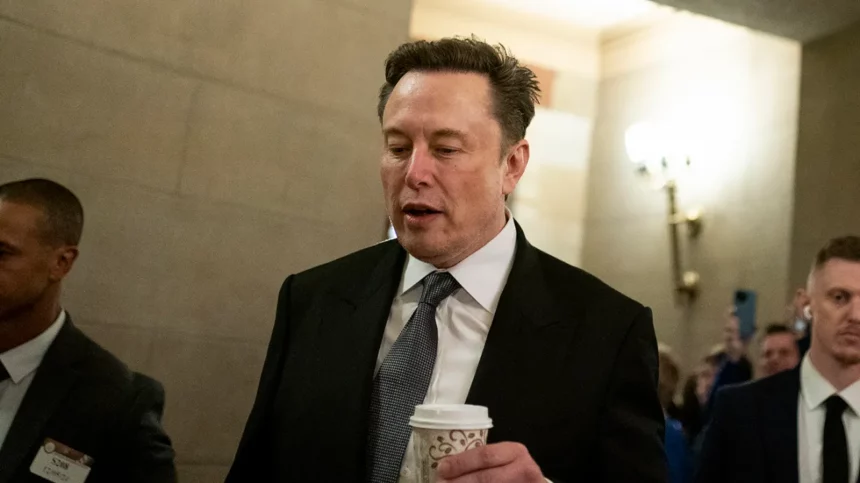
Elon Musk, the prominent entrepreneur and newly appointed leader of the Department of Government Efficiency (DOGE), has called for the dissolution of the United States Agency for International Development (USAID), labeling it a “criminal organization.” Elon Musk’s remarks came in response to a conflict between USAID and DOGE representatives over access to classified materials, which led to the suspension of two senior security officials from USAID.
On Monday, Musk took to his social media platform, X, to express his disdain for USAID, following reports that two of the agency’s top security officials, John Voorhees and Brian McGill, had been placed on leave. This disciplinary action followed the refusal of USAID personnel to grant access to DOGE staff, who were attempting to access secure areas of the agency’s headquarters in Washington, D.C. The DOGE personnel reportedly lacked the necessary security clearances to access sensitive materials, a move that led to a standoff between the two parties.
Despite the initial standoff, the DOGE representatives were ultimately granted access to the classified areas after the confrontation. This incident has raised concerns over the influence of DOGE, which was created by an executive order from former President Donald Trump. Although DOGE is not a government department, its reach and ability to bypass traditional government channels have sparked debates regarding its growing power.
White House communications director, Steven Cheung, dismissed reports of DOGE personnel trying to enter restricted areas, calling such claims “fake news.” He vehemently rejected the allegations, further accusing the media of misrepresentation. However, Katie Miller, a member of DOGE, acknowledged the situation, confirming that no classified material was accessed without proper security clearance.
The controversy surrounding USAID has intensified due to President Trump’s ongoing freeze on nearly all foreign aid, as well as his administration’s efforts to reduce or even eliminate the role of USAID. Speculation surrounding the agency’s future grew over the weekend after the USAID website temporarily went offline, replaced by a minimal page on the State Department’s website. This move fueled rumors that USAID might be absorbed into the State Department, further consolidating control over U.S. foreign aid.
Democratic lawmakers have voiced strong opposition to the administration’s attempts to dismantle the agency. Senator Chris Coons, representing Delaware, criticized the Trump administration, accusing them of targeting patriotic Americans who work to promote U.S. leadership globally. He expressed concern that Trump’s actions were undermining the safety and stability of the nation. Former USAID official Jeremy Konyndyk warned that eliminating the agency without Congressional approval would violate the separation of powers enshrined in the U.S. Constitution, signaling a broader threat to the country’s political system.
The timing of these events coincides with a growing debate over the scale of Elon Musk’s influence over U.S. government operations. Many have questioned the ability of an unelected billionaire to shape public policy and access classified information. Elon Musk’s involvement with DOGE, particularly his attempts to access the federal payment system, which holds sensitive personal information of millions of Americans, has raised alarm among lawmakers, especially within the Democratic Party. Congresswoman Alexandria Ocasio-Cortez warned that allowing a private citizen with conflicting interests to access national security data posed a severe threat to the country’s safety.
Trump’s administration has been notably critical of USAID’s foreign aid allocations, particularly in light of its dealings with South Africa. Trump recently announced that the U.S. would halt all future aid to South Africa in response to controversial land reforms that involve the confiscation of white farmers’ land without compensation. This move has added to the growing calls for the U.S. to reevaluate its foreign aid policies, with many arguing that funds should not be directed toward governments that do not align with U.S. interests.
As the U.S. remains the largest global provider of foreign aid, allocating $72 billion in 2023 alone, debates surrounding the future of USAID and its role in international assistance are expected to continue. The dispute between USAID and DOGE is not only a reflection of internal political dynamics but also signals broader concerns over the role of unelected individuals in shaping government policy and influencing national security.