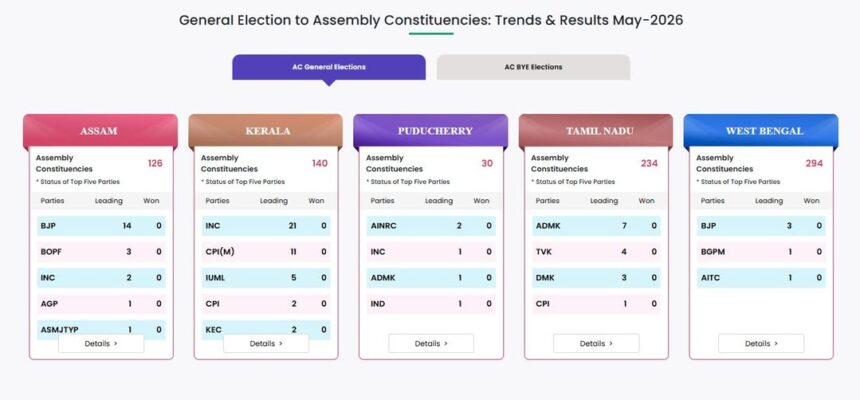
Election Commission trends show BJP crossing halfway in Bengal, Vijay’s TVK dominating Tamil Nadu, and Congress-led UDF gaining strong ground in Kerala.
The counting of votes for the 2026 Assembly elections is underway across multiple states under the supervision of the Election Commission of India, with early trends indicating a dramatic shift in political equations across West Bengal, Tamil Nadu, Kerala, Assam, and Puducherry. As results continue to unfold, the Bharatiya Janata Party is making significant inroads in West Bengal, actor Vijay’s party is reshaping Tamil Nadu politics, and the Congress-led alliance is showing strong performance in Kerala.
These elections are being closely watched nationwide, as they are expected to influence future political alignments and national narratives.
BJP Takes Commanding Lead in West Bengal
In West Bengal, the Bharatiya Janata Party has emerged as the dominant force in early trends, leading in over 130 seats and crossing the crucial halfway mark. This development marks a major challenge to the ruling All India Trinamool Congress, which has governed the state for years.
Key constituencies such as Bhabanipur, Nandigram, and Asansol are witnessing strong performances by BJP candidates. The scale of the lead suggests a potential political shift in the state, where the party has been steadily expanding its presence over recent election cycles.
Chief Minister Mamata Banerjee faces one of her toughest electoral challenges, as trends indicate a possible erosion of her party’s traditional voter base. However, final results will determine whether these early leads translate into a decisive mandate.
Congress Puts Up Strong Fight in Assam
In Assam, the electoral battle remains competitive. While the BJP continues to lead in several constituencies, the Indian National Congress is narrowing the gap and mounting a serious challenge.
Chief Minister Himanta Biswa Sarma is leading in Jalukbari, but Congress candidates are gaining ground in key seats such as Dispur. The close contest reflects a more balanced political scenario compared to previous elections.
The outcome in Assam is expected to depend on later counting rounds, where rural and semi-urban constituencies could play a decisive role.
TVK’s Historic Debut Reshapes Tamil Nadu Politics
Tamil Nadu has delivered one of the biggest surprises of the election season. Actor Vijay’s Tamilaga Vettri Kazhagam has crossed the majority mark of 118 seats in early trends, signaling a dramatic shift in the state’s political landscape.
The rise of TVK has disrupted the dominance of established parties such as the Dravida Munnetra Kazhagam and AIADMK. Chief Minister M K Stalin is trailing in his Kolathur constituency, while Udhayanidhi Stalin is also facing a tough contest.
Vijay himself is leading in constituencies such as Tiruchirappalli East and Perambur, reflecting the strong voter support for his party. The party’s performance suggests a powerful blend of celebrity influence and political messaging resonating with voters.
Security has been heightened in Chennai as supporters gather outside Vijay’s residence amid celebrations.
Congress-Led UDF Gains Momentum in Kerala
In Kerala, the Congress-led United Democratic Front has crossed the majority mark in early trends, indicating a possible change in government. The alliance is leading in more than 71 seats in the 140-member Assembly.
Prominent leaders such as V D Satheesan are ahead in their constituencies, while Chief Minister Pinarayi Vijayan is trailing in Dharmadam.
Congress leader Shashi Tharoor described the trends as a sign of revival, emphasizing economic reforms, investment, and job creation as key priorities for the state.
Key Trends Emerging Across States
The early results highlight several important trends shaping the political landscape:
- BJP’s strong performance in West Bengal indicates a potential shift in regional dominance
- Vijay’s TVK has disrupted traditional politics in Tamil Nadu with a remarkable debut
- Congress is regaining strength in Kerala and remains competitive in Assam
- Voter preferences appear to be shifting, with new political narratives gaining traction
These developments suggest a dynamic electoral environment where established patterns are being challenged.
Counting Process and Security Measures
Vote counting began at 8 am across all states, starting with postal ballots and followed by Electronic Voting Machines. Authorities have deployed multi-layered security arrangements at counting centers to ensure transparency and prevent disruptions.
Election officials have emphasized strict adherence to protocols, with observers and counting agents present to oversee the process.
National Political Implications
The outcomes of these elections are likely to have broader implications for national politics. A strong performance by the BJP in West Bengal could enhance its influence in eastern India, while Congress gains in Kerala may boost its morale ahead of future contests.
The emergence of TVK in Tamil Nadu could also reshape coalition dynamics and introduce a new political force at both state and national levels.
As counting continues, political parties are closely monitoring trends and preparing for potential shifts in governance and strategy.
Conclusion
The 2026 Assembly election results are unfolding as one of the most significant political events in recent years. With major shifts visible across multiple states, the results reflect changing voter preferences and evolving political dynamics.
While early trends provide strong indications, the final outcome will determine the true extent of these changes. Regardless of the final numbers, the elections have already signaled a new phase in India’s political landscape.