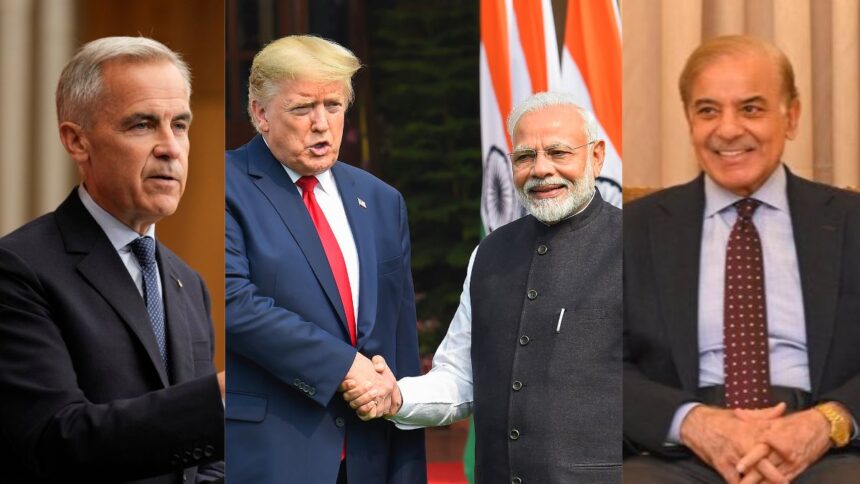
In a fresh escalation of rhetoric over trade imbalances and tariff policies, U.S. President Donald Trump launched another blistering critique of India, arguing that New Delhi had for years exploited America through what he described as “tremendous” and “one-sided” tariffs on American goods. While stressing that the two countries “got along very well,” Donald Trump insisted that Washington had borne the brunt of lopsided trade rules, and his administration’s decision to double tariffs on Indian products from 25 percent to 50 percent was, in his view, a long overdue corrective measure. His remarks, delivered from the Oval Office, revived a long-standing controversy about the cost of protectionism, the limits of free trade, and the geopolitical consequences of Washington’s increasingly hardline economic policies.
Donald Trump’s criticism of India’s tariff regime and his case for protectionism
Donald Trump’s latest outburst against India’s trade policies comes at a time when global supply chains are already under immense strain from the Ukraine war, energy crises, and shifting strategic alignments. Donald Trump, who has repeatedly criticized international trading partners for what he perceives as unfair practices, has often reserved his sharpest rebukes for India. According to him, India has historically imposed the “highest tariffs in the world” on American goods, creating a system in which U.S. exporters could not penetrate the Indian market while Indian producers enjoyed broad access to America.
Donald Trump pointed to the example of Harley-Davidson motorcycles, a symbol he has long used to illustrate his point about unfair trade barriers. Under India’s previous tariff structure, motorcycles faced duties as high as 200 percent, making it nearly impossible for U.S. manufacturers to compete in the Indian market. He argued that while India exported “massive amounts of everything they produced” to the United States, American companies were effectively shut out. Harley-Davidson, he said, was forced to set up a plant in India in order to escape the high tariff wall, a development that he considered a negative for American workers.
In Donald Trump’s framing, such tariff policies created a one-way relationship where India benefited disproportionately. “We get along with India very well, but for many years it was a one-sided relationship,” he declared. His comments underscored his belief that the U.S. had “foolishly” refrained from imposing similar duties, allowing Indian goods to flood American markets while domestic industries languished. By doubling tariffs on Indian goods to 50 percent, the Donald Trump administration has sought to create leverage, sending a message that America would no longer tolerate asymmetry in trade relations.
This protectionist stance is not limited to India. Donald Trump has consistently argued that tariffs are essential to rebuilding American manufacturing, insisting that global firms will only invest in U.S. factories if they are compelled by the threat of high import duties. He cited the influx of car companies from China, Mexico, and Canada that are now constructing plants in the United States as evidence that his policy is working. “When they build their cars here, they don’t have to pay any tariffs. When you build here, you don’t have any tariffs,” he told reporters, suggesting that such measures were not only protecting American jobs but also incentivizing global corporations to make the U.S. their manufacturing base.
The President’s approach, however, has sparked heated debates both at home and abroad. While supporters argue that tariffs help restore balance to unfair trade practices, critics warn that such policies risk igniting trade wars, disrupting supply chains, and raising costs for American consumers. India, in particular, finds itself at the center of this storm because of its expanding role in global trade and its increasingly close ties with both Washington and Moscow. Donald Trump’s decision to double tariffs was explicitly tied to India’s purchase of Russian oil, a move that the White House framed as incompatible with U.S. sanctions amid the Ukraine war. This linkage has transformed a trade dispute into a broader geopolitical flashpoint, drawing attention to the intersection of economics, energy security, and strategic alignment.
India’s response and ongoing negotiations with Washington
India, for its part, has sought to temper the rhetoric while keeping negotiations alive. Union Commerce and Industry Minister Piyush Goyal recently confirmed that New Delhi remains engaged in dialogue with Washington on a potential bilateral trade agreement. Speaking at an industry chamber event, Goyal emphasized that India and the United States have already completed five rounds of discussions, underscoring the importance of maintaining constructive engagement despite the tensions. “We are in dialogue with the U.S. for a BTA,” he stated, signaling that both sides remain committed to seeking common ground.
The timing of Donald Trump’s announcement, however, complicated matters. Following his decision to impose a 50 percent duty on Indian goods, a scheduled visit by U.S. officials to New Delhi for the next round of trade talks was deferred. The meeting, originally slated for August 25, was postponed indefinitely, and no new dates have yet been finalized. This development reflects the uncertainty that hangs over the bilateral economic relationship. While Washington appears determined to use tariffs as leverage, New Delhi is wary of being strong-armed into concessions that could undermine its domestic industries.
India has long defended its tariff policies by pointing to the needs of its emerging economy, where protectionist measures are often seen as necessary to shield local producers from overwhelming competition. Moreover, the narrative of self-reliance, which has gained traction in India’s political discourse in recent years, dovetails with the argument for maintaining tariff barriers. Policymakers in New Delhi argue that a country of India’s size and developmental challenges cannot afford to open its markets indiscriminately, especially when advanced economies continue to deploy their own subsidies and protections.
Nevertheless, the stakes are high. The United States remains one of India’s largest trading partners, and the two countries have deep strategic interests that extend beyond commerce. From defense cooperation to technology partnerships, the U.S.-India relationship is multifaceted and increasingly central to the broader Indo-Pacific strategy. Trade disputes, therefore, carry risks that go well beyond the economic sphere, threatening to complicate security cooperation and diplomatic coordination at a time when both countries are seeking to counterbalance China’s growing influence in the region.
The Harley-Davidson episode, repeatedly invoked by Donald Trump, serves as both a symbol and a case study in the larger debate over tariffs. While India eventually reduced tariffs on motorcycles, the broader issue of asymmetry in market access remains unresolved. Washington continues to press for deeper access for U.S. agricultural, technology, and industrial products, while India demands recognition of its developmental needs and greater flexibility in setting its trade policies. These conflicting imperatives lie at the heart of the ongoing negotiations.
The geopolitical dimension further complicates matters. India’s decision to continue purchasing Russian oil despite Western sanctions has become a source of friction with Washington. Donald Trump’s administration has explicitly linked tariffs to this issue, framing them as a penalty for New Delhi’s defiance of U.S. sanctions policy. For India, however, access to affordable energy supplies is an existential necessity, and policymakers argue that they cannot allow geopolitical alignments to dictate decisions that directly affect domestic energy security. This divergence in priorities highlights the complex balancing act both countries must perform as they navigate the intersection of trade, geopolitics, and national interest.
The uncertainty surrounding the future of trade talks has raised questions about whether a comprehensive bilateral trade agreement can be achieved anytime soon. Analysts suggest that while both sides have incentives to reach an understanding, the political environment in Washington makes compromise difficult. Donald Trump’s emphasis on tariffs as a central plank of his economic strategy leaves little room for flexibility, while India’s insistence on protecting its domestic industries limits its ability to concede. For now, the relationship remains in flux, oscillating between confrontation and negotiation.