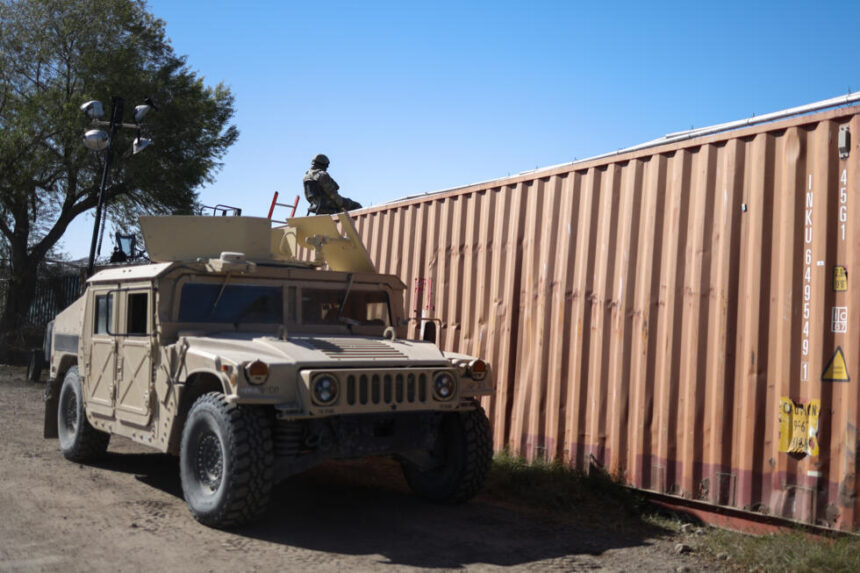
In a dramatic escalation of his immigration enforcement policies, President Donald Trump has ordered mass deportations and resumed workplace raids, targeting undocumented migrants across the country. Immigration and Customs Enforcement (ICE) agents conducted large-scale operations, including a raid on a seafood business in Newark, New Jersey, which resulted in multiple arrests. Simultaneously, Donald Trump has deployed active military troops to the US-Mexico border, reinforcing his hardline stance on immigration.
According to White House reports, ICE agents detained 538 undocumented individuals nationwide on Thursday, with hundreds already removed from the country via military aircraft. White House spokeswoman Karoline Leavitt described the operation as “the largest massive deportation in history,” emphasizing the administration’s commitment to removing undocumented individuals from the United States. The intensified enforcement measures come as Donald Trump moves aggressively to reinstate immigration policies that were softened under the Biden administration.
One of the most contentious incidents occurred in Newark, a designated “sanctuary city” where local law enforcement does not typically cooperate with federal immigration authorities. Newark Mayor Ras Baraka condemned an ICE raid that took place at Ocean Seafood Depot, calling it an unlawful and unjustified attack on the city’s immigrant community. Baraka stated that agents entered the business without a warrant and detained several workers, including a US Army veteran. The mayor expressed outrage, arguing that those targeted were not criminals but rather hardworking individuals contributing to the local economy. “The problem with this is that none of these people were rapists, murderers, or criminals,” Baraka said. “The problem is that ICE went in without a warrant.”
Witnesses to the Newark raid described a scene of fear and confusion as heavily armed ICE agents descended upon the workplace without prior warning. A witness speaking to NBC News reported that three individuals were apprehended, all believed to be from Ecuador. “They caught three guys… everybody is afraid. I don’t know if this is normal,” the witness said. Advocacy groups echoed these concerns, highlighting the terror instilled in immigrant communities. Amy Torres, executive director of the New Jersey Alliance for Immigrant Justice, stated that families were left in distress, with individuals too afraid to leave their homes. “We knew this was going to happen, and what we learned from folks that stayed behind was that ICE walked in like it was their empire’s own conquered land,” Torres said. “They were heavily armed, there was no prior announcement. They were blocking off entrances and exits.”
Donald Trump’s aggressive immigration agenda also includes significant troop deployments to the US-Mexico border. Active service soldiers began arriving on Friday, working to construct border barriers and military barracks to enhance security and facilitate rapid deportations. The president signed executive orders on his first day in office declaring a “national emergency” at the southern border and pledging to deport “criminal aliens.” His administration has argued that stricter enforcement is necessary to address what it calls an immigration crisis, though critics contend that such measures disproportionately target nonviolent individuals and families.
Sanctuary cities, including Newark and New York, have been a particular focus of Donald Trump’s immigration crackdown. The administration has repeatedly threatened to cut federal funding to municipalities that refuse to cooperate with ICE, creating ongoing legal and political battles between federal authorities and local governments. During Donald Trump’s first term, immigration enforcement agents conducted frequent workplace raids, a practice that was significantly curtailed under President Biden. Trump has vowed not only to reinstate these raids but also to extend enforcement operations to schools, churches, and hospitals—locations that were previously considered off-limits under Biden’s policies.
The broader immigration crackdown comes amid a significant rise in deportations. Under Biden, the US saw a 10-year high in deportations, with 270,000 individuals removed in 2023 alongside 113,400 immigration-related arrests. Donald Trump’s policies are expected to push these numbers even higher, with his administration emphasizing its goal of drastically reducing the number of undocumented individuals living in the country. The Department of Homeland Security estimates that there are currently around 11 million undocumented migrants in the United States.
The political and social implications of these actions have sparked intense debate. Supporters of Donald Trump’s immigration policies argue that stricter enforcement is necessary to uphold the rule of law and protect American jobs. However, opponents, including human rights organizations and local officials in sanctuary cities, argue that these actions create an atmosphere of fear and division. The resumption of workplace raids, in particular, has drawn sharp criticism from immigrant rights advocates who argue that such tactics lead to racial profiling, disrupt local economies, and inflict psychological distress on families and communities.
As deportations ramp up and military troops bolster border security, the United States faces a deeply polarized debate on immigration policy. The coming weeks will be critical in determining the long-term impact of Donald Trump’s aggressive enforcement measures and the extent to which local governments and advocacy groups will push back against federal actions. With more raids and deportations expected, the battle over immigration policy is set to remain at the forefront of national discourse, shaping the political landscape in the months ahead.