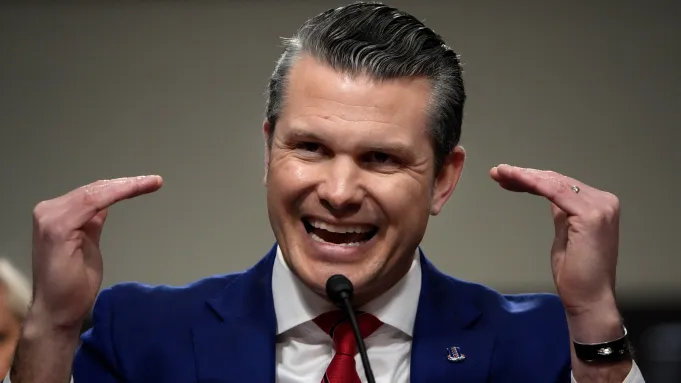
The US Senate is on the verge of confirming former Fox News host Pete Hegseth as the next Secretary of Defense, despite mounting concerns over his lack of experience and troubling personal history. President Donald Trump’s nominee has faced intense scrutiny over allegations of heavy drinking, domestic abuse, and inflammatory statements, yet he remains on track for a narrow approval. If confirmed, Hegseth will take the reins of the world’s most powerful military, overseeing 2.9 million personnel and managing an $850 billion budget, a responsibility that critics argue he is woefully unqualified to handle.
Hegseth’s background lacks the traditional credentials associated with a Pentagon leader. A former National Guard major, he has never led a major organization and is better known for his tenure as a combative host on Fox News, a platform that frequently amplified Trump’s messaging. His selection has raised alarm among lawmakers and defense officials who question his ability to command the vast and complex military apparatus. Adding to the controversy, a series of damaging allegations have surfaced about his personal conduct, including claims of abusive behavior towards his second wife, excessive drinking, and a past accusation of sexual assault. His former sister-in-law, Danielle Hegseth, provided an affidavit to lawmakers detailing emotional abuse she endured and recounting a conversation in which his second wife confided that she once hid in a closet out of fear for her safety. The affidavit further alleges that Hegseth expressed extremist views, stating that women should not work or have the right to vote, and that Christians should have more children to outnumber Muslims.
Despite these revelations, Trump has remained steadfast in his support, dismissing the allegations as politically motivated. Speaking to reporters, the former president described Hegseth as “a very, very good man” and praised his loyalty. Hegseth himself has rejected the accusations as smears, vowing to cease drinking alcohol if confirmed. His supporters argue that his firsthand experience in Afghanistan and Iraq makes him well-suited to lead the Department of Defense, contending that his perspective as a combat veteran provides a valuable counterbalance to the career military leaders who typically ascend to the role. Throughout his Senate hearings and public appearances, he has aggressively championed a vision of a military that is less “woke” and more “lethal,” advocating for the rollback of diversity and inclusion initiatives and calling for higher standards for female service members.
The confirmation vote is expected to be razor-thin, with Republicans holding only a slim majority in the Senate. Two GOP senators, Susan Collins and Lisa Murkowski, have signaled their opposition, joining a united Democratic front against Hegseth’s nomination. However, with 51 Republican senators still expected to support him, he appears poised to scrape through. If the vote ends in a 50-50 deadlock, Vice President JD Vance is expected to cast the tiebreaking vote in favor of confirmation.
Hegseth’s nomination is just one of several contentious confirmations unfolding in the Senate as Trump seeks to solidify his cabinet. On Thursday, the chamber confirmed John Ratcliffe as CIA director, while a vote on Kristi Noem’s nomination to lead the Department of Homeland Security is set for Sunday. In the coming days, attention will shift to other key nominees, including Treasury secretary pick Scott Bessent and transport secretary nominee Sean Duffy, both of whom are expected to sail through relatively easily.
However, the divisions exposed by Hegseth’s confirmation battle are likely to resurface as the Senate prepares to vet some of Trump’s most polarizing selections. On Thursday, Kash Patel, Trump’s controversial nominee to lead the FBI, will appear before the Senate Judiciary Committee. Patel, a former intelligence official and Trump loyalist, has been accused of politicizing national security matters and faces significant opposition. That same day, former congresswoman and presidential candidate Tulsi Gabbard will go before the Senate Intelligence Committee as Trump’s nominee for a key intelligence post. Gabbard’s past comments, particularly her alignment with Kremlin talking points on Ukraine, have made her a deeply divisive figure, with Democrats almost certain to reject her nomination.
Adding to the drama, the Senate will also hold its first of two confirmation hearings for Robert F. Kennedy Jr., Trump’s pick for health secretary. Kennedy’s controversial stance on vaccines and history of promoting conspiracy theories have drawn widespread criticism, setting the stage for a heated interrogation.
As the confirmation battles play out, the partisan divide in the Senate is becoming increasingly apparent. While Trump’s allies push through his preferred nominees, Democrats and a handful of moderate Republicans continue to push back, highlighting concerns over qualifications, personal conduct, and ideological extremism. The coming days will be critical in shaping the future of Trump’s administration and determining whether his most controversial picks can withstand the scrutiny of the Senate.