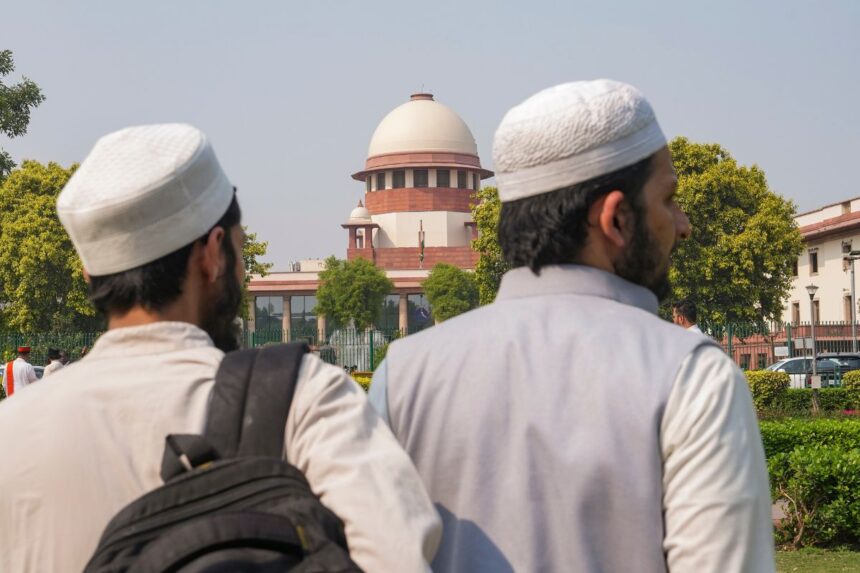
The Waqf (Amendment) Act, 2025, passed by the Narendra Modi government, has become a focal point of intense scrutiny across India. Recently, the matter reached the Supreme Court after several petitions challenged aspects of the Act. On April 16, 2025, the Supreme Court bench, headed by Chief Justice of India (CJI) Sanjiv Khanna, indicated that it is considering staying the operation of certain provisions of the Act, noting that this could be an exception to the usual rule of not staying legislation at such an early stage.
The court’s oral observation suggests it is deeply concerned with the implications of the new law, and with the request from both the Centre and the states for additional time to respond, the court decided to hear the matter again on April 17, 2025. Here, we explore the three key issues that the court is likely to pass interim orders on and the concerns it has raised.
1. The ‘Waqf-by-User’ Concept: A Controversial Shift
The first major concern flagged by the Supreme Court pertains to the removal of the “waqf-by-user” concept under the new law. Under the older Waqf laws, properties used for religious or charitable purposes could be considered waqf (a donation to charity) based on usage, even if not formally registered. This practice, known as “waqf-by-user”, applied to many mosques and graveyards that did not have formal documents but were in use as waqf properties for generations.
The new Waqf Act abolishes this provision, causing an uproar among petitioners. Senior advocate Abhishek Manu Singhvi, representing the petitioners, highlighted that nearly half of the existing waqfs in India could be classified under this category. The petitioners argue that the new law erases these waqfs with a single stroke, rendering them legally invalid. The petitioners also questioned how the government could “rewrite history” and deny the historical status of waqf properties, some of which date back centuries.
In response, Solicitor General Tushar Mehta argued that since 1923, registration of waqf properties has been mandatory under Indian law, and that waqf-by-user properties should have been registered earlier. The court, however, pointed out the practical difficulties in registering waqfs that were established centuries ago, like Delhi’s Jama Masjid, and expressed concerns about the fairness of removing waqf-by-user properties under the new law.
2. Non-Muslim Representation on Waqf Boards
The second key issue revolves around the representation of non-Muslims on the Waqf Boards. The new Waqf Act mandates that the boards include one member each from the Bohra and Aghakhani communities, in addition to two non-Muslim members. This provision has sparked controversy, with the petitioners arguing that it violates Article 26, which guarantees religious freedom and autonomy in managing religious affairs.
The Supreme Court expressed its concern by directly questioning Solicitor General Tushar Mehta about the inclusion of non-Muslims in the Central Waqf Council and state waqf boards. During the hearing, the court asked, “Would you allow Muslims to be part of Hindu religious trusts?” This analogy raised further concerns about the fairness of such provisions and their potential to alter the balance of religious representation in the governance of waqf properties.
Justice PV Sanjay Kumar of the Supreme Court pointed out that only eight of the 22 members of the Central Waqf Council would be Muslim under the new law, highlighting the skewed representation.
3. Powers of the Collector in Determining Waqf Properties
The third issue pertains to the powers granted to the Collector under Section 3C of the new law, which authorizes an officer above the rank of District Collector to determine whether a property is waqf or government property. According to this provision, until the Collector finalizes their report, the disputed property will lose its status as waqf property.
The Supreme Court expressed reservations about this provision, questioning its fairness. “The moment the Collector starts an inquiry, even without making a final decision, you say that the property cannot be treated as waqf. What purpose does this proviso serve?” asked the court.
This provision has raised concerns about the potential misuse of authority, with critics suggesting it could lead to arbitrary decisions that undermine the rights of waqf property holders. The court has expressed the need for clarity on this issue and is expected to review it in detail during the upcoming hearings.
The Supreme Court’s consideration of these three critical issues in the Waqf (Amendment) Act, 2025, highlights the ongoing tension between the government’s push for reforms in waqf property management and the concerns raised by petitioners about the law’s impact on religious rights, historical practices, and fair governance. As the court deliberates on these matters, it could have far-reaching implications for the future of waqf properties and their administration in India.
The final verdict from the Supreme Court will be crucial in determining whether the controversial provisions of the Waqf Act will be upheld, modified, or stayed. The case continues to be watched closely, as it touches upon key issues of religious autonomy, governance, and legal interpretation.