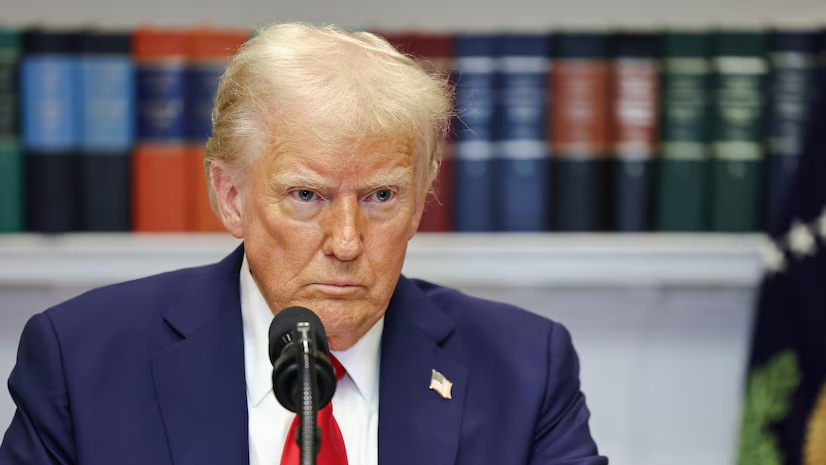
US President Donald Trump has announced that his administration will challenge a federal judge’s ruling that temporarily blocks his attempt to impose restrictions on birthright citizenship. The ruling, issued by Washington state District Judge John Coughenour, declared Donald Trump’s executive order as “blatantly unconstitutional,” dealing a significant legal setback to the administration’s efforts to alter long-standing immigration policies.
Speaking to reporters in the Oval Office on Thursday, Donald Trump confirmed his decision to appeal the ruling, stating, “Obviously, we will appeal it.” His remarks underscore the administration’s commitment to pursuing stricter immigration policies, despite legal challenges from civil rights groups and constitutional experts who argue that birthright citizenship is explicitly protected under the 14th Amendment of the U.S. Constitution.
The legal dispute stems from Donald Trump’s executive order aimed at limiting birthright citizenship, which grants automatic U.S. citizenship to children born on American soil, regardless of their parents’ immigration status. The policy has long been enshrined in the Constitution’s 14th Amendment, and any attempt to alter it through executive action has been widely criticized as legally untenable. Judge Coughenour’s ruling, which temporarily halts the administration’s order, cited clear constitutional protections, asserting that the president lacks the authority to unilaterally change birthright citizenship rules.
The Donald Trump administration’s push to restrict birthright citizenship has been a contentious issue, aligning with the president’s broader agenda of tightening immigration policies. Throughout his tenure, Donald Trump has repeatedly expressed opposition to the current interpretation of the 14th Amendment, arguing that it has been misused to incentivize illegal immigration and so-called “birth tourism.” His latest executive order was part of a broader strategy to reshape the country’s immigration system, including previous efforts to impose travel bans, increase deportations, and implement stricter asylum regulations.
Legal experts and immigrant advocacy groups have strongly opposed Donald Trump’s attempt to modify birthright citizenship, warning that such actions undermine constitutional principles and set a dangerous precedent. Constitutional scholars emphasize that any change to birthright citizenship would require a constitutional amendment, not an executive order. Civil rights organizations have vowed to continue challenging the administration’s policies in court, arguing that they violate fundamental rights and target immigrant communities unfairly.
The legal battle over birthright citizenship is expected to escalate, with the case likely to move through the appellate courts and potentially reach the Supreme Court. The Donald Trump administration’s appeal will set the stage for a high-stakes legal confrontation over the interpretation of the 14th Amendment and the limits of presidential power in shaping immigration policy.
As the case unfolds, the debate over birthright citizenship remains a flashpoint in American politics, with sharp divisions between those advocating for stricter immigration controls and those defending constitutional protections for all individuals born in the United States. With the 2024 presidential election on the horizon, Donald Trump’s stance on birthright citizenship is expected to remain a key issue, further fueling the broader national debate over immigration and constitutional law.