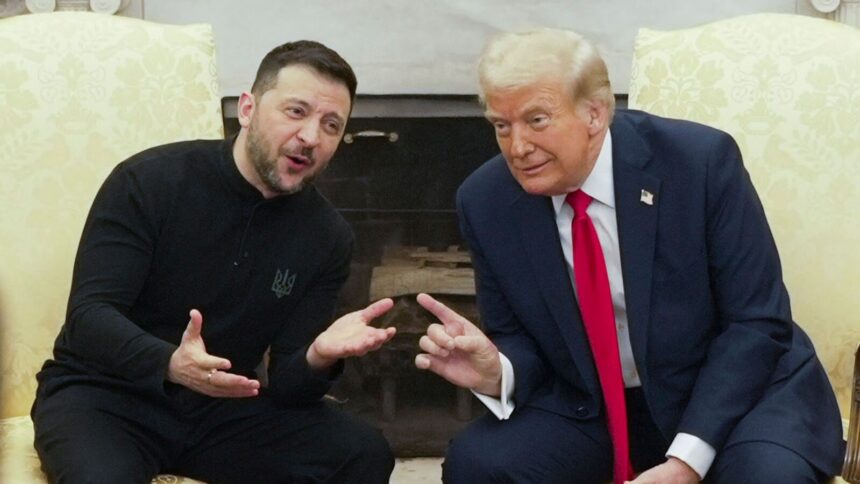
In a significant move, US President Donald Trump has suspended military aid to Ukraine, escalating pressure on Kyiv to negotiate peace with Russia. The decision follows a recent public confrontation between Donald Trump and Ukrainian President Volodymyr Zelensky, highlighting the growing rift between the two leaders. The White House confirmed the pause, emphasizing that the administration is reassessing aid to ensure it aligns with its broader peace objectives.
A White House official, speaking on condition of anonymity, stated that Donald Trump remains focused on achieving peace and expects international partners to support this goal. The official added that the aid suspension is under review to determine its role in fostering a resolution to the ongoing conflict. The decision is expected to impact hundreds of millions of dollars worth of weaponry that was in the process of being shipped to Ukraine, according to The New York Times.
Congressional Democrats swiftly condemned the move, calling it both dangerous and unlawful. Gregory Meeks, the ranking Democrat on the House Foreign Affairs Committee, urged Republican lawmakers to oppose the aid freeze, arguing that it undermines commitments to Ukraine in its struggle against Russian aggression. The suspension raises concerns about the strength of Ukraine’s defense capabilities, with experts warning that any disruption in US military support could significantly weaken Kyiv’s position on the battlefield.
Donald Trump has increasingly criticized Volodymyr Zelensky’s approach to the war, expressing frustration over what he perceives as a lack of appreciation for US assistance. He warned that without a ceasefire agreement with Russia, Volodymyr Zelensky’s position could become precarious. Speaking at the White House, Donald Trump stated that Ukraine’s leader “won’t be around very long” without a peace deal, a remark that further strained diplomatic ties.
Meanwhile, European nations have stepped up efforts to mediate a resolution. Britain and France are reportedly exploring a proposal for a temporary ceasefire covering air, sea, and energy infrastructure. Volodymyr Zelensky, however, remains skeptical of Russia’s willingness to negotiate in good faith, insisting that only strong security guarantees can ensure lasting peace. He reiterated that previous failures to secure Ukraine’s safety contributed to Russia’s initial invasion in 2014 and its subsequent expansion in 2022.
The suspension of US aid signals a potential shift in Washington’s stance on the war, raising concerns among allies about America’s long-term commitment to Ukraine. With Russia closely monitoring the situation, the international community now faces increased uncertainty over the future of the conflict and its broader geopolitical implications.