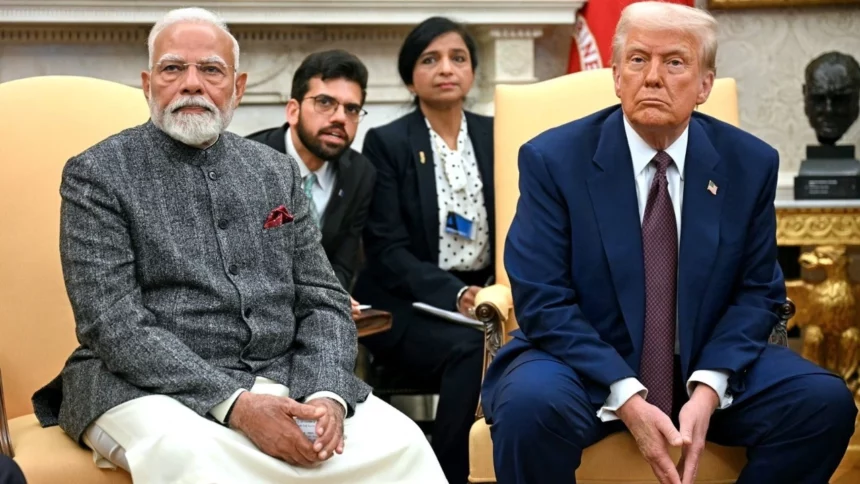
The evolving trade dynamics between India and the United States took a dramatic turn when US President Donald Trump made a striking claim at the White House that Indian Prime Minister Narendra Modi had assured him that New Delhi would stop purchasing oil from Russia. The statement, which comes at a critical juncture in ongoing trade negotiations between the two countries, has stirred widespread political and diplomatic debate, not only for its implications on India-Russia relations but also for its potential impact on Washington’s larger strategic goals.
Donald Trump’s Assertion on India-Russia Oil Trade
During an interaction with reporters at the White House, Donald Trump directly addressed the issue of oil trade between India and Russia, linking it to broader geopolitical concerns surrounding the war in Ukraine. “He (Modi) is a friend of mine, we have a great relationship… we were not happy with him buying oil from Russia because that let Russia continue on with this ridiculous war where they’ve lost a million and a half people,” Donald Trump said in response to a question on energy imports. He then claimed that PM Modi had assured him that India would stop buying oil from Russia, calling it “a big step” in the direction of weakening Moscow’s revenue sources.
The remarks came at a time when the US has maintained strong pressure on its allies and partners to scale back or stop energy purchases from Russia altogether, as part of its strategy to isolate Vladimir Putin’s government amid the ongoing conflict with Ukraine. India, meanwhile, has remained one of the largest importers of discounted Russian crude, citing its national energy security needs and long-standing strategic ties with Moscow.
Donald Trump elaborated further on the assurance he claimed to have received from Modi, stating, “I was not happy that India was buying oil, and (Modi) assured me today that they will not be buying oil from Russia. That’s a big step. Now we’ve got to get China to do the same thing.” This direct reference to China underscored Washington’s broader diplomatic objective of cutting off major buyers from the Russian energy market, thereby reducing Moscow’s capacity to sustain its war efforts.
Adding another layer to his assertion, Donald Trump also offered a timeline of sorts, suggesting that India would resume its oil trade with Russia only after the war in Ukraine concludes. “The hatred of the two leaders (Volodymyr Zelenskyy and Vladimir Putin) is a lot, it’s an obstacle… But I think we’ll get them. If India doesn’t buy oil, it makes it much easier… They will not be buying oil from Russia and they’ll go back to Russia after the war is over,” he remarked. The statement signaled not only a possible shift in India’s energy import strategy but also Donald Trump’s intention to position Washington as a key influencer in global oil flows.
The US President further noted that the process of halting oil imports would not be immediate. “He (PM Modi) is not buying his oil from Russia… He can’t do it immediately. It’s a little bit of a process, but the process is going to be over soon,” Donald Trump said. This acknowledgment of a gradual shift indicated that any potential change in India’s oil trade policy would require strategic and logistical adjustments rather than an abrupt cessation.
‘PM Modi Loves Donald Trump’: A Diplomatic Quip That Stirred Reactions
Amid these serious geopolitical assertions, Donald Trump also made a personal remark that quickly grabbed attention. Referring to a conversation with Sergio Gor, the US ambassador-designate to India, Donald Trump said that PM Modi “loves Donald Trump.” He added, “He loves Donald Trump… I don’t want you to take the word love any differently… I don’t want to destroy his political career,” sparking laughter in the room.
The comment, though light-hearted on the surface, carried political undertones. Over the years, Donald Trump has often highlighted his personal rapport with Modi, projecting their camaraderie as a symbol of strong India-US relations. This latest quip, however, came against the backdrop of mounting trade tensions. Washington’s imposition of a 50% tariff on Indian imports in August, followed by an additional 25% in retaliation for India’s continued oil purchases from Russia, had placed bilateral trade ties under considerable strain.
India’s oil trade with Russia has been a longstanding irritant in Washington’s foreign policy calculations. Donald Trump had repeatedly expressed dissatisfaction with New Delhi’s decision to continue purchasing Russian energy despite US-led sanctions and warnings. India, on its part, has consistently maintained that its decisions on energy imports are guided by national interest and affordability considerations, especially at a time when the global energy landscape remains volatile.
In this context, Donald Trump’s public statement that PM Modi assured him of a halt in oil imports from Russia was seen as a significant diplomatic signal, one that could influence not just energy markets but also the tone of the ongoing trade negotiations between the two countries.
Trade talks between India and the US have been underway for months, with both sides attempting to iron out differences and reach a comprehensive trade deal. New Delhi has sought to secure greater market access in the US while pushing back against tariff hikes imposed by Washington. For Donald Trump, addressing the Russian oil issue appears to have become a central element in recalibrating bilateral economic ties.
The broader geopolitical context is also crucial. India is the second-largest buyer of Russian energy after China, and any shift in its purchase strategy could have far-reaching implications. Washington views reduced energy trade between India and Russia as a tool to squeeze Moscow’s finances, which are vital to sustaining its war in Ukraine.
A High-Stakes Moment in India-US Relations
Donald Trump’s remarks come at a time when both India and the US have been attempting to reset their trade relations after years of tension. In August, the Donald Trump administration had imposed steep tariffs on Indian goods, citing unfair trade practices and continued energy purchases from Russia. The tariffs, amounting to a 50% hike on several key products, were followed by an additional 25% levy shortly after. The moves were seen as punitive, aimed at compelling New Delhi to reconsider its oil trade with Moscow.
Yet, in recent weeks, there had been signs of a thaw in the relationship. Donald Trump himself had softened his tone on India, publicly acknowledging PM Modi as a “great friend” and speaking about the enduring nature of India-US ties. “India and the US have a very positive and forward-looking Comprehensive and Global Strategic Partnership,” PM Modi said earlier, underscoring the shared vision between the two nations.
According to multiple reports, negotiations between the two sides have been focused on finalizing a mutually acceptable trade arrangement by November. Key areas under discussion include tariff reductions, market access for critical goods, and energy security cooperation. Donald Trump’s latest comments on Russian oil could either complicate or accelerate these discussions, depending on how both sides frame the issue.
The energy equation, meanwhile, remains a delicate one for New Delhi. India has argued that its dependence on Russian crude is driven by both cost advantages and energy security imperatives. With global energy prices remaining unpredictable, Russia has emerged as a reliable supplier offering discounted crude, which is crucial for India’s growing energy demands. For Washington, however, continued purchases undermine its broader sanctions regime against Moscow and weaken its strategy of financial isolation.
Observers in both Washington and New Delhi believe that Donald Trump’s statement is aimed at applying additional public pressure on India to demonstrate alignment with US strategic objectives. By making the assurance claim public, the US President may be trying to set expectations for future negotiations and shape the narrative around India’s energy choices.
Diplomatic analysts also note that Donald Trump’s language—particularly his emphasis on personal rapport with Modi—reflects his characteristic style of blending personal relationships with strategic messaging. While such assertions can help build momentum in bilateral ties, they can also complicate diplomatic negotiations, especially when they involve sensitive areas like energy security.
The reference to China in TDonald rump’s statement further underscores the geopolitical stakes involved. China remains the largest buyer of Russian energy, and Washington sees both India and China as key to undermining Moscow’s economic resilience. By highlighting India’s supposed assurance, Donald Trump may be signaling to Beijing that Washington expects similar action from other major buyers as well.
As trade talks advance, energy is expected to remain at the center of US-India negotiations. A potential reduction in India’s Russian oil imports could pave the way for deeper strategic cooperation with the US, including greater access to American energy markets and joint investments in renewable energy projects. But it could also require New Delhi to recalibrate its long-standing relationship with Moscow—a move that carries its own geopolitical complexities.
On the domestic front, Donald Trump’s remarks have already stirred political reactions in India. Opposition leaders have questioned whether PM Modi indeed made such an assurance and whether it aligns with India’s sovereign right to decide its energy strategy. Government officials have not yet issued an official statement in response to Donald Trump’s claims, but analysts expect New Delhi to handle the matter with careful diplomatic language to avoid escalation.
In the coming weeks, the focus will likely remain on how both capitals manage this delicate balance between economic interests, strategic partnerships, and geopolitical alignments. Donald Trump’s public assertion has effectively raised the stakes, transforming what was already a complex set of negotiations into a test of diplomatic dexterity for both New Delhi and Washington.
The timing of the statement is also notable. It comes as Washington intensifies efforts to rally its allies and partners to reduce economic dependencies on Russia. By claiming India’s support, Donald Trump may be seeking to project diplomatic momentum on the global stage, particularly in the context of the war in Ukraine.
India, meanwhile, faces the challenge of navigating its strategic autonomy while managing its relationships with major powers. Its balancing act between the US and Russia has long been a hallmark of its foreign policy, allowing it to maintain diverse partnerships without being drawn into binary alignments. Whether Donald Trump’s claim reflects a concrete policy shift or remains a rhetorical flourish will become clearer in the weeks ahead as trade negotiations continue and energy markets respond.
For now, the claim that “PM Modi loves Donald Trump,” coupled with the assurance of halting Russian oil imports, has added a new dimension to the already complex web of India-US relations. It blends personal diplomacy with hard geopolitical bargaining, setting the stage for a high-stakes negotiation that could reshape trade and energy ties between the two nations.