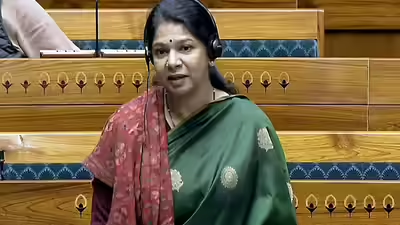
The political fallout of the collapsing relationship between the Dravida Munnetra Kazhagam and the Indian National Congress has now reached Parliament after DMK Parliamentary Party leader Kanimozhi Karunanidhi formally requested separate seating arrangements for DMK MPs in the Lok Sabha, signalling a decisive shift in the political equations between the two parties.
In a letter addressed to Lok Sabha Speaker Om Birla, Kanimozhi sought suitable changes in the seating allocation for DMK members following what she described as “changed political circumstances.” The request comes amid rapidly evolving political developments in Tamil Nadu after the 2026 Assembly election dramatically altered alliance structures across the state.
Kanimozhi stated in her communication that it would no longer be appropriate for DMK MPs to continue occupying their present seating arrangement alongside Congress members in the Lok Sabha because the alliance between the two parties had effectively come to an end.
The request carries major symbolic and political significance because seating arrangements inside Parliament often reflect alliance structures, coordination strategies and political proximity between parties. By seeking physical separation from Congress MPs inside the House, the DMK has publicly reinforced the reality of the growing distance between the two long-time allies.
The development follows the dramatic post-election realignment in Tamil Nadu after Vijay and his Tamilaga Vettri Kazhagam emerged as the single largest political force in the state Assembly election. The fractured verdict triggered intense coalition negotiations and forced multiple regional and national parties to reassess their political strategies.
Congress eventually chose to support Vijay’s government formation efforts instead of remaining aligned with the DMK, creating one of the biggest political ruptures in Tamil Nadu opposition politics in recent years. The Congress decision to back TVK became a major turning point in the state’s post-election power struggle and significantly weakened the traditional DMK-led opposition bloc.
The parliamentary seating request therefore represents not merely an administrative adjustment but also a public acknowledgement that the political relationship between the DMK and Congress has fundamentally changed.
For years, the DMK and Congress maintained a close electoral partnership in Tamil Nadu and collaborated extensively within broader opposition frameworks at the national level. Their alliance had played a significant role in parliamentary politics, particularly in opposing the BJP-led NDA government on multiple legislative and political issues.
However, the 2026 Tamil Nadu election appears to have reshaped those dynamics entirely. Congress leaders openly supported Vijay’s claim to form the government after TVK emerged as the largest party, arguing that backing the actor-turned-politician was necessary to preserve secular political space in Tamil Nadu.
The DMK leadership reportedly viewed Congress’s decision as a betrayal of long-standing alliance commitments. Tensions between the two parties escalated further as Congress leaders publicly defended their support for TVK while criticizing the DMK’s handling of alliance coordination and post-election negotiations.
Political observers believe the latest move by Kanimozhi signals that the DMK now intends to formally distance itself from Congress both inside and outside Parliament. The seating separation may also affect coordination on legislative strategy, opposition floor management and future alliance discussions at the national level.
The timing of the request is particularly important because Parliament remains one of the key arenas where opposition parties attempt to project unity against the BJP-led government. Any visible fragmentation among opposition parties could influence future national political calculations ahead of upcoming electoral contests.
Kanimozhi’s letter also reflects the growing uncertainty surrounding the future structure of opposition politics in southern India. The rapid rise of TVK has disrupted traditional alliance arithmetic and forced multiple parties to reconsider their long-term political positioning.
The DMK now faces the challenge of rebuilding political influence after losing its dominant position within Tamil Nadu opposition politics. Analysts suggest the party may increasingly attempt to assert an independent identity rather than functioning within broader alliance frameworks led by national parties.
At the same time, Congress appears to be recalibrating its Tamil Nadu strategy around emerging regional realities. By aligning with Vijay’s movement, the party may hope to retain political relevance in a state where traditional alliance structures have weakened dramatically after the election.
The parliamentary implications of the split could become increasingly visible in the coming weeks. Seating arrangements inside the Lok Sabha are often carefully managed to reflect political affiliations, ideological partnerships and coalition dynamics. Separate seating would visually underline the formal breakdown of coordination between the two parties.
The request also comes amid wider turbulence within opposition politics across India. Regional parties are increasingly asserting independent political identities and negotiating alliances based on state-specific electoral realities rather than long-term ideological alignments alone.
Political experts believe the collapse of the DMK-Congress partnership may influence alliance discussions in other states as well, particularly where regional parties seek greater autonomy from national opposition structures.
The rise of Vijay’s TVK has further accelerated these shifts by introducing a completely new political force capable of attracting support from parties that were previously aligned with older opposition formations. The success of TVK in securing support from Congress, Left parties and regional groups has effectively redrawn Tamil Nadu’s political map.
For the DMK, the separation from Congress inside Parliament may also serve as a message to party workers and supporters that the leadership intends to maintain an independent political course following the post-election developments.
Meanwhile, Congress leaders have so far avoided direct confrontation regarding the seating issue but continue defending their decision to support TVK during the government formation process. Party leaders maintain that their priority remains preserving democratic and secular politics in Tamil Nadu after the fractured mandate.
The developments highlight how rapidly political relationships can shift in coalition-driven Indian politics. Alliances that remain stable for years can quickly collapse when electoral outcomes alter the balance of power and strategic interests.
As Parliament prepares for future sessions, the requested seating changes are expected to become another visible reminder of the dramatic transformation currently reshaping Tamil Nadu politics.
The political consequences of the DMK-Congress split may continue unfolding not only inside the state but also within broader national opposition politics, where alliance management and regional leadership equations remain increasingly fragile.