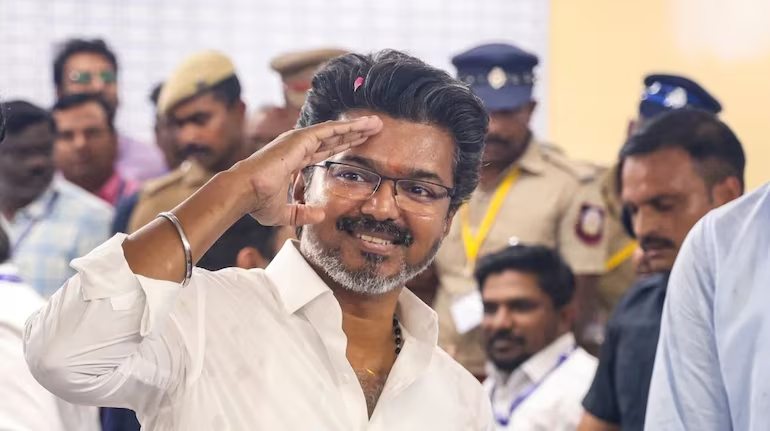
Tamil Nadu’s intense post-election political uncertainty moved toward a dramatic resolution after Vijay successfully secured the support required to cross the majority mark in the state assembly, bringing Tamilaga Vettri Kazhagam to the threshold of forming the next government in the state.
After several days of political negotiations, constitutional debate and alliance realignments following the fractured verdict in the 2026 Assembly election, TVK has now reached the crucial figure of 118 MLAs in the 234-member Tamil Nadu Assembly. The breakthrough came after the Viduthalai Chiruthaigal Katchi, Communist Party of India and Communist Party of India (Marxist) formally extended support to Vijay’s party.
The development marks one of the most significant political transformations in Tamil Nadu in decades and signals the emergence of a completely new power centre in a state historically dominated by the Dravida Munnetra Kazhagam and the All India Anna Dravida Munnetra Kazhagam.
TVK had emerged as the single largest party in the Assembly election after winning 108 seats. However, Vijay’s decision to contest from two constituencies meant that one seat would eventually need to be vacated, effectively reducing the immediate tally to 107 MLAs. Although the party achieved a stunning electoral breakthrough, it remained short of the majority figure needed to form a stable government.
The first major political support for TVK came from the Indian National Congress, which decided to back Vijay with its five MLAs. That decision raised the alliance tally to 112, but the coalition still remained six seats short of the majority mark required to form the government.
The numbers triggered a prolonged political deadlock in Chennai as all attention shifted toward smaller regional and Left parties capable of influencing government formation. Multiple rounds of negotiations then began between TVK representatives and opposition parties as uncertainty continued over whether Vijay could gather enough support before formally approaching Governor Rajendra Vishwanath Arlekar again.
The breakthrough finally arrived after VCK, CPI and CPM jointly decided to support the TVK government proposal. Together, the three parties contribute six MLAs in the Assembly, allowing Vijay’s alliance to touch the decisive figure of 118.
The final support structure now stands at:
TVK – 107 MLAs
Congress – 5 MLAs
VCK – 2 MLAs
CPI – 2 MLAs
CPM – 2 MLAs
The combined tally now provides Vijay with the numerical legitimacy required to strengthen his constitutional claim to form the next government in Tamil Nadu.
Senior CPM leader MA Baby confirmed that the CPI, CPM and VCK had coordinated efforts to enable TVK to demonstrate majority support and move toward government formation. Earlier, CPM state leaders had already indicated that democratic and constitutional conventions favoured inviting the single largest party to form the government in a hung assembly.
The support from the Left parties is politically significant because it effectively broke the prolonged uncertainty surrounding Tamil Nadu’s government formation process. Their decision also highlighted the rapidly changing political equations within the state after the election verdict disrupted traditional alliance structures.
The rise of TVK has emerged as far more than just an electoral upset. Political observers believe the 2026 Assembly election may ultimately become a defining turning point in Tamil Nadu politics after decades of bipolar dominance by the DMK and AIADMK.
Vijay’s transition from cinema superstar to political challenger has now evolved into one of the biggest political success stories in recent Indian regional politics. His campaign focused heavily on youth mobilisation, anti-corruption messaging, governance reform and public welfare themes that attracted strong support across urban and semi-urban constituencies.
The election outcome also reflected growing voter appetite for political alternatives outside the traditional Dravidian power structure. TVK’s performance especially resonated among younger voters and first-time electors who viewed Vijay as a fresh political face capable of challenging established political systems.
At the same time, the government formation process exposed the complexities of coalition politics in a hung assembly. For several days, uncertainty dominated the state after reports suggested that the Governor wanted clear evidence of majority support before inviting Vijay to form the government.
The delay triggered criticism from opposition leaders and constitutional experts who argued that democratic convention required giving the single largest party an opportunity to form the government first and then prove majority support on the Assembly floor within a stipulated period.
Speculation regarding possible alternative alliances also intensified political tensions during the deadlock. Reports suggesting exploratory discussions between the DMK and AIADMK created widespread surprise because of the historic rivalry between the two Dravidian parties. Although such reports were later denied, the speculation itself reflected the anxiety created by TVK’s sudden rise.
Congress leaders strongly defended their decision to support Vijay, arguing that ideological alignment and secular politics made the alliance necessary. Congress leaders repeatedly stated that supporting TVK was essential to preserve Tamil Nadu’s political identity and prevent expansion of BJP influence in the state.
The Left parties similarly framed their support decision within broader democratic and constitutional reasoning. Their backing signals an attempt to reposition regional opposition politics around Vijay’s emerging political movement while adapting to the rapidly evolving realities of Tamil Nadu’s electoral landscape.
Despite securing the majority figure, challenges remain ahead for TVK. Managing coalition expectations, balancing ideological differences among supporting parties and ensuring stable governance will become immediate priorities if Vijay is formally invited to form the government.
The coming days are expected to witness crucial constitutional developments including formal communication with Raj Bhavan, meetings with supporting legislators and internal consultations regarding cabinet formation and ministerial distribution.
The political implications of the development extend beyond Tamil Nadu itself. National political observers are closely monitoring the rise of TVK because the emergence of a successful regional force led by a major film personality could influence political strategies across several southern states.
Tamil Nadu has historically witnessed powerful cinema-to-politics transitions, but Vijay’s rise has been exceptionally rapid even by the state’s unique political standards. Comparisons are already being drawn with earlier charismatic leaders who successfully converted cinematic popularity into long-term political movements.
For TVK supporters, crossing the 118 mark represents validation of a political movement that many critics initially dismissed as personality-driven enthusiasm without organisational strength. The successful alliance negotiations have now demonstrated that the party possesses not only electoral momentum but also the political flexibility necessary to navigate coalition arithmetic.
As the state now awaits the Governor’s next move, preparations for possible government formation are expected to accelerate rapidly across Chennai. The prolonged uncertainty that followed the election results may finally be approaching closure.
Whether Vijay ultimately succeeds in reshaping governance and establishing long-term political dominance in Tamil Nadu remains uncertain. However, by successfully crossing the majority mark and positioning TVK at the centre of power, the actor-turned-politician has already ensured that Tamil Nadu politics has entered a completely new era.