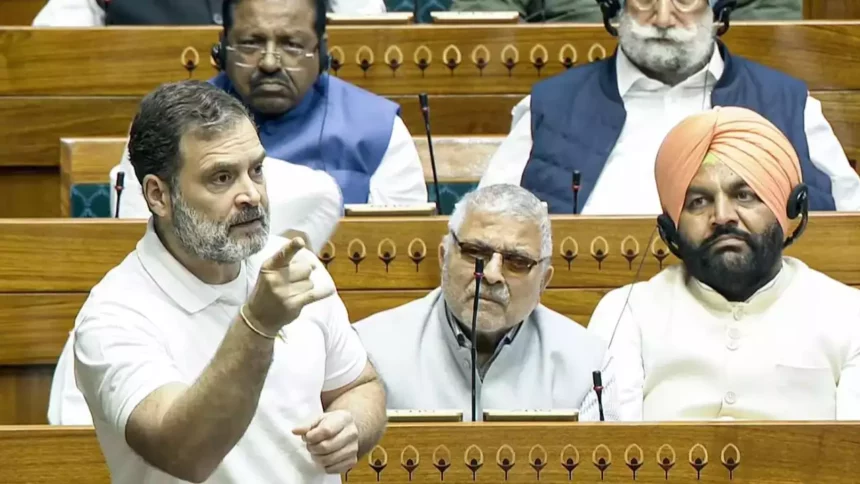
The Bharatiya Janata Party (BJP) sharply criticized Congress leader Rahul Gandhi on Monday after his speech in Parliament during the Motion of Thanks to the President’s address, in which he repeatedly mentioned China. BJP spokesperson Sambit Patra sarcastically referred to Rahul Gandhi as “Rahul Jinping,” a play on the name of Chinese President Xi Jinping, due to the frequency with which he mentioned China in his address.
Sambit Patra ridiculed Rahul Gandhi’s focus on China, stating, “I feel like addressing him as ‘Rahul Jinping’. He took China’s name 34 times… He must be praying that he gets to be Chinese in his next life.” Sambit Patra further accused Rahul Gandhi of undermining India’s manufacturing sector, citing that during Congress’s tenure from 2004 to 2014, the trade deficit with China had increased 25 times, a reference that sought to counter Rahul Gandhi’s criticism of India’s economic policies.
The BJP’s response was also directed at Rahul Gandhi’s remarks about the banking sector. Sambit Patra pointed out the achievements of Prime Minister Narendra Modi’s government, particularly the MUDRA scheme, which had extended loans to 51 crore people. He also highlighted that Congress had historically opposed financial innovations such as the Unified Payments Interface (UPI), which now facilitates over 500 million transactions daily.
Amit Malviya, the head of the BJP’s IT cell, also joined in the attack, sharing a video compilation of the 34 instances in which Rahul Gandhi mentioned China during his speech. Malviya’s post amplified the BJP’s criticism of Rahul Gandhi’s emphasis on China and his broader narrative in the address.
In his speech, Rahul Gandhi had claimed that China had a ten-year lead over India in manufacturing and warned that Beijing was “sitting on over 4,000 sq km” of Indian territory. He alleged a contradiction between the government’s stance and the Indian Army’s position on the matter. Rahul Gandhi stated, “The Prime Minister has denied it, but the Army has contradicted him—China is sitting on 4,000 sq km of our territory.”
Rahul Gandhi expressed concerns about India’s dependence on Chinese imports, particularly in sectors crucial for defense. He warned that in the event of a conflict with China, India would be forced to rely on Chinese-made equipment such as motors, batteries, and optics. “If and when we fight a war with China, we will be fighting with Chinese electric motors, Chinese batteries, and Chinese optics, and we will be buying Chinese motors, Chinese optics, and Chinese batteries,” he said, underscoring his concerns over the strategic implications of India’s dependence on Chinese products.
Additionally, Rahul Gandhi criticized Prime Minister Modi’s ‘Make in India’ initiative, arguing that its failure had enabled China to gain ground in India’s critical sectors, contributing to India’s reliance on Chinese imports. He suggested that the lack of sufficient domestic manufacturing capability had made India vulnerable, particularly in areas related to defense.
The ongoing back-and-forth between the BJP and Congress reflects the sharp political divide over issues of national security and economic policy. While the BJP focuses on criticizing Rahul Gandhi’s views on China and the economy, Rahul Gandhi continues to press the government on its handling of India-China relations and its economic policies, especially in terms of reducing the nation’s dependence on foreign imports.