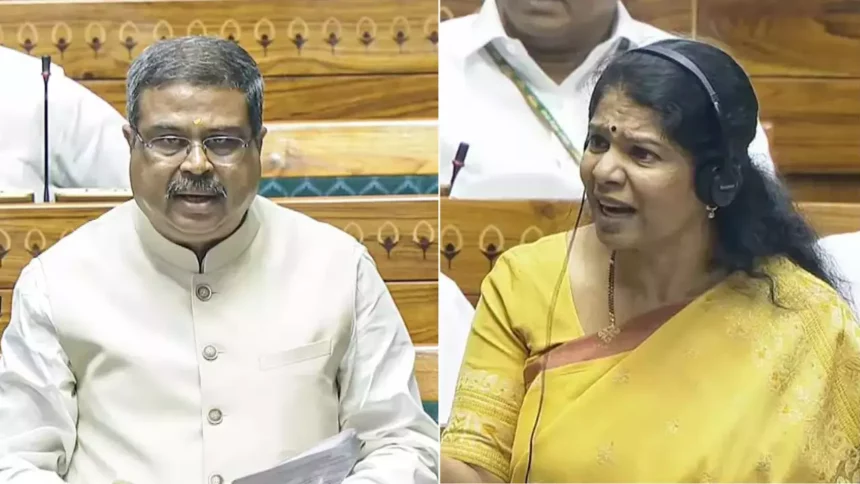
A fresh political tussle has erupted between the DMK and the central government over the implementation of the PM SHRI scheme in Tamil Nadu, with DMK MP Kanimozhi and Union Education Minister Dharmendra Pradhan engaging in a heated exchange on social media. The dispute revolves around Tamil Nadu’s stance on the scheme, the National Education Policy (NEP), and the three-language policy, with both sides accusing each other of misleading the public.
The controversy began when Dharmendra Pradhan shared Tamil Nadu’s consent letter for the PM SHRI scheme, dated March 15, 2024, and accused the DMK of changing its position. He alleged that the party had misled Parliament by first agreeing to implement the scheme and later opposing it for political gains. In his post on X, Pradhan stated that DMK MPs and Chief Minister M.K. Stalin had wrongly accused him of making false claims about Tamil Nadu’s approval of the scheme. He maintained that the state had given consent and criticized the DMK for trying to manipulate facts.
Responding to Dharmendra Pradhan’s claims, DMK MP Kanimozhi strongly refuted any shift in the Tamil Nadu government’s stance. She clarified that the state would accept PM SHRI schools only on the basis of recommendations from its own committee and not the Union government’s directives. She emphasized that Tamil Nadu had never agreed to adopt the three-language policy or the NEP in its entirety. In her post on X, she accused Dharmendra Pradhan of distorting facts and reiterated that Tamil Nadu would only implement policies that align with its own education framework.
The Union Minister further alleged that the DMK was using the language issue as a political tool rather than prioritizing students’ welfare. He questioned why the party had changed its position on the NEP, suggesting that the move was aimed at gaining political mileage. Calling DMK’s opposition to the NEP “retrograde politics,” Dharmendra Pradhan asserted that it was detrimental to the future of Tamil Nadu’s students.
The debate over language policy has been a long-standing issue in Tamil Nadu, with successive state governments opposing the imposition of Hindi and a three-language formula. Dharmendra Pradhan, addressing concerns in the Rajya Sabha, stated that the Modi government was not imposing any language on anyone. He assured that India, as a multilingual nation, would continue to respect linguistic diversity. He also dismissed DMK’s concerns by stating that Tamil was not anyone’s monopoly and that the central government was fully committed to preserving and promoting the language.
The ongoing clash highlights the broader tensions between the DMK-led Tamil Nadu government and the BJP-led central government, particularly on issues related to federalism, education policies, and language rights. While the Centre maintains that its policies aim to improve the education system, the DMK insists that Tamil Nadu’s unique linguistic and educational identity must be safeguarded. As the political debate intensifies, the fate of PM SHRI schools in the state remains uncertain.