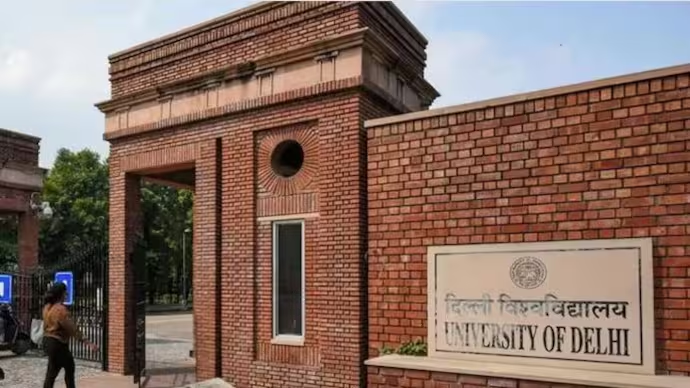
A heated debate has erupted at Delhi University after reports surfaced that the MA Political Science syllabus may soon exclude key topics such as Pakistan, China, Islam, and political violence. The move, allegedly prompted by recent security concerns and administrative directives, has triggered strong criticism from faculty members who argue that such omissions will undermine academic depth and geopolitical understanding.
Courses under review post-Pahalgam attack
Following the April 22 Pahalgam terror attack, Delhi University’s Vice Chancellor Yogesh Singh reportedly instructed department heads to ensure that the syllabus does not “glorify” Pakistan unnecessarily. As a result, courses like Pakistan and the World, China’s Role in the Contemporary World, Islam and International Relations, Pakistan: State and Society, and Religious Nationalism and Political Violence may be dropped or replaced. The review was part of a wider scrutiny by the university’s Standing Committee on Academic Matters, where several course contents were evaluated.
The Vice Chancellor’s directive, though not officially documented in policy form yet, appears to be influencing course restructuring at the postgraduate level. Reports suggest that any replacements to these topics will first be referred to the department’s course committee, and if approved, will be sent to the university syllabus panel before final clearance from the Academic Council.
Faculty members defend academic freedom and relevance
The proposal has drawn widespread criticism from the academic community. Dr. Monami Sinha, a member of the Standing Committee, argued that studying Pakistan in detail is academically essential. “We need to train our students and foster scholarship on Pakistan, as it remains one of India’s constant foreign policy challenges,” she noted in her statement. Similarly, she defended the inclusion of China in the syllabus, calling it an “emerging key player in the Global South” and urging that students must be educated on China’s international role.
Abha Dev, Secretary of the Democratic Teachers’ Front (DTF), called the proposed removals politically motivated and detrimental to higher education. “Academic autonomy of departments stands eroded. These forced revisions, which seem to be based on belief rather than pedagogy or scientific inquiry, are retrograde,” she said. According to her, such top-down changes would harm the intellectual development of students and compromise the university’s academic standards.
Mithuraaj Dhusiya, an elected member of the Academic Council, added that academic freedom includes the freedom to engage with difficult topics. “Instead of cancelling uncomfortable questions, one needs to engage with the perceived ‘other’ to develop the intellectual capability to address complex global challenges,” he said. He emphasized that departments should not be compelled to implement curricular changes without adequate academic debate.
As of now, no final decision has been made, but the internal discussions have ignited a wider conversation about academic autonomy, ideological influence, and the future of political science education in India’s leading universities. Whether or not these controversial courses will remain in the syllabus remains to be seen—but the backlash has already brought these tensions to the forefront.