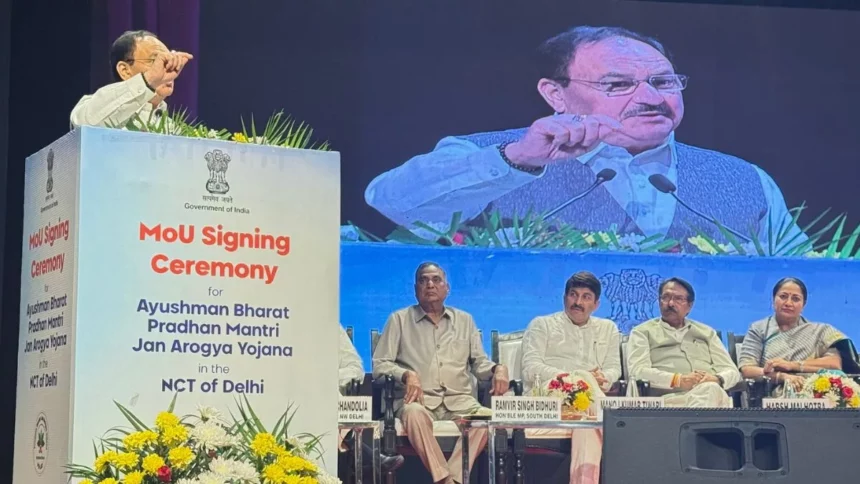
Starting this Thursday 09-April-2025 , the Delhi government will begin distributing Ayushman Bharat health cards to over 2.34 lakh families in the Capital, marking the formal rollout of the Centre’s flagship insurance scheme in the city. With this, nearly 6.54 lakh of Delhi’s poorest families will become eligible for annual health coverage worth Rs 10 lakh—Rs 5 lakh from the Centre and an additional Rs 5 lakh from the Delhi government. The scheme, which ensures no restriction on family size, age, or gender, will also cover all pre-existing conditions from day one.
Who is eligible under the scheme?
The Ayushman Bharat Pradhan Mantri Jan Arogya Yojana (AB-PMJAY) classifies beneficiaries into urban and rural categories. In urban areas, 11 occupational groups are eligible, including ragpickers, beggars, domestic workers, street vendors, construction labourers, sanitation workers, and security guards. For rural beneficiaries, eligibility is based on seven deprivation criteria from the Socio-Economic and Caste Census 2011. These include SC/ST households, families living in kucha houses with only one room, families with no adult male members aged 16 to 59, and those without any able-bodied adult members. Destitutes living on alms and manual scavenger households are also automatically eligible.
Additionally, ASHA and anganwadi workers and helpers—28,294 families in total—have been identified for inclusion. Eligibility will also be cross-verified using ration card data under the National Food Security Act. Delhi has three categories under this Act: 66,281 families under Antyodaya Anna Yojana (2.72 lakh beneficiaries), 1.68 lakh priority households (7.63 lakh beneficiaries), and 15.05 lakh families receiving basic food grains (62.33 lakh beneficiaries).
Healthcare access and services offered
Once enrolled, families can access free and cashless treatment for 1,961 medical procedures across 27 specialities, which include hospitalisation, ICU care, surgeries, diagnostic tests, and medicines. The scheme also covers three days of pre-hospitalisation and 15 days of post-hospitalisation care. Treatment will be available across 91 empanelled hospitals in Delhi—46 private, 34 Delhi government, and 11 central government institutions—all under the oversight of the state health authority.