New Delhi, March 24, 2026
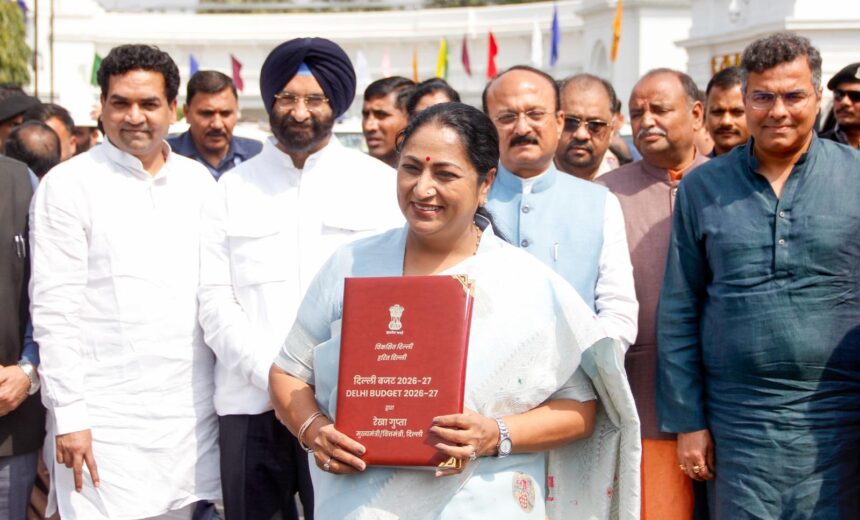
Chief Minister Rekha Gupta presented the Delhi Budget 2026–27 in the Legislative Assembly, announcing a total outlay of ₹1,03,700 crore and describing it as the capital’s first “Green Budget,” aimed at transforming Delhi into a modern, inclusive, safe and environmentally sustainable city.
The budget reflects a 3.7 percent increase over the previous financial year and sets a long-term vision focused on infrastructure expansion, environmental protection, and social welfare.
Green Budget with Strong Environmental Commitment
A key highlight of the budget is its strong environmental focus, with around 21 percent of the total allocation—₹22,236 crore—dedicated to green initiatives and sustainable development.
The government plans to significantly enhance waste management by increasing processing capacity from 7,000 metric tonnes to 15,000 metric tonnes per day. This will be achieved through expansion of waste-to-energy plants in Narela, Okhla, Ghazipur and Tehkhand.
Additional initiatives include mechanised road cleaning, anti-smog measures, real-time pollution monitoring systems, urban forest development, and carbon credit monetisation. These steps aim to reduce pollution levels while promoting a circular economy and sustainable urban growth.
Sector-Wise Allocation Highlights
The Chief Minister outlined major allocations across sectors, with education receiving the largest share of ₹19,326 crore (18.64%). Healthcare follows with ₹13,034 crore (12.57%), while transport, roads and bridges have been allocated ₹12,613 crore (12.16%).
Other significant allocations include ₹11,572 crore for housing and urban development, ₹10,537 crore for social welfare, and ₹9,000 crore for water supply and sanitation. Funds have also been earmarked for energy, agriculture, and public debt management.
Infrastructure Development and Urban Expansion
The budget outlines a major push toward infrastructure development. Municipal bodies will receive ₹11,266 crore, while ₹5,921 crore has been allocated for public works.
The government plans to reconstruct 750 kilometres of roads in 2026–27, building on ongoing projects. Additional initiatives include construction of flyovers, underpasses, drainage systems, modern markets, and parking facilities.
Projects such as the Barapulla corridor expansion, new foot overbridges, and development of roads along the Najafgarh drain are expected to ease traffic congestion and improve urban mobility.
Water Supply and Sanitation Improvements
An allocation of ₹9,000 crore has been made for the Delhi Jal Board to improve water infrastructure. This includes expansion of pipelines, increased treatment capacity, and reduction of water losses.
Sewage treatment capacity will be enhanced from 707 MGD to 814 MGD, with a long-term goal of 1500 MGD. Key projects such as the Chandrawal water treatment plant and drainage system upgrades have also been included.
Healthcare Expansion and Public Health Initiatives
The healthcare sector has been allocated ₹12,645 crore, with a focus on completing pending hospital projects and improving medical infrastructure.
New hospitals in Madipur, Siraspur, Hastsal and Jwalapuri will be completed, along with upgrades to major facilities. Over 750 Ayushman Arogya Mandirs will be established, supported by ₹1,500 crore.
The budget also includes ₹787 crore for procurement of medicines and equipment, ₹150 crore for ICU expansion, and new initiatives such as the ‘Anmol’ scheme for newborn screening and real-time monitoring of ICU beds.
Education and Skill Development Focus
Education remains a top priority, with ₹19,148 crore allocated to strengthen infrastructure and improve access to modern facilities.
Key initiatives include construction and expansion of school buildings, installation of smart classrooms, and provision of free bicycles to approximately 1.3 lakh girl students. Meritorious students will receive laptops, while digital education will be expanded across schools.
The government also plans to strengthen technical education through ITI upgrades, new centres of excellence, and development of an education hub in Narela.
Social Welfare and Women Empowerment
The budget includes ₹7,406 crore for women and child development, with a strong focus on empowerment and welfare.
Key initiatives include free bus travel for women and transgender individuals, free gas cylinders during festivals, financial assistance for girl children, and installation of sanitary pad vending machines in schools.
Additional provisions include development of Anganwadi centres, women’s markets, and welfare schemes aimed at improving economic participation and social security.
Transport and Green Mobility Initiatives
The transport sector has been allocated ₹8,374 crore, with a focus on promoting electric mobility and reducing pollution.
The government plans to add 6,130 new electric buses and expand the fleet to 12,000 by 2029. Metro expansion projects have been allocated ₹2,885 crore, while ₹568 crore has been set aside for regional rapid transit systems.
Investments in EV infrastructure, charging stations, and traffic decongestion projects are also planned.
Administrative Reforms and Governance
The budget introduces governance reforms aimed at improving transparency and efficiency. Mini secretariats will be established across 13 districts, and a ‘Bhu-Aadhaar’ system will be implemented to digitise property records.
Additional initiatives include paperless registration systems, improved public service delivery, and enhanced disaster management infrastructure.