The Delhi High Court on Wednesday refused to urgently hear a petition seeking to halt the release of actor Paresh Rawal’s upcoming film Taj Story, which has sparked widespread controversy for allegedly portraying a distorted and provocative version of the Taj Mahal’s origins. The court stated that the petition would be listed in due course, dismissing the petitioner’s plea for immediate intervention just two days before the film’s scheduled release.
Controversy over Taj Story’s content and symbolism
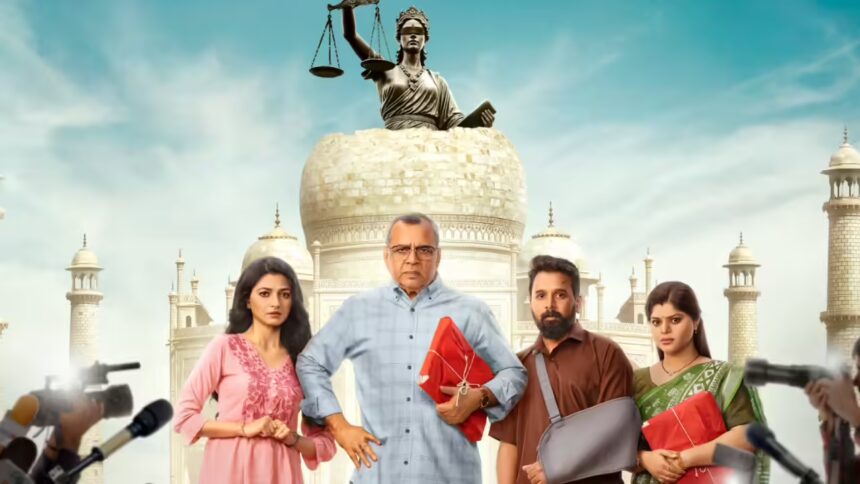
The film Taj Story, produced by CA Suresh Jha, is slated for release on Friday. It has drawn criticism ever since the release of its poster, which depicts a statue of Lord Shiva emerging from the dome of the Taj Mahal — an image that many critics have described as provocative and misleading. The controversy stems from claims that the film promotes an alternative narrative about the historical origins of the Taj Mahal, portraying it as a Hindu temple rather than a Mughal monument.
The petitioner, advocate Shakeel Abbas, approached the Delhi High Court seeking an urgent stay on the film’s release, arguing that the movie contains fabricated and inflammatory content capable of disrupting communal harmony. During the hearing, a bench comprising Chief Justice DK Upadhyay and Justice Tushar Rao Gedela declined to expedite the matter, asking the petitioner to wait for the case to be listed automatically.
“Why today? When was the certification issued? It will be auto-listed. Sorry,” the bench remarked, rejecting Abbas’s request for urgent listing. The court’s refusal to prioritize the hearing means that the film is likely to hit theatres as scheduled, barring any last-minute intervention by the censor board or another judicial order.
Petition seeks CBFC review and mandatory disclaimer
In his plea, Abbas urged the court to direct the Central Board of Film Certification (CBFC) to review the certification granted to Taj Story or impose necessary cuts to ensure that the film does not harm communal harmony. He also requested the inclusion of a disclaimer clarifying that the movie represents a contested interpretation rather than an established historical account.
According to the petition, Taj Story is “based on fabricated facts” and “designed with a specific propaganda intent to distort history.” It alleges that the film promotes misinformation about one of the world’s most iconic monuments — the Taj Mahal — by implying that it was originally a Hindu temple dedicated to Lord Shiva. The plea argues that such depictions could undermine public trust in historical scholarship, provoke religious tensions, and damage India’s global reputation, particularly since the Taj Mahal is a UNESCO World Heritage Site.
The petition further accuses the filmmakers of echoing controversial remarks previously made by certain political leaders and organizations that have attempted to link the Taj Mahal’s origins to Hindu mythology. It claims that the film amplifies divisive narratives often propagated by right-wing groups and risks inflaming communal sentiments at a time when maintaining social peace is crucial.
“The movie contains deeply divisive scenes that could provoke communal tensions and disturb peace in society. It has amplified controversial statements by political leaders and Hindutva organizations, which may spark nationwide unrest,” the petition stated. The petitioner contended that by releasing the film in its current form, the producers were not only promoting an unverified version of history but also potentially inciting hatred between communities.
Legal, social, and cultural implications
The controversy surrounding Taj Story reflects a broader tension between creative freedom and social responsibility in India’s film industry. While the Constitution guarantees freedom of expression, that freedom is subject to reasonable restrictions, particularly when content has the potential to disturb public order or communal harmony. The CBFC, tasked with reviewing films before release, is expected to ensure that no film promotes hatred or threatens public peace. However, critics often accuse the board of inconsistency, with some films facing stringent scrutiny while others with provocative content are allowed through.
In recent years, several films have sparked similar debates by reinterpreting historical or religious narratives, often leading to public protests, boycotts, or legal challenges. The controversy over Taj Story is reminiscent of earlier disputes surrounding films such as Padmaavat and Adipurush, where artistic depictions were perceived as offensive or historically inaccurate.
The film’s producers have not yet issued an official response to the petition. However, sources close to the production suggest that they view the controversy as politically motivated and maintain that the movie is a work of fiction inspired by cultural debates, not an attempt to rewrite history. Supporters of the film have also defended it as an exercise of artistic expression, arguing that audiences should have the freedom to interpret or reject such narratives on their own.
Meanwhile, legal experts believe that unless the CBFC revokes or modifies its certification, the court is unlikely to intervene at this stage. “Once a film is certified, the courts typically refrain from issuing preemptive bans unless there is clear evidence of a threat to law and order,” said a senior advocate familiar with similar cases. “The petitioner’s concerns may be genuine, but the remedy often lies in post-release review rather than preemptive restraint.”
For now, the film’s release continues to divide opinion. Many historians and heritage experts have condemned the depiction of the Taj Mahal in the film’s promotional material, arguing that it disrespects both historical scholarship and cultural sensitivity. The Taj Mahal, built by Mughal Emperor Shah Jahan in memory of his wife Mumtaz Mahal, remains one of India’s most enduring symbols of architectural brilliance and secular heritage.
As the release date nears, both supporters and critics of Taj Story are bracing for heightened public debate. The case has once again underscored the delicate balance between artistic freedom and social harmony — a debate that continues to shape the cultural and political discourse in modern India.