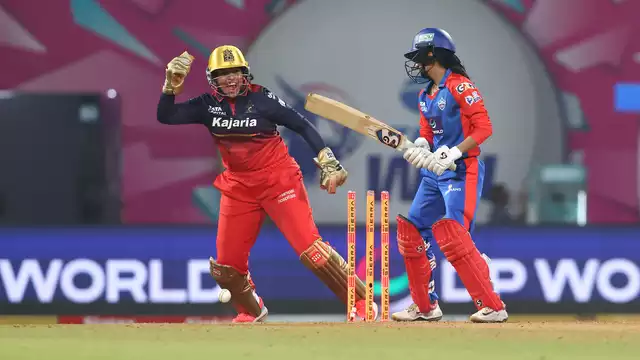
The women’s premier league fixture in Vadodara brought together two teams moving in sharply different directions, with Royal Challengers Bengaluru cruising confidently toward the playoffs while Delhi Capitals faced a mounting sense of urgency, knowing that every remaining match could determine whether their season would survive beyond the league stage.
Royal challengers bengaluru’s smooth journey and growing authority
Royal Challengers Bengaluru entered the Vadodara leg of the women’s premier league with the calm assurance of a side that has largely solved the puzzle of consistency. From the opening games of the season, they established a rhythm built on balance, clarity of roles and an ability to adapt quickly to conditions. Their unbeaten run was not defined by narrow escapes or reliance on individual brilliance alone, but by a collective understanding of how to control games across all phases.
A key factor in rcb’s success has been their batting depth, which allows them to absorb early setbacks without panic. Top-order batters have shown the discipline to build innings when conditions demand caution, while middle-order hitters have consistently accelerated at the right moments. This flexibility has enabled rcb to post competitive totals on challenging surfaces and chase targets with confidence, even when early wickets fall.
Equally important has been the bowling unit’s discipline. Rcb’s bowlers have maintained pressure through tight lines and intelligent variations, particularly in the powerplay and death overs. Rather than relying solely on pace or spin dominance, the attack has functioned as a cohesive unit, adapting to pitch behavior and opposition strengths. This adaptability has often forced opponents into mistakes, creating openings that rcb have been quick to exploit.
Leadership has also played a central role in shaping rcb’s campaign. On the field, decision-making has been decisive yet measured, reflecting a clear understanding of match situations. Field placements, bowling changes and batting promotions have generally aligned with broader strategic plans rather than reactive impulses. Off the field, preparation has been meticulous, with the team appearing mentally prepared for varied scenarios rather than dependent on ideal conditions.
By the time rcb arrived in Vadodara, their playoff qualification was already secure, granting them the rare luxury of playing without the immediate pressure of results. This freedom allowed them to experiment subtly with combinations while maintaining competitive intensity. Rather than easing off, rcb used their strong position to fine-tune strategies, test squad depth and maintain momentum ahead of the knockout phase.
The return of key all-round options further strengthened their balance, offering additional flexibility in both batting and bowling combinations. This depth has meant that rcb are rarely forced into compromising tactical decisions, a significant advantage as the tournament progresses. Their ability to rotate players without losing cohesion has reinforced the perception of a side peaking at the right time.
Psychologically, rcb’s campaign has benefited from early success. Confidence has bred composure, allowing players to express themselves without fear of failure. Matches have been approached with clarity rather than desperation, and this mindset has translated into consistent execution under pressure. By the Vadodara fixture, rcb were not just winning games but shaping the narrative of the tournament, positioning themselves as one of the teams to beat.
*Delhi capitals’ struggle for momentum and playoff survival*
In stark contrast, Delhi Capitals arrived in Vadodara with their season hanging in the balance. Once considered one of the more stable franchises in the league, they found themselves caught in a congested mid-table battle where margins for error had all but disappeared. Each defeat compounded the pressure, turning remaining fixtures into must-win encounters and placing immense strain on players and management alike.
Delhi’s campaign has been marked by inconsistency, with promising performances often followed by disappointing lapses. Injuries to key players disrupted continuity, forcing frequent changes in combinations and preventing the team from settling into a stable rhythm. The absence of influential all-rounders altered the balance of the side, leaving gaps that were not easily filled by replacements, despite genuine effort and intent.
Batting has been an area of particular concern. While individual innings have occasionally sparked hope, Delhi have struggled to build sustained partnerships that can anchor an innings or launch decisive accelerations. Top-order collapses have placed undue pressure on the middle order, and attempts to reshuffle the batting lineup have produced mixed results. The lack of consistent scoring patterns has made it difficult for Delhi to dictate terms, especially against more settled sides.
Bowling, too, has reflected the broader uncertainty of the campaign. While there have been spells of discipline and control, these moments have often been undermined by lapses in execution at crucial stages. Defending totals has proved challenging, particularly when fielding standards drop or plans unravel under pressure. The inability to close out tight games has cost Delhi valuable points, deepening their playoff predicament.
As the Vadodara match approached, the psychological weight on Delhi Capitals was evident. Unlike rcb, who could afford to look ahead, Delhi were forced to focus narrowly on immediate survival. Net run rate calculations, results from other matches and qualification scenarios loomed large, creating an environment where players were acutely aware of what was at stake in every over.
Despite these challenges, there were signs of resilience within the squad. Young players were given opportunities to step up, and mid-season reinforcements were integrated in an attempt to inject fresh energy. The management’s willingness to experiment reflected a determination to salvage the campaign, even as time began to run out.
Conditions in Vadodara added another layer of complexity. The slower surface demanded patience and smart shot selection, testing Delhi’s ability to adapt under pressure. For a side already struggling with confidence, the challenge lay in resisting the urge to force the game and instead trusting process and discipline. Whether Delhi could rise to that challenge would determine not just the outcome of the match, but potentially the fate of their season.
The matchup against rcb therefore symbolized more than a routine league fixture. It represented a collision between assurance and anxiety, between a team refining its path to the playoffs and another fighting to keep its hopes alive. For Delhi Capitals, the game was about reclaiming belief and momentum before it was too late, while for rcb it was another step in a campaign defined by control, confidence and clarity.