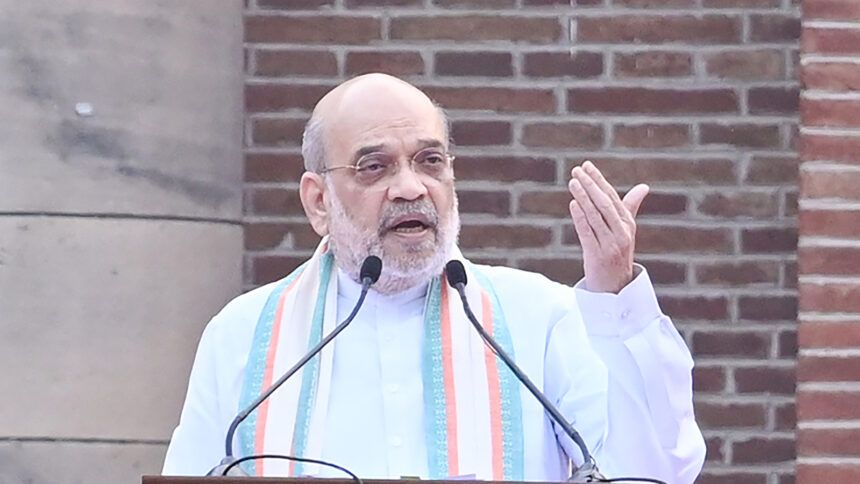
The three-day Uttar Pradesh Diwas celebrations commenced in Lucknow with the inauguration led by Amit Shah, marking a moment that blended cultural pride, political symbolism and developmental messaging as the state presented itself as a space where heritage, governance and future aspirations intersect in a shared public narrative.
A ceremonial opening rooted in culture, identity and governance
The inauguration of Uttar Pradesh Diwas in Lucknow unfolded as a carefully curated event designed to reflect both the historical depth and contemporary ambitions of the state. The venue, Rashtra Prerna Sthal, became the focal point of celebrations as political leaders, officials, artists and citizens gathered to mark the beginning of three days dedicated to reflecting on Uttar Pradesh’s journey since its formation. Amit Shah’s presence at the opening lent national significance to the occasion, reinforcing the state’s political and cultural prominence within India’s broader federal framework.
Accompanied by Yogi Adityanath, the home minister participated in a ceremonial walkthrough of exhibition spaces that visually narrated the state’s progress in infrastructure, social welfare, agriculture, industry and law and order. These exhibits were designed not merely as displays, but as storytelling tools that connected policy outcomes with lived experiences across districts. Multimedia presentations, interactive installations and archival visuals created a layered account of how governance priorities have shaped everyday life.
Cultural performances formed a central pillar of the inaugural day, with classical dance, folk music and regional art forms reflecting the diversity of Uttar Pradesh’s cultural landscape. Artists from different regions presented traditions rooted in centuries-old practices, underscoring the idea that development and heritage need not exist in opposition. The performances were interwoven with visual symbolism, including representations of rivers, historical cities and literary traditions that have long defined the state’s identity.
A significant highlight of the opening day was the emphasis on regional cuisine through the ‘one district one cuisine’ concept, which brought together signature dishes from across Uttar Pradesh under one roof. This culinary showcase functioned as both a cultural celebration and an economic narrative, highlighting local food traditions as potential drivers of tourism and entrepreneurship. Visitors engaged not only with flavors but with the stories of communities, agricultural practices and regional identities embedded in each dish.
Security arrangements and logistical coordination reflected the scale of the event and the anticipated public participation. Authorities deployed extensive measures to ensure smooth movement, crowd management and safety, allowing the focus to remain firmly on celebration rather than disruption. The meticulous planning reinforced the administration’s intent to present the event as orderly, inclusive and accessible.
Beyond the main venue in Lucknow, the inauguration was broadcast live to district headquarters across the state, symbolically extending participation beyond the capital. This statewide connectivity reinforced the idea that Uttar Pradesh Diwas is not confined to a single city but belongs to the collective consciousness of millions across urban and rural spaces alike.
Statewide participation and the broader meaning of up diwas
As the celebrations expanded beyond the inaugural ceremony, Uttar Pradesh Diwas evolved into a statewide expression of identity and aspiration. Districts across the state organised parallel events that echoed the themes introduced in Lucknow, adapting them to local contexts and histories. Cultural programmes, exhibitions and community gatherings created spaces where residents could engage with their district’s unique contributions while situating them within the larger narrative of the state.
Educational institutions, civic bodies and local artists played a visible role in shaping these celebrations. Students participated in debates, art competitions and performances that explored themes of statehood, civic responsibility and cultural heritage. These activities aimed to foster a sense of belonging among younger generations, connecting them to the historical and social fabric of Uttar Pradesh while encouraging reflection on its future trajectory.
The celebrations also served as a platform to recognise individual achievement through honours that acknowledged contributions in fields such as education, science, literature, entrepreneurship and social service. By spotlighting these achievements, the state sought to project an image of Uttar Pradesh as a space of opportunity and innovation, countering older narratives that often focused solely on challenges rather than progress.
Tourism and cultural promotion emerged as prominent threads within the Diwas framework. Exhibits and digital displays highlighted heritage circuits, pilgrimage routes, wildlife reserves and emerging travel destinations, positioning the state as a multifaceted tourism landscape. These efforts aligned cultural pride with economic ambition, suggesting that preservation and growth can reinforce each other when strategically aligned.
Diaspora engagement added another dimension to the celebrations. Through digital outreach and online participation, residents originally from Uttar Pradesh but living elsewhere were invited to reconnect with the state’s cultural rhythms. This outreach reinforced emotional and cultural ties, framing Uttar Pradesh Diwas as a moment of shared identity that transcends geography.
At its core, Uttar Pradesh Diwas functioned as both reflection and projection. It looked back at the state’s historical foundations while projecting a vision of governance, cultural confidence and developmental ambition. The presence of national leadership at the inauguration symbolised alignment between state and central narratives, while the widespread participation across districts suggested an effort to ground that narrative in local experience.
As events continued over the three days, the celebrations maintained a balance between festivity and messaging, between cultural expression and administrative storytelling. Uttar Pradesh Diwas thus emerged not merely as a commemorative date, but as a living platform through which the state articulated who it is, where it has been, and how it envisions its future within the national imagination.