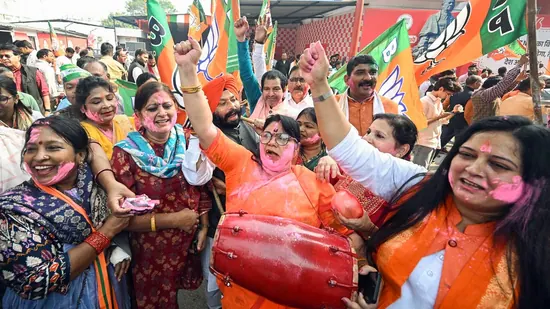
The recent by-election in Hyderabad’s Jubilee Hills assembly constituency has marked a decisive moment in Telangana’s political landscape, highlighting the resurgence of the Congress party in urban constituencies and reinforcing the significance of strategic candidate selection, community representation, and coalition-building. Held on November 11, the by-poll witnessed a relatively low voter turnout of just 48.42 percent among the total 4.01 lakh eligible voters, yet it produced a striking outcome. Congress candidate Vallala Naveen Yadav secured a landslide victory by defeating Maganti Sunitha of the Bharat Rashtra Samithi (BRS) by a margin of 24,729 votes, polling 98,988 votes against Sunitha’s 74,259. The result not only wrested the seat from BRS control following the death of sitting MLA Maganti Gopinath earlier this year but also demonstrated Congress’s ability to regain confidence among Hyderabad’s urban electorate. The victory sent waves of jubilation through the Congress party, with celebrations at party offices reflecting both strategic success and public support for development-focused governance.
Congress Triumph and Electoral Dynamics in Jubilee Hills
The Jubilee Hills by-election showcased Congress’s strategic mastery in candidate selection, campaign execution, and coalition-building. Vallala Naveen Yadav, representing the OBC community, was pitched against upper-caste opponents Maganti Sunitha of BRS and Lankala Deepak Reddy of BJP. Naveen Yadav’s background as a youth leader, coupled with his extensive voluntary work through the organisation “Nava Yuva Nirman,” helped him connect with younger voters and communities seeking skill-development and employment opportunities. His ability to leverage social influence and grassroots engagement translated into overwhelming support at the polls, resulting in Congress securing 51 percent of total polled votes in the constituency. The margin of victory, exceeding 24,000 votes, reflected both the popularity of the candidate and the strategic impact of party alliances. Crucially, Naveen Yadav’s induction into Congress in November 2023, facilitated by then Telangana Pradesh Congress Committee president A Revanth Reddy, positioned him as a credible and appealing candidate capable of uniting diverse voter segments.
The political context of Jubilee Hills, an urban constituency with a dynamic and diverse electorate, accentuated the importance of candidate profile and campaign strategy. Following the death of sitting MLA Maganti Gopinath in June, the BRS nominated his wife, Maganti Sunitha, signaling continuity of local influence. However, Congress’s deliberate emphasis on OBC representation and the inclusion of youth leadership through Naveen Yadav proved decisive. The support extended by the All India Majlis-e-Ittehadul Muslimeen (AIMIM), which chose not to field a candidate in the by-election, also contributed significantly to consolidating minority votes in favor of Congress. AIMIM chief Asaduddin Owaisi’s appeal to Muslim voters to back Congress in the interest of development added strategic depth to the campaign, ensuring broader cross-community support.
The by-election results also reflected the wider sentiment among urban voters, many of whom responded positively to Congress’s focus on governance, welfare programs, and inclusive representation. Telangana Chief Minister A Revanth Reddy highlighted that the outcome demonstrated public faith in the government’s developmental initiatives and commitment to welfare, pointing out that the Congress had previously regained the Secunderabad Cantonment seat as part of its recent resurgence. Reddy’s statements emphasized that the electorate was increasingly evaluating performance and development outcomes over traditional political loyalties, suggesting a shift in voter priorities within Hyderabad’s urban constituencies. The victory, therefore, was not merely a reflection of individual popularity but also a testament to the party’s strategic alignment with public sentiment and community representation.
Opposition Reactions and BRS Perspective
The Jubilee Hills by-election outcome prompted varied reactions from opposition parties, particularly the BRS. Despite the defeat, BRS working president KT Rama Rao emphasized that the result confirmed BRS as the primary alternative to Congress in Telangana. He acknowledged the efforts of party workers and leaders in maintaining voter engagement and praised their campaign management despite the loss. Rama Rao highlighted that the defeat served as an opportunity for introspection, especially in terms of evaluating public perception, constituency engagement, and implementation of policy guarantees. BRS leaders underlined that the party had been instrumental in holding Congress accountable, raising concerns regarding minority representation, and pressing for reforms within the state cabinet, including the induction of a minority minister. These actions, according to BRS leadership, reflected the party’s ongoing commitment to addressing governance issues and ensuring equitable representation across communities.
The BJP’s performance in the by-election was notably weak, with candidate Lankala Deepak Reddy securing only 17,061 votes and losing his deposit. This outcome reflected the limited influence of BJP in Jubilee Hills and highlighted the party’s inability to challenge effectively in urban constituencies dominated by strong local networks and issue-based voter sentiment. The significant gap between the BJP candidate and the winners underscored the role of strategic candidate positioning and local engagement in urban electoral dynamics. Furthermore, the presence of 58 candidates in the fray added complexity to the election, emphasizing the challenges parties face in consolidating voter bases in competitive constituencies while navigating diverse social and political factors.
Vallala Naveen Yadav: Leadership Profile and Political Trajectory
Vallala Naveen Yadav’s political journey provides critical insights into the factors driving Congress’s success in Jubilee Hills. Born into the Yadav community and hailing from other backward classes, Naveen Yadav carries both social and political capital, inheriting influence from his father, Chinna Srisailam Yadav, a former local strongman. Leveraging his social connections, Naveen transitioned into youth-oriented work, establishing “Nava Yuva Nirman” to focus on skill-building, employment training, and community development. His grassroots engagement and reputation as a youth leader positioned him as a candidate capable of mobilizing widespread support across communities, particularly among OBCs and younger voters seeking practical development initiatives.
Naveen Yadav’s political career began with the All India Majlis-e-Ittehadul Muslimeen (AIMIM), where he held multiple organizational roles before contesting the 2014 assembly elections as an MIM candidate. Though he lost to TDP’s Maganti Gopinath by 9,242 votes, this early experience laid the foundation for his understanding of electoral strategy, constituency dynamics, and voter engagement. Subsequently, Naveen Yadav contested independently in the 2018 elections, securing 18,817 votes and finishing third, a performance that underscored both his personal appeal and the necessity of strategic party alignment for electoral success.
In the 2023 assembly elections, Naveen Yadav once again pursued an independent candidacy but withdrew following a personal appeal from former cricketer and Congress leader Mohammed Azharuddin. This withdrawal facilitated his formal induction into Congress on November 15, 2023, in the presence of A Revanth Reddy, positioning him as a unifying candidate capable of bridging community and party support. Congress’s emphasis on 42 percent OBC reservations, combined with Naveen Yadav’s background, allowed the party to consolidate OBC votes effectively while appealing to broader segments of the electorate. The careful consideration of caste dynamics, candidate profile, and coalition-building proved decisive in the Jubilee Hills by-election.
The campaign itself focused on countering negative narratives, emphasizing development-oriented governance, and highlighting Naveen Yadav’s track record in youth and community development initiatives. In post-election statements, Naveen Yadav expressed commitment to fulfilling the aspirations of the constituency, particularly emphasizing skill development, employment opportunities, and inclusive governance. The jubilation at the Congress office and the celebratory response across Hyderabad illustrated both party morale and the electorate’s endorsement of a candidate perceived as capable, relatable, and development-focused.
The Jubilee Hills by-election outcome underscores the importance of strategic candidate placement, coalition-building, and community representation in Telangana’s urban electoral politics. Congress’s success, marked by Naveen Yadav’s victory, reflects a broader trend in which voter evaluation increasingly emphasizes performance, inclusivity, and effective governance over historical party loyalties. The integration of OBC representation, youth engagement, and minority support created a multi-faceted campaign approach that successfully countered opposition narratives and achieved a decisive electoral victory.
The by-election also demonstrates the interplay between past political experience, grassroots mobilization, and strategic alliances in shaping election results. Naveen Yadav’s journey from AIMIM organizational roles, through independent candidacy, to Congress leadership highlights the significance of adaptability, coalition support, and consistent engagement with voters. The election serves as an example for political parties regarding candidate selection strategies, coalition management, and the role of social and community networks in achieving electoral success.
Congress’s ability to capture the Jubilee Hills constituency from BRS represents not only a tactical victory but also a statement of political resilience, strategic foresight, and responsive governance. The by-election outcome reinforces the party’s position in Telangana, demonstrates effective engagement with the OBC community, and indicates broader implications for upcoming electoral contests in the state’s urban constituencies. It also reflects the importance of coalition support, particularly from AIMIM, in consolidating votes and ensuring cross-community endorsement.
Through the Jubilee Hills by-election, Congress has showcased the efficacy of combining development-focused campaigns, representative leadership, and strategic alliances to achieve political success. The election illustrates how careful planning, candidate selection, and community engagement can translate into a decisive victory, even in competitive urban constituencies. With Naveen Yadav’s mandate, Congress secures a platform to implement its developmental agenda while demonstrating the value of inclusive governance, community representation, and youth-focused initiatives, signaling a path forward for continued political relevance in Hyderabad and Telangana.