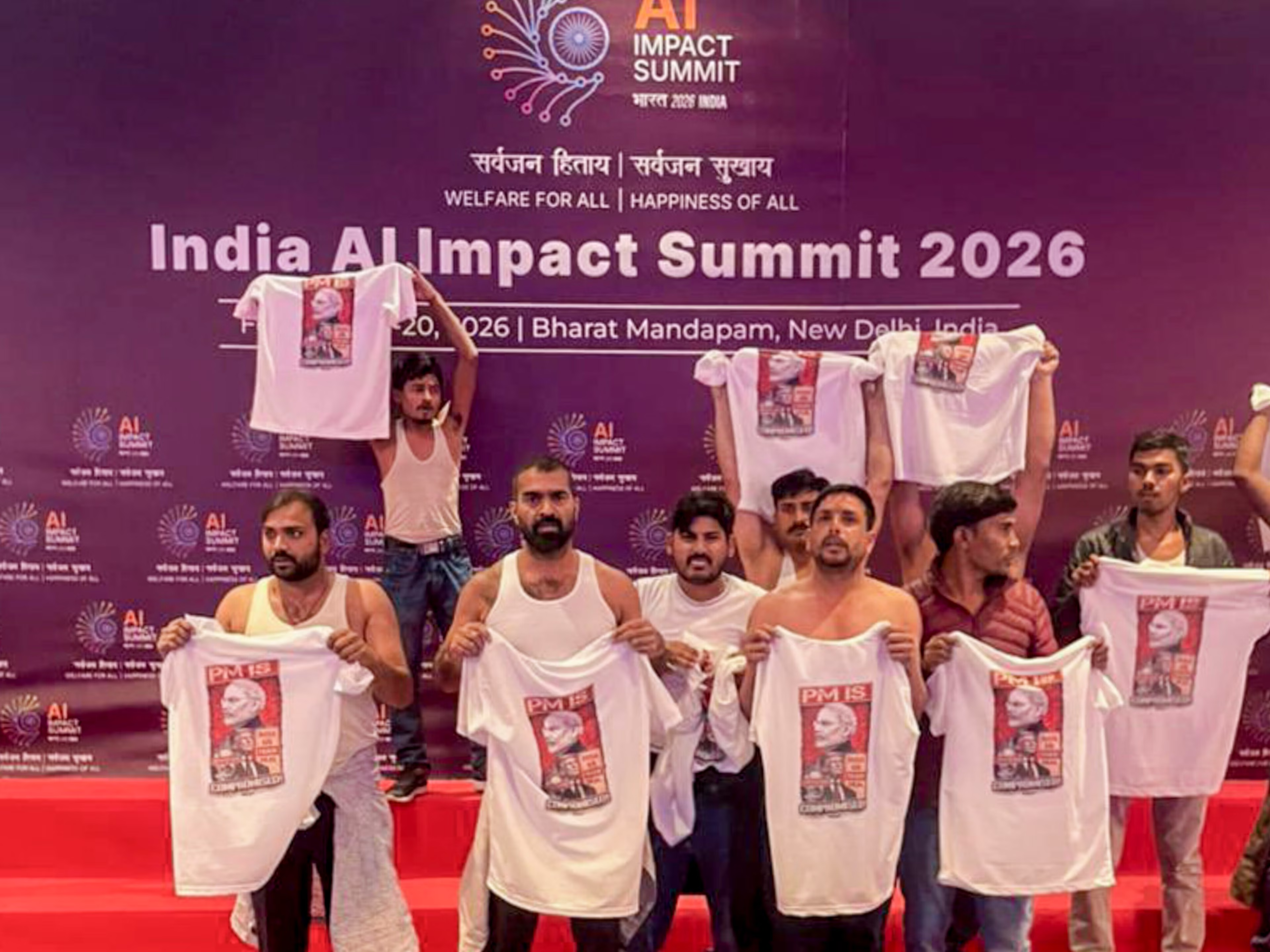
The controversy surrounding the Congress protest at AI summit has rapidly evolved into a wider political debate, extending beyond the immediate spectacle of dissent to deeper questions about political conduct, messaging strategies, and the optics of protest in an international setting. A day after Indian Youth Congress workers staged a topless protest at the Global AI Impact Summit in New Delhi, prominent leaders including Bahujan Samaj Party chief Mayawati and Samajwadi Party leader Akhilesh Yadav expressed strong criticism, describing the episode as inappropriate and damaging to the country’s image.
The incident, occurring at a high-profile international conference attended by delegates from India and abroad, immediately captured public attention. Political protests are neither new nor unusual in India’s democratic framework, yet the form, location, and symbolism of this demonstration have intensified reactions across party lines. The debate is not merely about disagreement with Congress policies or strategies, but about the boundaries of acceptable protest and the intersection of political expression with national representation.
In a country where protest remains a constitutionally protected democratic tool, political actors frequently rely on symbolic gestures to convey dissent. However, the Congress protest at AI summit has sparked reflection on whether certain modes of demonstration risk overshadowing substantive political arguments. When protests occur in globally visible forums, they often acquire layers of interpretation that extend beyond domestic political messaging.
Mayawati and Akhilesh Yadav’s responses reflect not only immediate disapproval but also broader anxieties within opposition politics. Their statements underscore a recurring tension between aggressive political expression and the perceived need to maintain decorum in international contexts. This episode, therefore, serves as a focal point for examining evolving norms of protest, political optics, and inter-party dynamics.
Protest as Political Expression and the Contest Over Public Optics
Political protest has long been embedded within India’s democratic traditions. From mass movements to symbolic demonstrations, dissent remains a defining feature of political engagement. Yet, the effectiveness of protest often depends not only on intent but also on perception. The Congress protest at AI summit illustrates how the form of protest can become as consequential as its underlying message.
Akhilesh Yadav’s remarks encapsulate this tension. While acknowledging political disagreements and asserting that governments can be challenged through institutional and democratic mechanisms, he questioned the appropriateness of disruptive demonstrations that may project an adverse image internationally. His statement suggested that protest strategies must account for contextual sensitivities, particularly when conducted before foreign delegates.
This line of argument reflects a broader debate within democratic politics: the balance between visibility and credibility. Protest is designed to attract attention, disrupt routine narratives, and generate discourse. However, when the method itself becomes the dominant story, the intended political critique may recede into the background. In such scenarios, opponents frequently redirect discussions toward protest ethics rather than substantive grievances.
The Congress protest at AI summit also raises questions about symbolic politics. Symbolic gestures can be powerful tools of communication, capable of condensing complex political dissatisfaction into visually striking acts. Yet symbolism is inherently interpretative. What some view as bold dissent may be perceived by others as indecorous or counterproductive.
Political communication in the contemporary era operates within an environment shaped by media amplification, rapid opinion formation, and heightened sensitivity to visual narratives. Protests staged at international events inevitably become subject to global scrutiny. Images, once circulated, often transcend contextual explanations, shaping perceptions that may not align with protesters’ intentions.
Mayawati’s characterization of the protest as “highly indecent and condemnable” highlights another dimension of the debate: political accountability within opposition spaces. Opposition politics frequently relies on coalition-building and collective credibility. Actions by one constituent group can influence perceptions of broader alliances, even when ideological or strategic differences exist.
This dynamic reflects the interconnected nature of modern political ecosystems. Opposition parties must navigate internal diversity while maintaining coherence in public messaging. Episodes that generate controversy may prompt recalibration of rhetorical positions, particularly when political actors seek to differentiate themselves without fracturing alliances.
The setting of the protest further complicates interpretations. International conferences function not only as policy platforms but also as arenas of diplomatic symbolism. Political events hosted in such spaces often carry implicit expectations of decorum, amplifying reactions to disruptions perceived as inappropriate.
Opposition Dynamics, Political Signaling, and the Politics of Respectability
Beyond immediate reactions, the Congress protest at AI summit has exposed underlying currents within opposition politics. Mayawati and Akhilesh Yadav’s criticism reflects not merely disagreement with protest tactics but also strategic positioning within a competitive political environment.
Opposition alliances often operate within delicate frameworks of cooperation and differentiation. While parties may collaborate electorally, they simultaneously compete for distinct political constituencies. Public responses to controversial episodes frequently become opportunities for signaling ideological boundaries and leadership identity.
Akhilesh Yadav’s remarks emphasized institutional mechanisms of political contestation, framing protest strategies within broader democratic norms. This positioning aligns with efforts to project political maturity, governance-oriented credibility, and rhetorical restraint. In contrast, Mayawati’s sharper critique underscored concerns about national dignity and international perception.
Such responses illustrate how political actors navigate controversies through calibrated language. Criticism of an ally’s actions must balance assertiveness with strategic caution. Excessive alignment risks association with controversy, while excessive distancing risks alliance tensions.
The Congress protest at AI summit also intersects with debates about political respectability. Democratic politics frequently oscillates between confrontational activism and institutional engagement. The politics of respectability often emerges when leaders seek to frame certain forms of protest as legitimate while delegitimizing others perceived as excessive.
Mayawati’s emphasis on preserving the dignity and image of the country reflects this framing. By highlighting the presence of international delegates and the global visibility of the summit, she positioned the protest within a narrative of national representation. This rhetorical approach shifts focus from party politics to broader notions of collective identity.
Political protests conducted in international forums inevitably invite such interpretations. Actions undertaken in globally visible spaces often become proxies for debates about national image, diplomatic norms, and political responsibility. Leaders responding to controversies frequently invoke these themes to reinforce their positions.
The episode further underscores the evolving nature of protest politics in the digital age. Media ecosystems amplify visual narratives, often privileging spectacle over nuance. Political actors must therefore anticipate how actions may be framed, interpreted, and disseminated across audiences.
Within opposition politics, controversies can reshape internal dynamics. Leaders may seek to assert distinct identities, recalibrate messaging strategies, or emphasize alternative modes of political engagement. Public criticism, in such contexts, functions as both commentary and strategic communication.
The Congress protest at AI summit thus becomes emblematic of broader tensions shaping contemporary democratic discourse. It reflects the interplay between protest, perception, political signaling, and the persistent negotiation of legitimacy within competitive political environments.