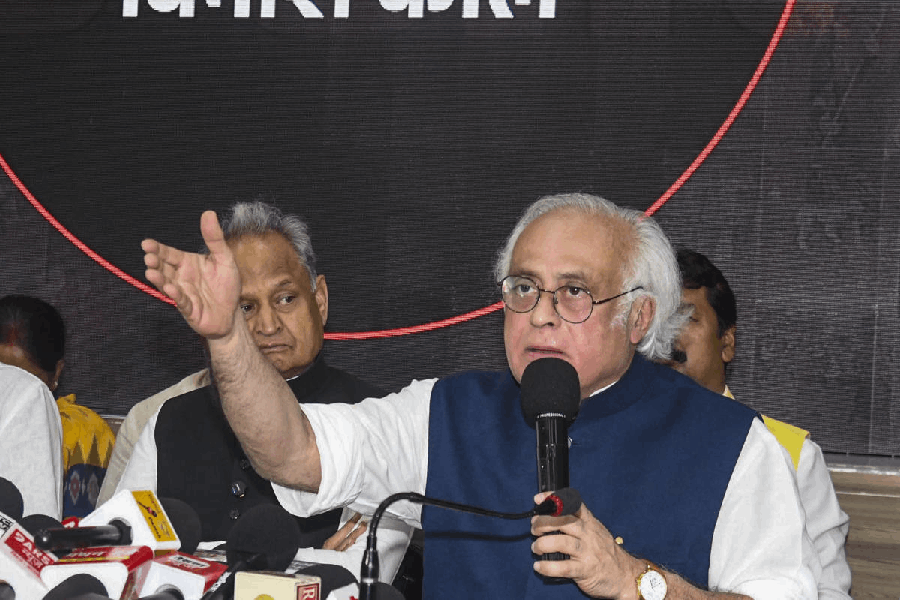
The Indian National Congress has launched a major political and social mobilisation titled the “MGNREGA Bachao Sangram” from Gurdaspur in Punjab, positioning it as a nationwide struggle to protect rural employment guarantees and resist what the party describes as an erosion of workers’ rights under recent policy changes.
Congress frames the campaign as a fight to protect rural livelihoods
The decision to launch the “MGNREGA Bachao Sangram” from Gurdaspur reflects the Congress party’s intent to place rural employment and social security at the centre of national political discourse. The campaign is aimed at mobilising rural workers, farmers, and marginalised communities against what the party alleges is a systematic weakening of the Mahatma Gandhi National Rural Employment Guarantee Act, widely known as MGNREGA. According to Congress leaders, the programme has been a lifeline for millions of rural households by guaranteeing up to 100 days of wage employment and providing a safety net during periods of economic distress.
Senior leaders of the Indian National Congress have stated that the movement will begin in Gurdaspur and gradually expand across Punjab before spreading to other parts of the country. They argue that Punjab, with its strong history of agrarian movements and labour mobilisation, offers an appropriate starting point for a campaign that seeks to defend rural livelihoods and employment security. The choice of Gurdaspur is also symbolic, as the district has a large rural population that has historically depended on public employment schemes during agricultural off-seasons.
Punjab Congress president Amarinder Singh Raja Warring has described the campaign as a people’s movement rather than a conventional political protest. He has emphasised that the objective is to reach villages and blocks directly, engage with workers on the ground, and explain how changes to the rural employment framework could affect their daily lives. According to him, the party intends to take the message door to door, ensuring that rural families understand what is at stake and why collective action is necessary.
Congress leaders claim that the original spirit of MGNREGA lay in its rights-based approach, which legally empowered rural households to demand work and receive compensation if employment was not provided. They argue that recent changes, including the introduction of a new framework under a different name, dilute this legal guarantee and shift the programme away from being a right to becoming a discretionary welfare scheme. In their view, this fundamentally alters the relationship between the state and rural workers, weakening accountability and reducing transparency.
The campaign is expected to involve rallies, village-level meetings, interactions with job card holders, and coordination with grassroots party workers. Congress functionaries have said the focus will not only be on protest but also on listening to rural grievances, collecting feedback, and building a narrative around employment insecurity, delayed wages, and reduced work availability. By framing the movement as a defence of dignity and livelihood, the party hopes to broaden its appeal beyond traditional political supporters.
Former Chhattisgarh chief minister Bhupesh Baghel, who is also the party’s state in-charge for Punjab, is expected to play a key role in the campaign. Baghel has previously positioned himself as a strong advocate of welfare schemes and rural development, and his involvement is being seen as an attempt to give the movement both organisational strength and policy credibility. Party leaders believe that sustained engagement over the coming weeks could turn the campaign into a focal point of opposition politics at the national level.
Political debate, government stance, and broader implications
The launch of the “MGNREGA Bachao Sangram” has intensified political debate around the future of rural employment policy in India. While Congress portrays the campaign as a defence of the poor and vulnerable, the ruling establishment has rejected these claims, arguing that reforms to rural employment schemes are necessary to improve efficiency, transparency, and outcomes. Supporters of the government contend that changes have been introduced to modernise implementation, reduce leakages, and integrate employment generation with broader development goals.
According to critics of the Congress campaign, MGNREGA in its earlier form faced issues such as delayed payments, misuse of funds, and lack of durable asset creation. They argue that restructuring the programme allows for better targeting, technological monitoring, and alignment with long-term rural development strategies. From this perspective, the opposition’s agitation is being framed as resistance to reform rather than a genuine concern for workers.
However, Congress leaders have countered this narrative by pointing to persistent problems faced by workers on the ground, including delayed wages, reduced allocation of funds, and fewer days of work being offered. They argue that instead of addressing these shortcomings through stronger implementation and adequate funding, the government has chosen to alter the legal framework itself. In their view, this weakens the enforceability of employment guarantees and leaves workers more vulnerable to administrative discretion.
The debate has also brought into focus the ideological divide between major political parties on welfare and rights-based legislation. For Congress, MGNREGA represents a cornerstone of social protection policy, one that reflects a commitment to inclusive growth and state responsibility. The party has repeatedly highlighted the scheme’s role during economic crises, including droughts and the pandemic, when it provided crucial income support to rural families. By launching the “MGNREGA Bachao Sangram,” Congress is attempting to reclaim this legacy and position itself as the principal defender of social welfare.
From a broader political perspective, the campaign is also seen as part of Congress’s effort to reconnect with rural voters and rebuild organisational strength at the grassroots level. Punjab, where the party is seeking to regain political ground, offers an opportunity to test the effectiveness of sustained rural mobilisation. Party strategists believe that focusing on employment and livelihood issues can help counter narratives centred on identity politics and shift attention to economic concerns that cut across social groups.
The movement is expected to unfold over several weeks, with planned phases of agitation, outreach, and public engagement. Congress leaders have indicated that the campaign will eventually culminate in a nationwide mobilisation, linking rural struggles across states and regions. By emphasising unity among workers and farmers, the party hopes to create momentum that extends beyond Punjab and influences national policy debate.
Observers note that the outcome of the “MGNREGA Bachao Sangram” will depend on its ability to translate political messaging into tangible mobilisation. While the issue of rural employment resonates widely, sustained engagement and organisational discipline will be crucial in maintaining momentum. The government’s response, both politically and administratively, will also shape how the campaign is perceived by the public.
As the debate continues, the launch of the movement from Gurdaspur has already succeeded in drawing attention to the future of rural employment guarantees in India. Whether it leads to policy reconsideration or primarily serves as a platform for political mobilisation, the campaign underscores the enduring significance of MGNREGA in India’s socio-economic landscape. For millions of rural households, the scheme remains closely tied to questions of survival, dignity, and economic security, making the contest over its future a deeply consequential one.