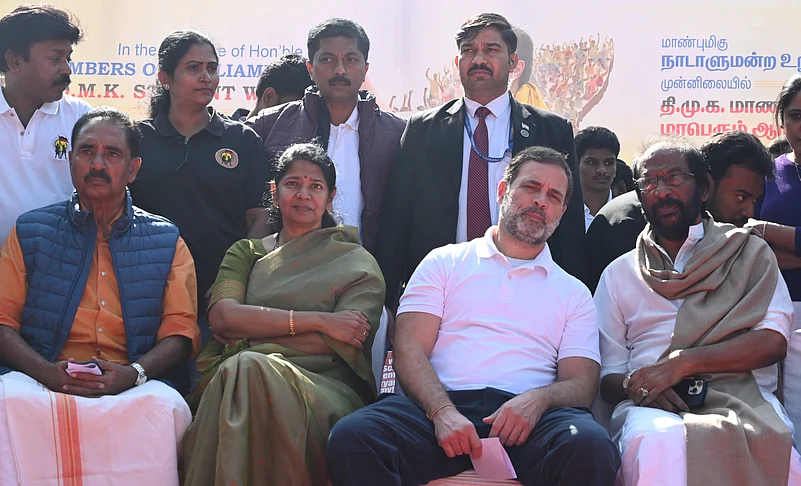
The announcement that Congress-DMK alliance talks will formally begin on February 22 has added fresh intensity to Tamil Nadu’s evolving political landscape, transforming what might otherwise have been a routine pre-election development into a focal point of wider political interpretation. Tamil Nadu Congress Committee president K Selvaperunthagai’s statement did more than merely confirm a negotiation timeline; it became a declaration about opposition unity, electoral arithmetic, political narratives, and the increasingly symbolic importance of alliances in contemporary Indian politics. In a state where coalition politics has long been a defining characteristic, the reaffirmation of cooperation between the Indian National Congress and the Dravida Munnetra Kazhagam is not simply administrative. It carries strategic and psychological implications that ripple across party structures, voter perceptions, and ideological messaging.
Selvaperunthagai’s remarks came at a politically sensitive moment, with Tamil Nadu gradually moving toward another electoral contest that is expected to sharpen debates around governance, identity, welfare, and federal politics. By asserting that the INDIA bloc remains intact, he framed the alliance discussions as part of a larger story about opposition cohesion rather than isolated seat-sharing mechanics. This framing is significant because alliances today function not only as electoral tools but also as symbols of ideological resistance, political stability, and narrative construction.
The emphasis on unity is especially important given the national political environment, where opposition alliances frequently face speculation about internal contradictions, leadership tensions, and ideological divergences. Against this backdrop, the TNCC chief’s insistence that “nothing the BJP is thinking will happen” was as much a rhetorical strategy as it was a political assurance. It signaled a defensive posture aimed at countering perceptions of fragmentation, while simultaneously projecting confidence in the alliance’s durability.
Alliance Politics, Perception Battles, and the Strategic Language of Unity
Tamil Nadu’s political history has long been shaped by alliances that extend beyond conventional party boundaries. Unlike states where political competition often revolves around binary contests, Tamil Nadu’s electoral dynamics frequently involve layered partnerships, negotiated seat allocations, and ideological accommodations. In this context, the Congress-DMK alliance talks are less about novelty and more about continuity, yet the surrounding discourse reveals how even established arrangements can become sites of political contestation.
Selvaperunthagai’s articulation of alliance unity reflects an understanding of the modern political battlefield, where perception can be as influential as policy. The INDIA bloc, by design, is an aggregation of parties with diverse regional priorities and political cultures. Maintaining coherence within such a framework demands constant reaffirmation, especially when rival parties attempt to highlight perceived fissures. The BJP’s alleged attempts to “push someone out of the INDIA alliance to split the vote bank,” as described by Selvaperunthagai, illustrate how alliance stability itself has become a contested narrative.
Political messaging surrounding alliances is rarely neutral. When leaders emphasize unity, they are responding not only to actual tensions but also to anticipated political narratives. In contemporary politics, speculation about alliance breakdowns often precedes tangible developments, creating an environment where reassurance becomes a recurring necessity. Selvaperunthagai’s comments thus functioned both as political communication and strategic signaling.
Equally revealing was his response to actor-politician Vijay’s remark regarding the “SOP in Tamil Nadu.” By dismissing the criticism and stating that similar procedures apply to all parties, Selvaperunthagai sought to depoliticize what could otherwise have become a polarizing controversy. Security protocols, administrative procedures, and event management norms frequently become politically charged topics, particularly when interpreted through the lens of selective enforcement or political bias. By framing SOP compliance as a universal requirement, the TNCC chief positioned the issue within the realm of institutional necessity rather than political grievance.
The reference to Rahul Gandhi’s proposed visit further underscored this point. Selvaperunthagai’s explanation that permissions had been sought and accepted reflected a broader attempt to reinforce procedural legitimacy. In an era where political optics increasingly shape public trust, demonstrating adherence to established norms becomes a defensive strategy against allegations of preferential treatment or institutional conflict.
The Salem accident mentioned by Selvaperunthagai introduced another dimension to the discourse: governance and administrative accountability. Public events, particularly those involving large gatherings, carry inherent risks that often translate into political responsibility. By alleging lapses in arrangements, the TNCC chief subtly redirected the conversation from alliance politics to governance standards, highlighting issues of safety, infrastructure, and administrative diligence.
Such rhetorical shifts are emblematic of how political leaders navigate multi-layered controversies. Rather than allowing debates to remain confined to symbolic clashes or personal remarks, they frequently expand the frame to include governance narratives, public welfare, and institutional efficiency.
Personal Controversies, Political Priorities, and the Contest Over Public Discourse
Selvaperunthagai’s criticism of Tamil Nadu BJP president Nainar Nagendran over remarks involving actors Trisha and Trina reflects a recurring tension in political communication: the boundary between personal commentary and political relevance. In contemporary politics, public discourse often oscillates between governance debates and personality-driven controversies, raising questions about priorities, tone, and the nature of political engagement.
By questioning why personal matters were being raised, Selvaperunthagai implicitly argued for a return to issue-based politics. This stance resonates with broader concerns about the dilution of policy discourse amid sensationalism, social media amplification, and personality-centric narratives. Political leaders frequently leverage public attention through rhetorical provocation, yet such strategies can also invite criticism for diverting focus from substantive governance concerns.
The TNCC chief’s remarks suggest an awareness of this dilemma. By framing personal commentary as unfair and irrelevant, he positioned the Congress as advocating a more policy-oriented discourse. Whether such positioning influences voter perceptions depends on multiple factors, including media framing, public sentiment, and the resonance of competing narratives.
The mention of the Tamil Nadu government’s decision to deposit funds into women’s bank accounts introduces yet another critical element: welfare politics. Tamil Nadu has long been associated with expansive welfare schemes that shape electoral behavior, policy debates, and governance priorities. Direct benefit transfers, social support measures, and targeted financial assistance programs have become central to political competition, reflecting the intersection of economic policy and electoral strategy.
Selvaperunthagai’s observation that the move could positively impact voters underscores the enduring importance of welfare narratives. In states like Tamil Nadu, where governance performance is often evaluated through the lens of social support and public service delivery, welfare measures become both policy instruments and political messaging tools.
The broader political context surrounding the Congress-DMK alliance talks further highlights the evolving nature of coalition politics. Alliances today operate within a media environment characterized by rapid information cycles, amplified controversies, and persistent speculation. Leaders must therefore navigate not only negotiation tables but also perception arenas, ideological narratives, and rhetorical contests.
Selvaperunthagai’s emphasis on unity, procedural legitimacy, governance concerns, and discourse priorities reflects the multi-dimensional nature of modern political communication. Each statement serves multiple functions, addressing immediate controversies while contributing to longer-term narratives about party identity, alliance stability, and electoral strategy.
In Tamil Nadu’s intricate political ecosystem, alliances are rarely static arrangements. They are living constructs shaped by negotiations, recalibrations, and evolving political realities. The Congress-DMK alliance talks beginning on February 22 thus represent more than a scheduling milestone. They are embedded within a broader story about opposition strategy, political symbolism, and the shifting contours of public discourse