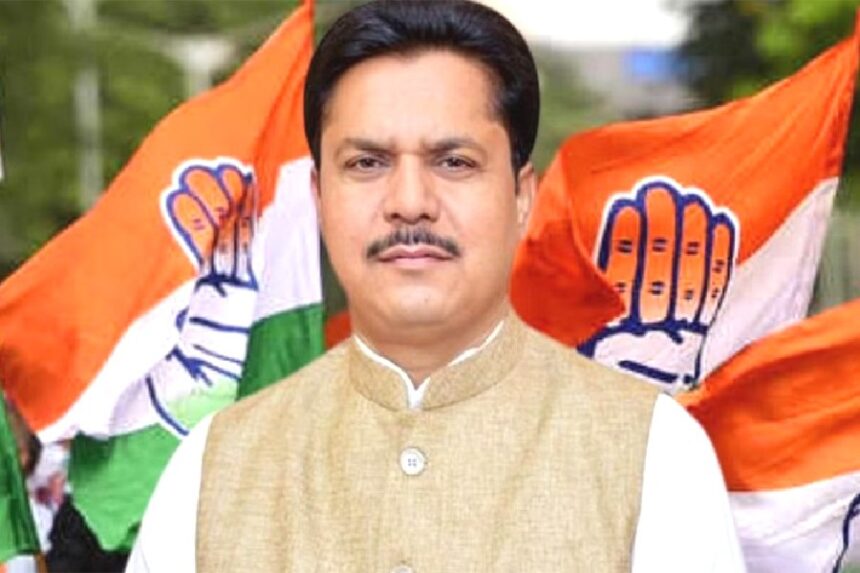
The announcement that Bhupen Kumar Borah will formally join the Bharatiya Janata Party on February 22 has rapidly evolved from a routine political development into a moment of wider significance for Assam’s political landscape. Made public by Chief Minister Himanta Biswa Sarma following his visit to Borah’s residence, the decision carries implications that extend beyond individual political realignment. It speaks to the shifting balance of power in the state, the internal turbulence within the Indian National Congress, and the increasingly fluid nature of political loyalties in contemporary Indian politics.
For weeks, speculation had swirled around Borah’s future after he submitted his resignation. Would he retract his decision under pressure from party leadership, remain politically inactive, or seek a new ideological home? The Chief Minister’s declaration ended that uncertainty, but it simultaneously opened up a broader conversation about the structural and psychological factors driving political exits. When a leader associated with a party for more than three decades chooses to depart, the move inevitably becomes symbolic, inviting scrutiny not only of the individual’s motivations but also of the institution being left behind.
Borah’s departure is particularly noteworthy because it arrives at a politically sensitive moment. Assam, long marked by complex identity politics and evolving electoral dynamics, is approaching another cycle of Assembly elections. In such a context, the movement of a high-profile leader from the opposition to the ruling party is rarely interpreted as a mere career decision. Instead, it becomes part of a larger narrative about ideological shifts, leadership effectiveness, and political survival.
A Defection That Reflects More Than Personal Choice
Political defections are often framed as acts of opportunism, ideological awakening, or strategic necessity. In Borah’s case, the story appears more layered. His public expression of dissatisfaction with how the Congress was being led in Assam suggests that internal party dynamics played a decisive role. By stating that he had apprised the central leadership of his concerns about the party’s future under its current direction, Borah positioned his resignation not as a sudden rupture but as the culmination of growing unease.
This articulation of discontent raises questions that resonate beyond Assam. Opposition parties across India have faced challenges in balancing centralized leadership with regional autonomy. Leaders at the state level frequently grapple with constraints imposed by national strategies, factional rivalries, and leadership hierarchies. Borah’s remarks implicitly reflect this tension, highlighting the friction that can arise when local realities clash with broader organizational frameworks.
Chief Minister Sarma’s characterization of Borah’s entry into the BJP as a “homecoming” is politically astute. The language of return rather than arrival reframes the defection, suggesting continuity rather than rupture. It subtly reinforces the BJP’s narrative of expanding ideological inclusivity while simultaneously projecting the Congress as a party losing its traditional anchors. Such rhetorical positioning is central to modern political communication, where perception often rivals policy in shaping public discourse.
Equally revealing is Sarma’s observation that when a leader leaves after decades of service, the party should introspect about the reasons. This argument, while politically convenient for the ruling party, touches upon a legitimate organizational dilemma. Parties are not static entities; they evolve through leadership transitions, ideological recalibrations, and generational shifts. Yet, excessive turbulence or perceived drift can create disillusionment among long-serving members, especially those who view themselves as custodians of legacy.
Borah’s decision also illustrates the growing pragmatism of political careers. Electoral viability, access to governance structures, and strategic positioning increasingly influence political choices. Sarma’s indication that the BJP would prefer Borah to contest from a “safe seat” underscores the transactional dimension inherent in such transitions. While ideology remains a visible layer of political identity, calculations about winnability and influence are never far beneath the surface.
Congress, Identity, and the Narrative of Erosion
Perhaps the most consequential aspect of this episode lies in the competing narratives it generates about the Congress in Assam. Sarma’s assertion that the party, now left with very few Hindu leaders, is no longer representative of mainstream Assamese society is not merely descriptive; it is strategically constructed. It aims to reshape perceptions of political legitimacy and social alignment.
Identity politics has long been a defining feature of Assam’s electoral landscape. Ethnicity, religion, language, and regional aspirations intersect in complex ways. In this milieu, the portrayal of a party as disconnected from dominant social currents can have tangible electoral consequences. Borah’s exit thus becomes ammunition in a broader ideological contest over representation and belonging.
At the same time, it is essential to approach such claims with analytical caution. Political identities are rarely monolithic, and voter behavior often defies simplistic categorizations. Yet, narratives—accurate or otherwise—play a powerful role in shaping political momentum. If the perception of erosion gains traction, it can influence both voter confidence and internal party morale.
Borah’s trajectory also echoes a familiar pattern in Assam’s recent political history. Sarma himself, once a prominent Congress leader, left the party in 2015 after falling out with then Chief Minister Tarun Gogoi. His subsequent rise within the BJP exemplifies how political realignments can redefine careers and alter state-level power equations. The parallel between the two leaders’ journeys is unlikely to be lost on observers.
The Congress leadership’s attempt, reportedly involving figures such as Rahul Gandhi, to persuade Borah to reconsider his resignation highlights another recurring challenge: retaining experienced leaders amid shifting political tides. Such interventions, while demonstrating organizational concern, can also inadvertently signal vulnerability if they fail to produce desired outcomes.
Beyond individual personalities, Borah’s defection contributes to a deeper debate about the Congress’s evolving identity. Once the dominant political force in many states, the party has struggled to adapt to changing electoral realities. Questions about ideological clarity, leadership renewal, and organizational coherence have become central themes in political commentary.
In Assam, these challenges intersect with regional complexities. The BJP’s consolidation of power, combined with its ability to attract leaders from rival parties, has reshaped competitive dynamics. Each high-profile defection reinforces the narrative of momentum, creating a feedback loop in which perceived strength attracts further alignments.
For Borah, the move to the BJP may represent a strategic recalibration aimed at sustaining political relevance. For the Congress, it represents another moment demanding introspection. Political parties, like individuals, are judged not only by victories but also by how they respond to setbacks and transitions.
The broader electorate, meanwhile, observes these developments through the lens of governance expectations, identity affiliations, and policy priorities. Defections may generate headlines, but their ultimate significance is measured by how they influence political behavior, institutional stability, and public trust.