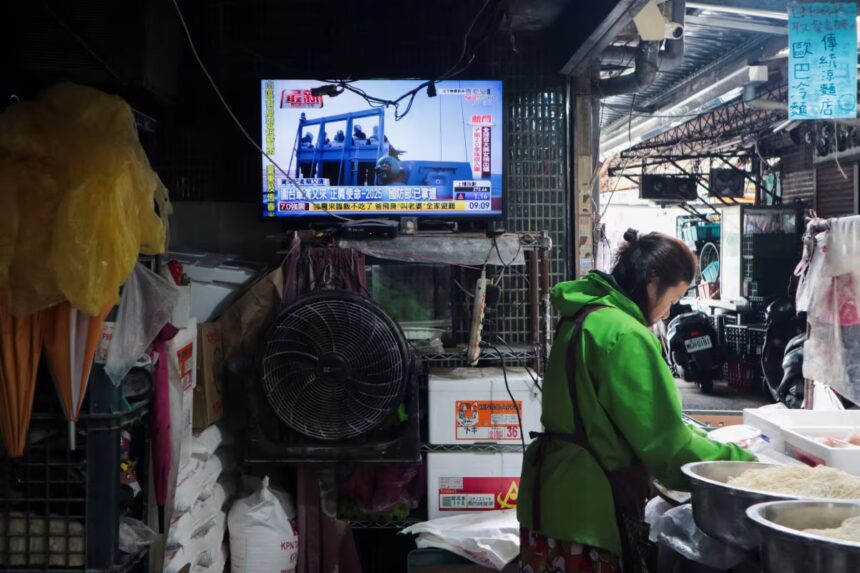
China has launched large-scale military exercises encircling Taiwan, sharply escalating regional tensions and underscoring Beijing’s anger over a major United States arms deal with the self-governing island. The drills, announced as a serious warning against Taiwanese independence and external interference, come at a time of heightened geopolitical friction in the Indo-Pacific and growing concerns about stability in the Taiwan Strait.
China intensifies military pressure with justice mission 2025 drills
The latest round of exercises, officially named Justice Mission 2025, marks one of the most expansive military mobilisations China has carried out around Taiwan in recent years. According to statements from the Eastern Theater Command of the People’s Liberation Army, the drills involve coordinated deployments of army, navy, air force and rocket units, testing combat readiness and simulating blockade and control of key ports and strategic areas.
Live-fire activities have been planned across multiple maritime and airspace zones surrounding the island, creating a near-encirclement that analysts say closely resembles scenarios designed to cut Taiwan off from external military support. In the 24 hours following the start of the drills, Taiwan’s defence ministry reported that China had deployed 130 military aircraft and 22 naval vessels around the island, with a significant number of aircraft crossing the median line of the Taiwan Strait, an informal boundary that Beijing no longer recognises.
Taiwan’s military responded by scrambling fighter jets, deploying naval assets and activating coastal missile systems, while maintaining that it remained fully on guard. Officials in Taipei condemned the exercises as military intimidation, arguing that such actions undermine regional security and threaten the status quo in the Indo-Pacific.
The drills reflect a pattern Beijing has increasingly adopted in recent years, using large-scale military manoeuvres to signal displeasure at political developments involving Taiwan. Simulated blockades, amphibious operations and denial of access to foreign forces have become recurring features, blurring the line between exercises and preparations for potential conflict.
Chinese state media amplified the message domestically with nationalistic imagery and videos, including computer-generated footage depicting advanced weapons systems and futuristic combat scenarios aimed at thwarting what Beijing describes as separatist forces. Analysts note that such messaging is designed not only to intimidate Taiwan but also to reinforce domestic support for the Communist Party’s stance on sovereignty.
China’s leadership maintains that Taiwan is an inseparable part of its territory, despite the island having been self-governed for decades. Beijing has repeatedly vowed to bring Taiwan under its control, by force if necessary, framing military pressure as a legitimate measure to safeguard national unity. Statements from military and defence ministry spokespersons during the drills explicitly warned external powers against what China calls the illusion of using Taiwan to contain China.
United states arms deal and widening regional fallout
The timing of the exercises has drawn particular attention due to their close proximity to the announcement of what could become one of the largest arms deals between the United States and Taiwan. The package, valued at approximately 11.1 billion dollars, includes advanced rocket systems, anti-tank and anti-armor missiles, loitering drones, howitzers and military software, significantly enhancing Taiwan’s defensive capabilities.
Washington, while recognising the People’s Republic of China as the sole legitimate government of China, maintains close unofficial relations with Taipei and is legally bound to provide the island with the means to defend itself. United States officials have long described such arms sales as defensive in nature, aimed at deterring aggression rather than provoking conflict.
Beijing, however, has reacted with fury, accusing Washington of infringing on China’s sovereignty and emboldening pro-independence forces in Taiwan. Chinese officials have described the arms deal as collusive action between the United States and Taiwan, warning that such moves cross red lines in bilateral relations.
Taiwan’s President Lai Ching-te, who has pledged to maintain the status quo while defending the island’s democracy, said China’s repeated military pressure falls far short of what is expected of a responsible major power. His administration has argued that strengthening Taiwan’s defences is a necessary response to the growing frequency and scale of Chinese military activities around the island.
The drills have also had immediate civilian and economic impacts. Taiwan’s Civil Aviation Administration said more than 100,000 travellers could be affected, with hundreds of international flights disrupted and dozens of domestic flights cancelled due to airspace restrictions imposed during the exercises. Maritime routes near strategically important outlying islands such as Kinmen and Matsu have also been affected, raising concerns about the potential for miscalculation in heavily trafficked waters.
The ripple effects extend beyond the Taiwan Strait. Relations between China and Japan have become increasingly strained following remarks by Japan’s prime minister suggesting Tokyo could respond militarily if China attempted to seize Taiwan by force. Beijing has responded with diplomatic and economic pressure, further heightening regional anxieties.
In Washington, President Donald Trump downplayed concerns about the drills, citing his relationship with Chinese leader Xi Jinping and expressing confidence that China would not move toward an invasion. Nevertheless, security analysts warn that the growing complexity and realism of China’s exercises increase the risk of escalation, particularly if foreign forces are drawn into the vicinity.
Experts observing the drills say the emphasis on denying intervention is especially significant. By practicing control over sea and air routes and simulating blockades, the People’s Liberation Army appears to be refining strategies aimed at preventing the United States and its allies from accessing the area in the event of a conflict. Such capabilities would be central to any attempt to coerce Taiwan without immediately resorting to a full-scale invasion.
As Taiwan continues to ramp up defence spending, including a proposed historic special defence budget that remains stalled in its legislature, the strategic contest around the island shows no signs of easing. With Chinese aircraft and ships now operating near Taiwan almost daily, and major powers increasingly drawn into the dispute, the Taiwan Strait remains one of the world’s most volatile flashpoints.