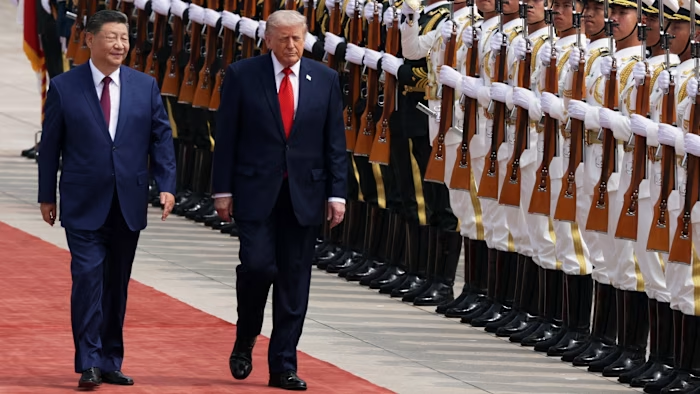
The decision by China to skip the upcoming BRICS Foreign Ministers’ meeting in New Delhi has triggered widespread diplomatic speculation, especially as the development coincides with U.S. President Donald Trump visiting Beijing for high-level talks with Chinese President Xi Jinping. The absence of Chinese Foreign Minister Wang Yi from the important multilateral gathering has drawn attention from geopolitical observers across the world, with analysts questioning whether the timing reflects shifting strategic priorities within Beijing’s foreign policy framework.
China’s Foreign Ministry confirmed that Wang Yi would not attend the BRICS Foreign Ministers’ meeting scheduled in New Delhi on May 14 and 15, citing “scheduling reasons.” Instead, China will be represented by its Ambassador to India, Xu Feihong. While Beijing insisted that the move should not be interpreted negatively, the timing of the announcement has intensified international debate due to its overlap with Donald Trump’s official trip to China.
The BRICS grouping — comprising Brazil, Russia, India, China, and South Africa along with newly inducted members — has increasingly emerged as a major platform for discussions on global economic reforms, trade cooperation, and geopolitical balance. India, which currently chairs the grouping, had hoped for strong participation from all member nations at the ministerial-level discussions in New Delhi.
China’s absence at the top diplomatic level, however, has shifted the focus away from the summit agenda and toward the broader geopolitical implications of Beijing’s diplomatic scheduling.
Trump’s China Visit Overshadows BRICS Diplomacy
The timing of the BRICS meeting coinciding with Donald Trump’s Beijing visit has become one of the most discussed aspects of the development. Trump is scheduled to arrive in the Chinese capital a day before the BRICS gathering begins, with expectations that trade tensions, Taiwan, technology restrictions, and strategic competition will dominate discussions between Washington and Beijing.
Political analysts believe China may have prioritized direct engagement with the United States over multilateral diplomacy at a time when global power alignments are rapidly evolving. Although the Chinese Foreign Ministry publicly denied any political message behind Wang Yi’s absence, observers note that major diplomatic decisions are rarely detached from broader strategic calculations.
The Trump-Xi meeting is expected to carry enormous global significance. Relations between the United States and China have remained tense over issues including semiconductor controls, Indo-Pacific security, military presence near Taiwan, and trade disputes. Trump’s visit is viewed as an attempt to stabilize ties while simultaneously asserting American strategic interests in Asia.
Against this backdrop, Beijing’s decision to keep its foreign minister focused on bilateral diplomacy with Washington instead of attending a multilateral forum in India has fueled interpretations that China currently considers U.S.-China engagement more urgent than BRICS coordination.
Diplomatic experts say the symbolism matters. BRICS has long been projected by member nations as an alternative voice to Western-led institutions. Therefore, the absence of one of the group’s most influential members at a high-level meeting inevitably raises questions about internal priorities and cohesion.
India Pushes Ahead With BRICS Leadership Agenda
Despite the diplomatic buzz surrounding China’s decision, India appears determined to maintain focus on the objectives of the BRICS meeting. Under the leadership of External Affairs Minister S. Jaishankar, New Delhi is expected to emphasize economic cooperation, supply chain resilience, digital governance, climate financing, and Global South representation during the discussions.
India has actively positioned itself as a bridge between emerging economies and developed nations, particularly at a time when geopolitical tensions continue reshaping international alliances. Officials familiar with the preparations indicated that India remains committed to ensuring a productive and outcome-oriented BRICS summit despite the absence of Wang Yi.
The Chinese Foreign Ministry also attempted to strike a cooperative tone in its statement, saying Beijing was ready to work with all BRICS members and support India in its role as Chair. Such messaging appears aimed at preventing diplomatic speculation from escalating into perceptions of bilateral strain between India and China.
However, analysts note that India-China relations remain complex despite efforts to stabilize ties in recent years. Border tensions, economic competition, and strategic rivalry in the Indo-Pacific continue to influence interactions between the two Asian giants. At the same time, both nations recognize the importance of maintaining engagement through platforms like BRICS and the Shanghai Cooperation Organisation.
India’s diplomatic strategy during the BRICS chairmanship has focused heavily on strengthening the voice of developing economies amid growing global uncertainty. New Delhi has also attempted to push discussions on reforming international financial institutions and creating fairer mechanisms for trade and development financing.
The absence of China’s foreign minister may not derail the summit, but it undeniably changes the optics of the gathering at a time when BRICS seeks to project unity and collective influence.
Global Reactions and Strategic Implications
International reactions to the development have been mixed. Some experts see the absence as a routine scheduling issue amplified by geopolitical sensitivities, while others interpret it as a subtle diplomatic signal reflecting China’s current foreign policy priorities.
Several geopolitical analysts argue that Beijing is carefully balancing multiple diplomatic fronts simultaneously. On one side, China aims to preserve strategic partnerships within BRICS and the Global South. On the other, it must manage increasingly complicated relations with the United States, which continue to shape global economic and security dynamics.
Trump’s return to high-profile diplomacy has added another layer of complexity. His visit to Beijing is expected to generate global headlines, particularly because of his strong rhetoric on trade, tariffs, and strategic competition with China during previous political campaigns and presidencies.
The Taiwan issue is also expected to remain central during Trump’s discussions with Xi Jinping. Chinese leadership has repeatedly described Taiwan as a core national interest, warning against foreign interference. Reports ahead of the summit suggested Beijing planned to emphasize red lines concerning Taiwan, regional military deployments, and technology-related restrictions.
As these developments unfold, BRICS countries are simultaneously attempting to deepen cooperation on financial systems, local currency trade, and economic multipolarity. The contrast between China’s focus on bilateral engagement with Washington and the multilateral aspirations of BRICS has therefore become a major talking point among observers.
Diplomatic insiders believe the long-term impact on BRICS unity may ultimately depend on how actively China participates in future initiatives under India’s chairmanship. Beijing remains a critical economic pillar within the bloc, and its role continues to influence the direction and credibility of BRICS on the global stage.
Meanwhile, India is likely to use the summit as an opportunity to reinforce its growing international stature. Over the past few years, New Delhi has increasingly emerged as a key diplomatic actor capable of engaging with both Western powers and emerging economies. Hosting major international events and leading multilateral discussions has strengthened India’s image as an influential voice in global governance.
BRICS at a Turning Point
The current moment also reflects a broader transition within BRICS itself. Originally established as an economic grouping of emerging markets, the bloc has gradually evolved into a platform for discussing strategic, political, and developmental issues affecting the Global South.
Recent expansion efforts and growing interest from multiple countries in joining BRICS indicate that the organization is seeking greater geopolitical relevance. However, managing internal differences among members remains a persistent challenge.
China and India, despite sharing interests in economic development and multipolarity, continue to maintain competing regional ambitions. Russia’s geopolitical confrontation with Western nations has also altered the strategic context within which BRICS operates.
Against this backdrop, high-level participation at summits carries symbolic importance. Diplomatic representation often reflects political messaging, strategic priorities, and international alignment calculations. Therefore, Wang Yi’s absence has naturally generated intense discussion within diplomatic circles.
Still, experts caution against overinterpreting the move. They note that international diplomacy frequently involves overlapping schedules and competing strategic commitments. China’s statement supporting India’s BRICS chairmanship suggests Beijing is attempting to avoid perceptions of division within the grouping.
The coming days will likely reveal whether the issue remains a temporary diplomatic headline or evolves into a broader debate about BRICS cohesion and China’s geopolitical priorities.
As New Delhi hosts the crucial ministerial discussions, attention will remain divided between the BRICS summit halls and the parallel high-stakes diplomacy unfolding in Beijing between Donald Trump and Xi Jinping. Together, these events underscore the rapidly shifting landscape of global politics, where strategic partnerships, economic competition, and diplomatic symbolism increasingly intersect.