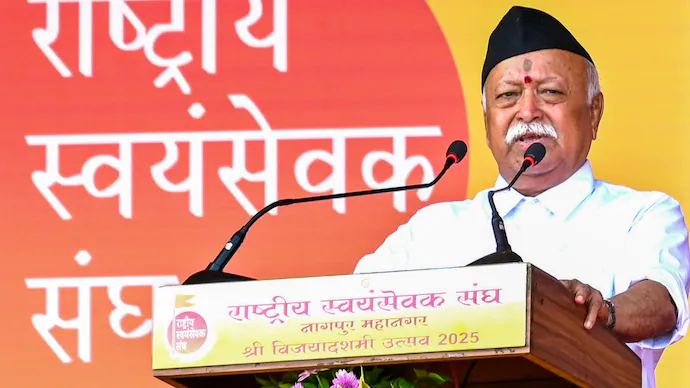
Rashtriya Swayamsevak Sangh chief Mohan Bhagwat, during an address in Manipur, argued that Hindu civilisation forms the spiritual and cultural foundation of the world, asserting that the world’s continuity is tied to the survival of Hindu society. His remarks, delivered during his first visit to the state since ethnic clashes escalated last year, also highlighted India’s enduring civilisational strength, national self-reliance and the need for societal unity to counter long-standing challenges.
Bhagwat positions Hindu civilisation as globally enduring while contrasting India with vanished ancient empires
Speaking to a large gathering, Bhagwat emphasised that Hindu civilisation possesses a unique internal strength that has enabled it to survive when other great cultures collapsed. He noted that ancient societies such as Greece, Egypt and Rome—once dominant across vast regions—eventually disappeared from the world stage, whereas India’s civilisational identity has remained intact for thousands of years. His assertion that “without Hindus, the world will cease to exist” became the most striking statement of his address, underscoring his belief that Hindu society functions not only as a cultural identity but as a global custodian of dharma and moral order.
He explained that India’s survival through invasions, political shifts and social upheavals was not accidental. According to him, the country preserved its civilisational memory because society embedded its principles into community life rather than limiting them to institutions. He described Bharat as an “immortal civilisation,” bound together by cultural, spiritual and social networks capable of withstanding threats across centuries. This network, he said, ensures that the Hindu community continues to exist, regardless of external challenges.
During his address, he also referenced earlier statements in which he had argued that every Indian, regardless of religion, shared deep ancestral roots. He reiterated that Muslims and Christians in India too descended from the same civilisational heritage, and therefore belonged to a broader cultural family. This framing, he said, was necessary to restore a sense of unity in a country often fragmented by political and social divisions.
His visit to Manipur added significance to his remarks. The state has experienced prolonged conflict following ethnic clashes between communities, prompting national concern. Bhagwat urged people to look at local disputes not as isolated events but as challenges to a long-standing cultural fabric that has historically held Indian society together. He reiterated that Hindu society’s strength came from its ability to adapt, absorb and rebuild, even when faced with adversity.
Bhagwat’s narrative linked India’s modern struggles back to civilisational continuity. He argued that while external threats and internal tensions have persisted across centuries, the core principles of the civilisation have allowed it to live through imperial domination, political restructuring and social transformations. To him, the endurance of Hindu society is proof that it plays a foundational role in the world’s spiritual and moral balance.
RSS chief emphasizes national self-reliance, economic strength and societal resolve as essential for India’s future
Transitioning from civilisational philosophy to contemporary challenges, Bhagwat stressed the need for India to become completely self-reliant. He described economic independence as the starting point of national strength, asserting that no country can secure its future if it depends heavily on foreign economies or global markets. His remarks came at a time when India is re-evaluating its economic strategies after steep tariffs imposed by foreign governments, especially the United States under President Donald Trump.
Bhagwat argued that the idea of “superiority” is often mistaken for domination, but for India, superiority must mean self-sufficiency. He said that the country’s economy, military capability and knowledge ecosystem have to be strong enough to stand independently. According to him, building national strength begins with economic power, but must be supported equally by intellectual capacity and security preparedness.
To reinforce his point, he offered historical examples of how societal willpower shaped outcomes. He cited the decline of Naxalism, stating that the movement weakened not solely because of state action but because society collectively decided it would no longer tolerate armed extremism. He argued that societal determination partnered with state efforts to reduce the movement’s influence across regions where it once dominated.
He also referenced India’s long struggle for independence from British rule. The British empire, he said, was once described as so vast that “the sun never set” on it, yet its authority began eroding in India long before other parts of the world. For ninety years, he said, Indians sustained the fight through unity, resilience and moral conviction. Even when the freedom movement weakened at times, it was never extinguished because the society refused to let the aspiration for independence die.
Bhagwat framed these examples as evidence that India’s greatest strength lies not in external support but in internal resolve. He urged citizens to recognise that cultural continuity, economic autonomy and social cohesion were interconnected pillars of national progress. He also highlighted that India’s future depends on reaffirming its cultural identity while embracing modern capacities and strategic independence.
His address in Manipur ended with an appeal to strengthen societal bonds, revive collective responsibility and build a self-reliant structure capable of withstanding global and domestic challenges. The speech reflected the RSS narrative that India’s civilisational identity should guide its political, economic and social choices.