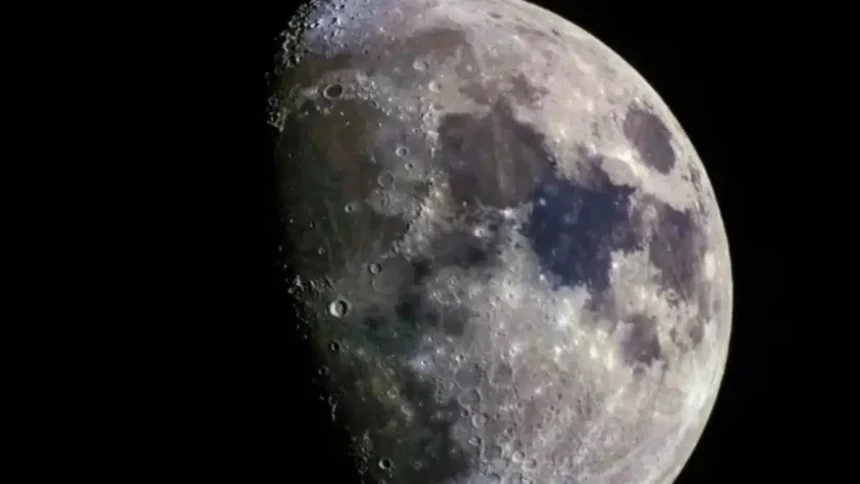
A new study based on data from India’s Chandrayaan-3 mission suggests that ice may be present beneath the Moon’s surface at more locations than previously believed, particularly in the polar regions. The findings, published in the journal Communications Earth and Environment, indicate that variations in surface temperatures could directly impact ice formation and distribution, potentially offering valuable insights into the Moon’s geological history.
Lead researcher Durga Prasad Karanam, a faculty member at the Physical Research Laboratory in Ahmedabad, explained that analyzing these ice deposits could provide crucial information about their origin and evolution. He noted that studying how ice has accumulated and moved over time could shed light on the Moon’s early geologic processes.
The Chandrayaan-3 mission, launched by the Indian Space Research Organisation (ISRO) from Bengaluru, successfully landed near the Moon’s south pole on August 23, 2023. The historic landing site was later named ‘Shiv Shakti Point.’ As part of the study, researchers examined temperature variations at depths of up to 10 centimeters beneath the lunar surface, using data collected by the ‘ChaSTE’ probe aboard the Vikram lander.
Their analysis revealed significant temperature fluctuations at the landing site, which was located on a sunlit slope angled at six degrees. During the day, temperatures peaked at approximately 82°C but plunged to around -170°C at night. Interestingly, a flat surface located just one meter away from the landing point recorded a lower peak temperature of 60°C. This difference, the researchers noted, was due to the slope’s angle, which resulted in increased solar radiation exposure at the ChaSTE penetration point.
To further explore the relationship between slope angles and surface temperatures, the team developed a model predicting ice accumulation in high-latitude lunar regions. According to their findings, slopes facing away from the Sun and toward the Moon’s nearest pole—at an inclination greater than 14 degrees—could maintain temperatures low enough for ice to remain close to the surface.
These conditions closely resemble those of the proposed landing sites for NASA’s Artemis mission, which aims to send humans to the Moon’s south pole. The researchers suggested that there might be multiple locations where ice could form and be more easily accessible than previously thought.
Addressing the possibility of liquid water on the Moon, Karanam explained that the absence of atmospheric pressure prevents water from existing in liquid form. Instead, ice would sublimate directly into vapor under lunar conditions. He added that while the Moon may never have supported habitable conditions, ice remains a crucial resource for future exploration and long-term lunar habitation.
The study emphasized the need for further measurements and technological advancements to extract and utilize lunar ice effectively. The researchers concluded that ChaSTE’s findings highlight the potential for water-ice scouting, resource prospecting, and human settlement in high-latitude lunar regions. These sites, they noted, not only hold scientific significance but also pose fewer technical challenges for exploration compared to areas closer to the Moon’s poles.