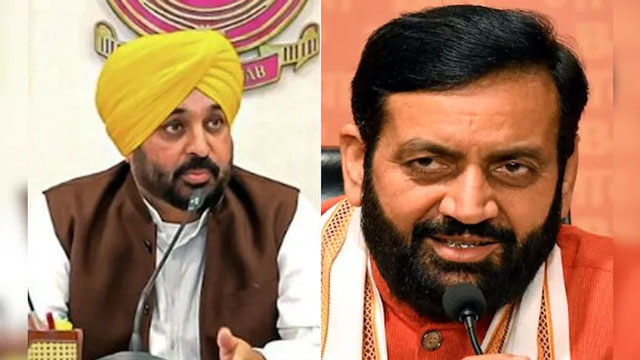
The recent suspension of the Indus Water Treaty by the Centre has intensified discussions around water sharing between Punjab and Haryana, with Punjab Chief Minister Bhagwant Mann urging the Centre to utilise this opportunity to address the state’s severe water crisis while exploring alternative solutions to the contentious Sutlej-Yamuna Link (SYL) canal dispute. In a meeting with Haryana Chief Minister Nayab Saini, Mann proposed a Yamuna-Sutlej Link (YSL) canal, arguing it could provide a more sustainable resolution to the decades-old water-sharing conflict between the two states.
Punjab, grappling with alarming groundwater depletion, views the Centre’s move to suspend the Indus Water Treaty with Pakistan as an opportunity to redirect water from the western rivers within Indian territory to meet the needs of its farmers and residents. Mann stressed that Punjab must be prioritised in any new strategy involving the usage, diversion, or allocation of river waters, especially as the state’s groundwater crisis worsens.
Punjab proposes YSL canal as alternative
During the high-level meeting convened by Union Jal Shakti Minister C R Patil, Mann presented the idea of constructing the Yamuna-Sutlej Link (YSL) canal in place of the SYL canal, stating, “Haryana and Punjab are like brothers. This fight should end now. There has always been politics over this matter. Both states have been fighting for just 2 MAF (million acre-feet) water, but if the canal comes from Kashmir, we will get 23 MAF water.”
The SYL canal, conceptualised under the 1981 water-sharing agreement following Haryana’s separation from Punjab in 1966, aimed to allocate river water between the two states by building a 214 km canal, with 122 km in Punjab and 92 km in Haryana. However, the Punjab Termination of Agreement Act of 2004 attempted to cancel this agreement, leading to a prolonged legal battle, with the Supreme Court ruling in favour of Haryana in 2002 and rejecting Punjab’s challenge in 2004.
Mann reiterated during the meeting that Punjab has no surplus water to share with any other state and that the SYL issue is deeply emotive for the people of Punjab. He warned of serious law and order concerns should the issue escalate, highlighting that most of Punjab’s blocks are overexploited, with the state on the brink of a groundwater catastrophe.
Haryana calls for resolution, BJP faces criticism
Haryana Chief Minister Nayab Saini described the meeting as cordial and meaningful, noting that Mann agreed the issue should be resolved, as it has remained pending for decades. Saini echoed Mann’s sentiment on the states being like brothers, expressing hope that the next meeting, scheduled for August 5, will yield constructive outcomes.
Meanwhile, former Haryana Chief Minister Bhupinder Singh Hooda criticised the BJP-led Centre, stating that the Supreme Court had given the responsibility to the central government to secure Haryana’s share of water and that, with the BJP in power in both Haryana and the Centre, Haryana should have already received its due share. Hooda accused the BJP of adopting an anti-Haryana stance and urged the Centre to file a contempt of court petition to expedite the resolution of the water-sharing dispute.
Indian National Lok Dal MLA Arjun Chautala also criticised Mann, accusing him of politicising the water-sharing issue. Chautala emphasised that water is a national resource, not the property of any single state, and declared that the SYL canal is Haryana’s lifeline, demanding the Centre ensure Haryana receives its rightful share of water.
The meeting was attended by Union Secretary Debashree Mukherjee, Haryana Chief Secretary Anurag Rastogi, and Additional Chief Secretary of Irrigation and Water Resources Department Anurag Aggarwal, along with senior officials from the Irrigation Department, reflecting the significance the Centre has placed on resolving the dispute under the current circumstances.
As Punjab pushes for the potential of using suspended Indus water resources and explores alternatives like the YSL canal, the water-sharing dispute with Haryana remains a critical issue that could shape the future of water governance and interstate relations in northern India.