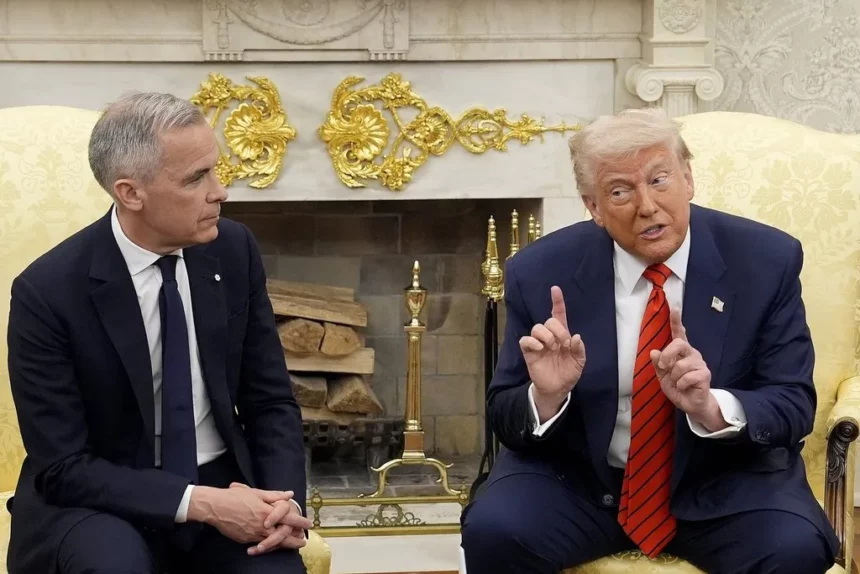
Canada is bracing for an economic jolt after US President Donald Trump announced a 35% tariff on Canadian imports starting August 1, citing trade imbalances and fentanyl flow concerns. Canadian Prime Minister Mark Carney responded firmly, asserting that his government will continue defending Canadian workers and businesses while working with the US on shared challenges, including curbing fentanyl trafficking in North America.
Carney took to X to reaffirm Canada’s commitment to safeguarding its economic interests amid the escalating trade tension with its largest trading partner. In his statement, Carney emphasised that Canada has made critical progress in stopping the spread of fentanyl and remains committed to collaborating with the US to protect communities on both sides of the border. “Throughout the current trade negotiations with the United States, the Canadian government has steadfastly defended our workers and businesses. We will continue to do so as we work towards the revised deadline of August 1,” Carney stated.
Trade Standoff Amid Fentanyl Crisis
The sharp tariff move from Washington came in a letter addressed directly to Carney, marking the latest in a series of similar communications sent to multiple trading partners since Monday. Trump has framed the tariff as necessary due to Canada’s trade practices, which he claims have contributed to the United States’ unsustainable trade deficit. He also tied the measure to the ongoing fentanyl crisis, criticising Canada for its role in the flow of the drug into the US.
While Trump’s letter signals a hardening stance on trade, the extension of the deadline from July 9 to August 1 indicates a potential window for further negotiations. Trump has been using tariffs as leverage in ongoing trade talks, with Canada now facing the brunt of this policy push just weeks before the deadline.
Building Economic Resilience
Carney highlighted that despite the escalating trade tensions, Canada remains focused on strengthening its economy and diversifying trade partnerships globally. “We are building Canada strong. The federal government, provinces, and territories are making significant progress in building one Canadian economy. We are poised to build a series of major new projects in the national interest. We are strengthening our trading partnerships throughout the world,” Carney shared in his post.
Canadian officials believe that a robust domestic economy will be crucial in weathering the impact of the impending tariff, while also preparing for possible retaliatory measures if negotiations do not lead to a resolution before the August 1 implementation date. Businesses across Canada are expected to brace for potential disruptions in supply chains and export markets, with several trade analysts warning that the tariffs could escalate into a broader trade dispute if not managed carefully.
The decision to impose a 35% tariff on Canadian goods has also sparked concerns within business communities in both countries, as Canada is a significant trading partner for the US. Industry groups have urged both governments to resolve the dispute swiftly to prevent further economic damage and uncertainty that could affect cross-border investments and jobs.
As the deadline approaches, Canada will need to navigate carefully between defending its economic interests and maintaining its critical relationship with the United States, with the stakes high for businesses and workers on both sides of the border.