In a haunting revelation timed with the 40th anniversary of the Air India Kanishka bombing, Canada’s Royal Canadian Mounted Police (RCMP) has confirmed the identity of the mysterious ‘Mr X’—a man long suspected of testing a bomb that would later kill 329 people onboard Air India Flight 182. While the RCMP did not publicly disclose the name due to privacy laws, the revelation marks a key development in one of the most devastating terrorist attacks in aviation history. Shockingly, the man died without ever facing any charges.
Tracing Mr X and the Final Days Before the Attack
Mr X was identified as one of the three men who tested an improvised explosive device (IED) in the woods of Duncan, British Columbia, just weeks before the bombing on June 23, 1985. He had traveled there with Talwinder Singh Parmar, a known Khalistani extremist and the mastermind behind the plot. The duo met with Inderjit Singh Reyat, an electrician who was later convicted of building the bomb.
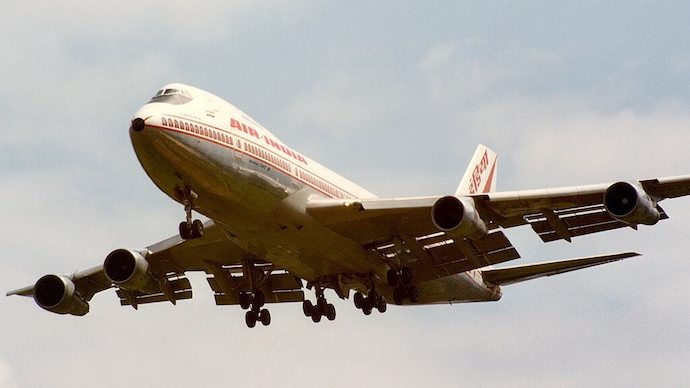
Canadian Security Intelligence Service (CSIS) agents were monitoring the group and even heard the explosion during the bomb test. However, they mistook the sound for gunfire and failed to act, a critical lapse in the lead-up to the tragedy. The attack, carried out by Khalistani terrorists, involved planting a bomb on Air India Flight 182, which exploded midair off the coast of Ireland, killing everyone on board.
The aircraft was en route from Montreal to Mumbai with a stopover in London. Most of the victims were Canadians of Indian origin. To date, the bombing remains the deadliest act of terrorism in Canadian history.
Delayed Justice and Lingering Questions
RCMP Assistant Commissioner David Teboul revealed the long-awaited identification of Mr X at a memorial service for the victims in British Columbia. Though the case saw two key suspects acquitted in 2005, RCMP investigators continued to pursue the case to resolve what they described as “loose ends.”
Despite the identification of Mr X, justice was never served in his case. He died recently, having never faced charges. Investigators had struggled for decades to confirm his identity due to a lack of conclusive evidence and bureaucratic limitations.
Inderjit Singh Reyat, the only person ever convicted in the case, admitted to helping construct the bomb but denied knowing Mr X’s identity. Reyat was also convicted of perjury during the 2005 trial for giving false testimony, which extended his prison sentence. He has since completed his sentence and been released.
Talwinder Singh Parmar, the alleged mastermind and founder of the Babbar Khalsa terrorist group, was killed in a shootout with Punjab Police in 1992. His death closed a significant chapter in the case but left many unresolved threads, including the full scope of involvement by other conspirators.
At the memorial, Commissioner Teboul stated that while the chance of bringing anyone else to trial is slim, the RCMP felt a duty to honour the memory of the victims and continue acknowledging the scale of the tragedy each year. “This was the largest act of terrorism in Canadian history,” he said. “We have a responsibility to never forget.”