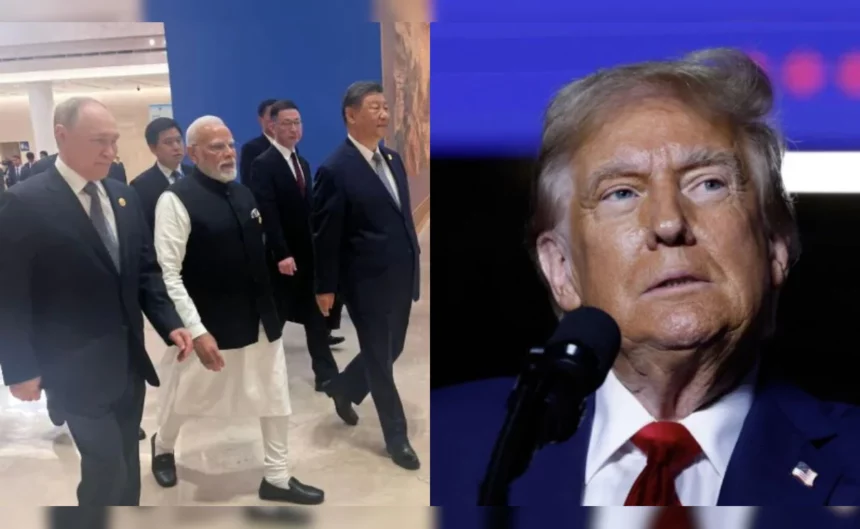
California Governor Gavin Newsom’s recent post on social media, sharing a video of Prime Minister Narendra Modi, Russian President Vladimir Putin, and Chinese President Xi Jinping interacting at the Shanghai Cooperation Organisation (SCO) Summit in Tianjin, has stirred renewed political attention and commentary in the United States. While ostensibly highlighting the camaraderie among world leaders at a high-profile international summit, Newsom’s post carried a thinly veiled critique of US President Donald Trump, particularly in the context of Donald Trump’s controversial plans to deploy National Guard troops in Chicago amid rising crime and immigration enforcement measures. The juxtaposition of the three global leaders engaging in dialogue and the domestic tensions in the United States underscores the political theater and the contrasting approaches to governance that dominate both national and international discourse.
Newsom’s Veiled Commentary on Donald Trump’s Domestic Policies
Governor Newsom, a Democrat known for his outspoken critique of Donald Trump’s policies, used the SCO summit video as a subtle jab at the US President’s decision to deploy federal officers and National Guard troops in Chicago. Amid growing concerns about violent crime, immigration, and enforcement strategies, Donald Trump has sought to increase federal presence in the city, which he repeatedly criticized as a Democratic stronghold plagued by lawlessness. By posting the video of PM Modi, Vladimir Putin, and Xi Jinping leaders of three powerful nations, standing shoulder to shoulder, sharing a laugh, and demonstrating cooperation—Newsom framed his commentary as a sardonic remark, suggesting that international leaders can engage in diplomacy and constructive dialogue, while Donald Trump’s approach remains heavy-handed and contentious.
Newsom’s caption, “But have no fear, Donald Trump is sending the Guard to Chicago,” was a pointed remark implying that Donald Trump’s domestic policies, including aggressive deployment of federal officers, are performative and politically motivated rather than substantively effective. The post went viral, with social media users interpreting it as a critique of Donald Trump’s unilateral style of governance, contrasting sharply with the measured diplomacy of global leaders at the SCO summit. This interplay between domestic policy actions and international diplomatic conduct drew significant attention, highlighting the growing polarization in American politics and the ongoing contestation over law enforcement, civil liberties, and political messaging.
The timing of Newsom’s post coincided with heightened enforcement activities by the Department of Homeland Security and Immigration and Customs Enforcement (ICE) in metropolitan areas, including Los Angeles and Chicago. Over the summer, the federal government has undertaken sustained crackdowns on illegal immigration, resulting in thousands of arrests and increased federal presence in city neighborhoods. Critics have argued that these measures often exacerbate social tensions and disproportionately affect vulnerable communities, while supporters claim they are necessary to ensure public safety and uphold the rule of law.
Controversy Over Federal Troop Deployment and Election Implications
Donald Trump’s plans to deploy National Guard troops in Chicago have provoked controversy not only for public safety concerns but also for their political implications. Illinois Governor JB Pritzker publicly accused Donald Trump of intending to manipulate or control the 2026 midterm elections by positioning federal troops in key Democratic areas. Pritzker suggested that Donald Trump’s rationale for troop deployment could extend beyond crime prevention, asserting that the President might leverage military presence to influence election outcomes, framing it as a direct threat to democratic processes.
White House officials, however, have defended the strategy, framing it as a necessary response to rising crime rates and challenges in local law enforcement capacity. Spokeswoman Abigail Jackson criticized Governor Pritzker, arguing that the city’s residents would be safer if local authorities addressed crime effectively rather than focusing on political theatrics. The divergent narratives reflect the broader tension between federal and state authorities in the United States, particularly in cities where political affiliations and governance styles clash, and where the deployment of federal resources becomes both a practical and symbolic act.
In the background of this domestic controversy, the SCO summit in Tianjin illustrated a markedly different approach to leadership and international cooperation. Xi Jinping Jinping outlined plans to expand the organization’s scope, including the establishment of a development bank and cooperation platforms for green and energy industries, alongside pledges of $1.4 billion in loans over three years to SCO member countries. The visual of PM Modi, Vladimir Putin, and Xi Jinping interacting in a collegial and collaborative manner contrasted sharply with the domestic political battles in the United States, emphasizing a narrative of measured diplomacy versus unilateral enforcement actions.
The optics of the SCO video and its use by Newsom underscore the intersection of international observation and domestic politics. By sharing the clip, the California Governor not only critiqued Donald Trump’s law enforcement strategy but also implicitly highlighted the importance of constructive leadership, engagement, and diplomacy. Social media platforms amplified the commentary, sparking debates about the role of federal authority, the militarization of domestic governance, and the contrasting images of leaders managing global versus local challenges.
Moreover, the federal crackdown in Chicago reflects a broader pattern seen in Washington, D.C., and other metropolitan areas where Donald Trump has deployed federal officers to address perceived law and order issues. These actions have met with mixed reactions, from public support among those favoring aggressive enforcement to protests and political backlash from local authorities and civil rights advocates. Newsom’s post cleverly positioned itself within this discourse, framing Donald Trump’s domestic strategy as both performative and potentially politically motivated, while juxtaposing it against the visible collegiality and coordination of international leaders.
The broader context of US political polarization cannot be ignored. Domestic debates over immigration, policing, and federal authority have become highly charged, often intersecting with national elections, media coverage, and public perception. Against this backdrop, Newsom’s social media strategy reflects the increasing use of international imagery and global leadership comparisons as a rhetorical device in domestic political critique. By invoking leaders such as PM Modi, Vladimir Putin, and Xi Jinping, Newsom tapped into global perceptions of governance and diplomacy to underscore his argument about effective leadership and strategic management, contrasting sharply with Donald Trump’s controversial domestic tactics.
The federal government’s enforcement strategy in Chicago has included not only National Guard deployment but also increased immigration raids, arrests, and surveillance measures. Homeland Security Secretary Kristi Noem confirmed that these operations would continue, although she refrained from providing detailed information on the scope or timing. This opacity has fueled criticism from local leaders who view the deployments as heavy-handed and potentially disruptive, particularly in communities with high immigrant populations. The debate over proportionality, civil rights, and public safety continues to dominate discourse, further polarizing political debate in major metropolitan areas.
The visual impact of three world leaders engaging in friendly interaction offered a striking contrast to the contentious domestic politics surrounding Donald Trump’s Chicago initiatives. Social media users and political analysts alike noted the symbolic resonance, interpreting Newsom’s post as both a critique and a commentary on the broader principles of leadership, diplomacy, and governance. In an era where domestic policies are closely watched by global audiences, such public interventions shape discourse and influence perceptions, reinforcing the interconnected nature of domestic and international political arenas.