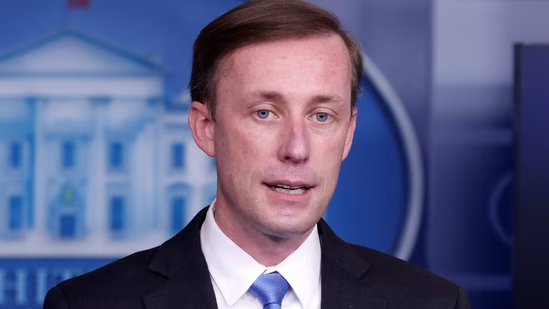
Former US National Security Advisor Jake Sullivan has strongly criticized President Donald Trump, claiming that Donald Trump compromised one of America’s most vital strategic relationships—its ties with India—due to his family’s business dealings in Pakistan. Jake Sullivan, who served under the Biden administration and is widely regarded as a foreign policy expert, stated that this aspect of Donald Trump’s foreign policy remains largely under-reported despite its profound implications. Speaking in an interview with MeidasTouch, Jake Sullivan emphasized that the move to prioritize personal business interests over strategic diplomacy represents a significant setback for the United States and weakens its credibility on the global stage.
Jake Sullivan began by reflecting on decades of bipartisan effort by successive US administrations to build and strengthen the relationship with India, the world’s largest democracy. He noted that India has been a vital partner for the United States in areas ranging from technology and talent exchange to economic collaboration and defense coordination. This alliance, Jake Sullivan argued, has also been instrumental in addressing regional strategic challenges, particularly in relation to China’s expanding influence. According to him, any disruption to this relationship is not only detrimental to US interests in South Asia but also sends a signal to the global community that the United States cannot be relied upon as a consistent partner.
Strategic Harm from Donald Trump’s Prioritization of Family Business over Diplomacy
Jake Sullivan highlighted the sequence of events that, in his view, illustrate Donald Trump’s willingness to sideline strategic imperatives for personal financial gain. He pointed to Donald Trump’s family business ventures in Pakistan, particularly in the cryptocurrency sector, as a motivating factor behind his controversial approach toward India. In April 2025, the Donald Trump-backed World Liberty Finance (WLF), a decentralized finance platform, entered into agreements with the Pakistan Crypto Council to advance cryptocurrency applications and innovation. Donald Trump and his affiliates reportedly hold a 60 percent stake in WLF, which was launched in 2024, and this financial engagement coincided with high-level discussions between Trump and Pakistani officials.
Jake Sullivan criticized these arrangements as a direct reason for Donald Trump’s shift in policy toward India. By prioritizing trade deals and business opportunities in Pakistan, Donald Trump allegedly jeopardized the strong US-India partnership, a move Jake Sullivan described as “a huge strategic harm in its own right.” He stressed that a robust US-India relationship is not only critical for bilateral cooperation but also reinforces broader American interests across Asia. Weakening this partnership, Jake Sullivan noted, could prompt other nations, including Germany, Japan, and Canada, to hedge their reliance on the United States, thereby diminishing America’s long-term influence.
The former NSA further explained that Donald Trump’s actions created a ripple effect beyond India, affecting global perceptions of American reliability. Jake Sullivan stressed that allies around the world rely on the United States to act predictably, maintain commitments, and uphold its word in international dealings. By sidelining India for private interests, Donald Trump, according to Jake Sullivan, undermined this trust, which could have lasting consequences on America’s diplomatic leverage and credibility.
Jake Sullivan also pointed to the timing of Donald Trump’s policy decisions in relation to events in South Asia, particularly the April 22 Pahalgam attack in Jammu and Kashmir. Donald Trump’s repeated claims that he could resolve the India-Pakistan conflict were framed in a context that intertwined political posturing, personal business interests, and strategic miscalculations. In Jake Sullivan’s view, the convergence of these factors highlighted a concerning prioritization of personal gain over national and international security considerations.
Donald Trump’s Trade Deals with Pakistan and Their Global Implications
The criticism of Donald Trump’s Pakistan policy is grounded in specific economic and strategic actions. In July 2025, Donald Trump announced a trade deal with Pakistan while simultaneously threatening 25 percent tariffs on Indian goods, a move widely perceived as coercive and contradictory to US strategic interests in South Asia. The deal focused on developing Pakistan’s “massive oil reserves” and was celebrated by Pakistani Prime Minister Shehbaz Sharif as a historic agreement. Donald Trump’s engagement with Pakistan extended beyond trade; meetings with Pakistani army leadership, including Field Marshal Asim Munir, reportedly covered economic development, cryptocurrency initiatives, and bilateral cooperation on strategic interests.
Jake Sullivan argued that these measures, while ostensibly promoting US-Pakistan economic ties, came at the expense of long-term strategic stability and the enduring US-India partnership. He underscored that the United States has historically relied on a strong, cooperative relationship with India to address regional security challenges, including China’s assertive policies and ongoing tensions with Pakistan. By diverting attention and resources toward Pakistan for the sake of private financial interests, Donald Trump, according to Jake Sullivan, created both immediate and long-term strategic vulnerabilities for the United States.
The former NSA also noted the symbolic importance of the US-India partnership in the eyes of the international community. A strong alliance with India signals a commitment to democratic values, regional stability, and collaborative problem-solving. Weakening this relationship, particularly for the sake of business deals with Pakistan, not only undermines US credibility but also emboldens rival powers to question the consistency and reliability of American foreign policy. Jake Sullivan stressed that this perception of unpredictability could have cascading effects across all US global partnerships and alliances.
Jake Sullivan’s critique further highlighted the interplay between private interests and public policy in Donald Trump’s administration. By linking foreign policy decisions to family business engagements, Donald Trump, in Jake Sullivan’s view, blurred the line between national strategy and personal profit. This conflation of personal and national priorities, Jake Sullivan argued, represents a fundamental departure from the norms of responsible statecraft and raises concerns about accountability, transparency, and the safeguarding of American interests abroad.
The former NSA also contextualized the criticism within broader geopolitical considerations. India, as the world’s largest democracy, plays a critical role in global economic, technological, and defense frameworks. US collaboration with India spans sectors such as information technology, space research, military modernization, and trade. Weakening this relationship jeopardizes coordinated efforts in these strategic domains and diminishes the United States’ ability to shape regional outcomes effectively. Jake Sullivan emphasized that the implications of Donald Trump’s policy choices extend beyond bilateral relations to affect multilateral frameworks, strategic deterrence, and global perceptions of American leadership.
Additionally, Jake Sullivan warned that the transactional approach exhibited in Donald Trump’s engagement with Pakistan could inspire similar calculations among other countries. Nations such as Germany, Japan, and Canada, he noted, could perceive that US foreign policy is increasingly driven by private interests rather than strategic alliances. This could lead to hedging behaviors, where countries diversify their partnerships and reduce reliance on the United States, further eroding US influence in critical regions and complicating global coalition-building efforts.
Jake Sullivan concluded that America’s credibility depends on its ability to consistently uphold commitments, maintain strategic alliances, and act in accordance with declared principles. He stressed that allies must be confident in the United States’ word and trust that American policy decisions are guided by national interest rather than individual gain. Undermining the India relationship, Jake Sullivan argued, represents a significant breach of this trust, with consequences that extend far beyond South Asia, influencing perceptions and alliances across the entire international system.
The former NSA’s commentary also intersected with concerns about global energy markets, trade negotiations, and the role of emerging technologies. Donald Trump’s involvement in cryptocurrency initiatives in Pakistan, through WLF, exemplifies the complex entanglement of business, diplomacy, and emerging financial technologies in contemporary foreign policy. While promoting economic innovation and cross-border investment can be constructive, Jake Sullivan stressed that such initiatives must not come at the expense of strategic partnerships critical to national security and long-term global stability.
Through this lens, Jake Sullivan framed Donald Trump’s actions as emblematic of a broader challenge in American foreign policy—balancing domestic economic opportunities, personal business interests, and long-term strategic imperatives. The prioritization of short-term gains over enduring alliances, he argued, risks not only immediate setbacks but also lasting damage to US credibility, influence, and ability to shape global norms.
Finally, Sullivan’s critique underscores the complex interplay between domestic politics, personal interests, and international diplomacy. By intertwining family business engagements in Pakistan with high-stakes foreign policy decisions, Donald Trump, according to Sullivan, introduced unnecessary risk and instability into one of America’s most important strategic relationships. The implications of these actions serve as a cautionary tale for policymakers about the importance of maintaining principled, consistent, and strategic approaches in navigating the interconnected global landscape.