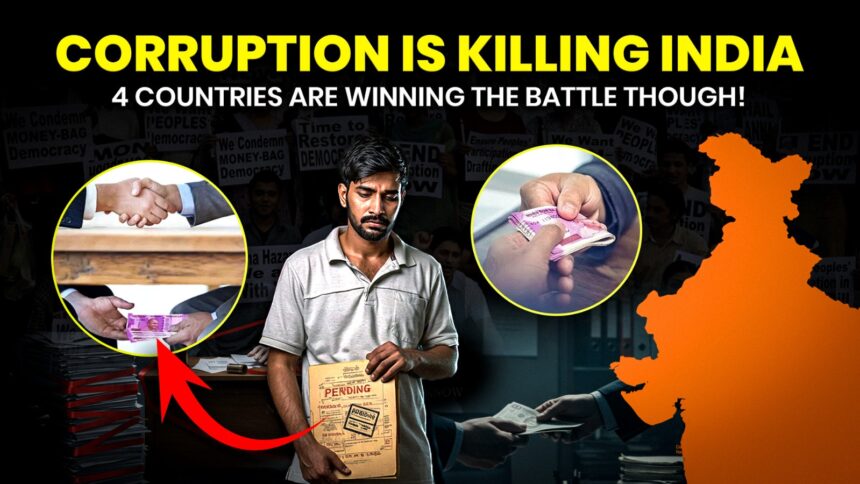
We’ve all seen it. A file stuck for weeks until a bribe is paid. A government officer who won’t move a finger without “something under the table.” A permit that should take 7 days takes 7 months—unless you “know someone.”
This is bureaucratic corruption—the quiet, everyday theft that doesn’t make breaking news, but slowly breaks a nation from the inside.
Across the world, many countries have faced this problem. But what makes the difference is what they did about it. In Brazil, a massive investigation called Operation Car Wash exposed powerful people, including presidents, and sent them to jail. In Estonia, they turned almost every government service digital, so there was no one to bribe. In Rwanda, officials use GPS tracking and digital audits to stop money from leaking. Even in South Korea, a president was held accountable and imprisoned.
Brazil – Operation Car Wash: How One Investigation Shook an Entire Continent
In 2014, a seemingly routine money laundering investigation in Brazil spiraled into one of the largest anti-corruption operations in history—Operation Car Wash (Operação Lava Jato). It began with suspicious transactions at a gas station in Brasília, but what followed was a trail of corruption that ran through Petrobras, the national oil giant, and deep into Brazil’s political heart. Federal police uncovered a massive bribery and kickback scheme: construction companies like Odebrecht and Andrade Gutierrez were colluding with Petrobras executives and government officials to inflate project costs, and the extra funds were being funneled back as political bribes.
The operation had a clear, multi-agency structure—the judiciary, the federal police, and public prosecutors worked in tandem. They used plea bargaining (delação premiada), a legal tool which allowed arrested businessmen and politicians to turn informants in exchange for reduced sentences. This created a domino effect—every arrest exposed new links.
Between 2014 and 2020, the operation led to over 1,000 search warrants, 278 convictions, and over $3 billion in recovered public funds. Notably, former president Lula da Silva was convicted, along with dozens of senators and CEOs. The model emphasized autonomous prosecutors, special anti-corruption task forces, and international cooperation—since many bribes flowed through offshore accounts in Switzerland and Panama.
While later political interference did slow down Lava Jato’s momentum, its impact was historical—it proved that powerful elites are not untouchable if systems are empowered to act without fear.
Estonia – How a Small Country Coded Out Corruption
After gaining independence from the Soviet Union in 1991, Estonia faced a choice: rebuild using old bureaucratic templates, or start fresh. They chose the latter, and in doing so, created the world’s most advanced digital state—a decision that drastically reduced corruption opportunities.
Estonia’s philosophy was simple: reduce human discretion, increase digital transparency. They launched a national digital ID system, allowing every citizen secure access to over 99% of government services online—including healthcare, banking, voting, and tax filing. This meant fewer in-person interactions with government officials, which in turn meant fewer chances to ask for or offer a bribe.
Every action on Estonia’s digital platforms is time-stamped, encrypted, and logged. If a government employee accesses your file, you can see it. If you apply for a permit, there’s no “line” or middleman—just a clean digital form and a decision based on set rules. Estonia even became the first country to implement blockchain technology to protect national data against tampering.
The government established X-Road, a decentralized data exchange system allowing different public and private institutions to communicate securely. The e-Cabinet system ensures that ministers prepare and vote on policy papers digitally—cutting off opaque lobbying.
As a result, Estonia has climbed the Transparency International CPI to 14th place globally (2023). This wasn’t magic—it was strategic digitization, done with purpose and long-term investment.
Rwanda – A Post-Conflict Nation’s Digital Battle Against Corruption
In the aftermath of the 1994 genocide, Rwanda had to rebuild not just its economy, but its trust in governance. Under President Paul Kagame, the country focused on strong accountability systems, backed by digital infrastructure to reduce manual processes and financial leaks.
Rwanda’s approach is proactive. For instance, all government tenders and contracts are published through an online e-procurement platform called Umucyo (“transparency” in Kinyarwanda). This means any citizen, journalist, or watchdog can access and scrutinize public spending.
Another cornerstone reform was IremboGov—a digital one-stop portal where Rwandans can apply for over 100 services like birth certificates, ID cards, and land titles without stepping into a government office. By cutting down face-to-face interactions, the platform eliminates a major channel of petty bribery.
Additionally, Rwanda implemented GPS-based monitoring of public infrastructure projects. Let’s say a rural road is being built—officials and auditors can track its exact GPS coordinates and status, making it harder for funds to be diverted or for ghost projects to exist.
There’s also the Office of the Ombudsman, a constitutionally empowered agency that investigates corruption complaints and publicly names officials found guilty. They use asset declaration systems and enforce strict conflict-of-interest rules for civil servants.
The result? Rwanda is now ranked 3rd least corrupt in Africa and has seen a drop of over 70% in corruption-related complaints over the past decade. This is an example of how even resource-scarce countries can win the battle if they use data and design smartly.
South Korea – When the Streets Lit Up to Clean the System
South Korea’s most iconic battle against bureaucratic corruption wasn’t just fought in courtrooms—it was fought on the streets. In 2016–17, millions of citizens joined peaceful candlelight protests, demanding the resignation of President Park Geun-hye, who was embroiled in a massive influence-peddling scandal.
At the center of the scandal was Choi Soon-sil, a long-time confidante of the president, who had no official role but was allegedly pulling strings in state affairs and extorting donations from conglomerates like Samsung, Hyundai, and Lotte in exchange for political favors.
The Korean government had already established robust anti-corruption institutions like the Board of Audit and Inspection and the Anti-Corruption and Civil Rights Commission (ACRC). But what made this episode different was the scale of public participation and the political will to follow through.
President Park was impeached by the National Assembly and later sentenced to 25 years in prison, while Samsung heir Lee Jae-yong was also convicted (later paroled, sparking debate).
South Korea also implemented the Improper Solicitation and Graft Act (Kim Young-ran Act) in 2016, which restricted gifts and entertainment expenses for public servants and teachers. This law dramatically reduced “soft bribes,” which were often considered a part of social culture.
The message was loud and clear: in South Korea, no one is above the law. High-level accountability, combined with public pressure, made it a turning point in the country’s fight against entrenched corruption.
These are powerful examples. They show us one thing: corruption can be fought—with the right tools, the right people, and strong will.
In India, bureaucratic corruption feels like part of everyday life. And that’s the scariest part—it has become “normal.” People joke about it. “Chai-pani” is no longer tea—it’s a code word for bribery. It kills ambition, frustrates honest citizens, and blocks progress.
But we can’t afford to stay silent anymore.
Because this isn’t just about bad governance. It’s about lost dreams. It’s about a student who doesn’t get a scholarship because someone paid their way in. It’s about a startup founder whose idea dies because a license took too long. It’s about an old man who doesn’t get his pension without “oiling the system.”
This isn’t fair. This isn’t India’s best. India is not short on ideas. We are not short on technology, talent, or even laws. What we often lack is the urgency to act, the courage to hold the powerful accountable, and the systems that make honesty easier than corruption. From Brazil’s fearless investigators to Estonia’s digital precision, from Rwanda’s bottom-up transparency to South Korea’s top-down reckoning—the world has shown that corruption is not a cultural destiny. It’s a design flaw. And design can be changed.
India’s fight against bureaucratic corruption doesn’t need to start from scratch. It needs to borrow boldly, localize smartly, and execute ruthlessly. We must build a bureaucracy where public service means serving the public—not controlling access to rights. We must create systems where files move faster than bribes, where rules are stronger than relationships, and where every citizen—not just the well-connected—can dream, build, and rise.
In the end, the real reform isn’t just in laws or portals. It’s in mindset. And that begins not in Parliament or secretariat buildings—but in homes, classrooms, exam halls, and election booths. A clean India is not a fantasy. It’s a possibility—if we decide to make it non-negotiable.
So what do we do?
We learn from the world. We adopt what works. We demand accountability. We use technology. We build systems where things move forward because of rules, not relationships.
And most importantly—we start with ourselves. With honesty. With courage. With raising our voice. With not paying that bribe, even when it’s easier.
Bureaucratic corruption may be silent. But we don’t have to be.
Let’s be the noise that breaks it.
The fight against corruption isn’t just about punishing the bad—it’s about protecting the good. And the good begins with us.