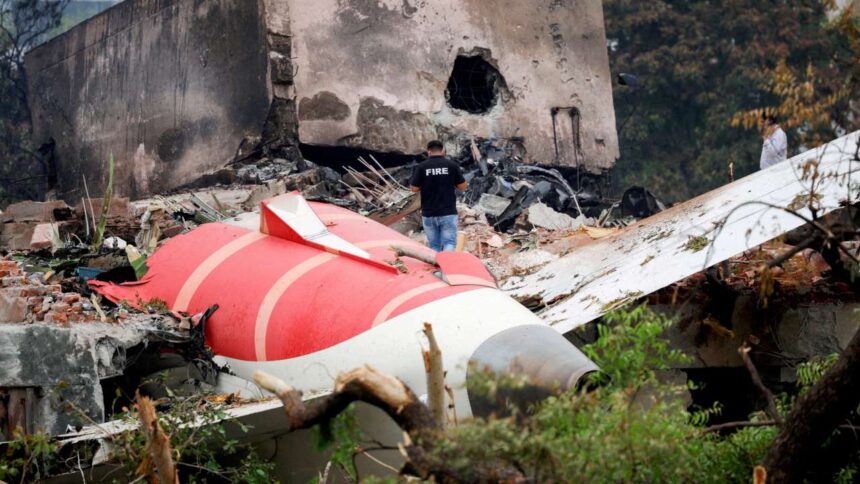
The initial probe into the devastating Air India crash in Ahmedabad has revealed critical engine failures, unexpected fuel cutoff mid-flight, and cockpit confusion just before the Boeing 787-8 Dreamliner went down, killing 240 passengers and 19 people on the ground. The Aircraft Accident Investigation Bureau (AAIB) released its preliminary 15-page report, providing the first official insight into what led to the tragic incident on June 12 while confirming that further investigation is underway.
The incident occurred when the Air India Dreamliner crashed into the premises of BJ Medical College near the airport, leaving only one passenger alive out of 241 onboard. The AAIB’s report, based on Engine and Aircraft Flight Recorder (EAFR) data, details the sequence of technical failures and crew responses that contributed to the crash.
Engines Showed Inconsistent Recovery and Sudden Shutdown
According to the AAIB report, both engines’ N2 values, which indicate the rotational speed of the engine core, fell below the minimum idle speed during the incident. Engine 1 showed signs of halting its core deceleration and began progressing toward recovery, while Engine 2, despite relighting, failed to stabilise and continued losing core speed. The report noted that repeated attempts to reintroduce fuel could not arrest the deceleration in Engine 2, indicating a critical inability to recover engine performance in time.
Shockingly, at 13:38:42 IST, the aircraft reached 180 knots indicated airspeed, after which both engines’ fuel cutoff switches unexpectedly moved from the ‘Run’ position to ‘Cutoff’, leading to a complete fuel supply interruption. Within seconds, the crew switched the fuel controls back to ‘Run’, which resulted in a rise in Exhaust Gas Temperature (EGT) in both engines, showing signs of relight attempts. However, these efforts were insufficient to stabilise the engines fully before the crash.
Cockpit Confusion and Communication Breakdown
The preliminary report reveals concerning cockpit communication during these critical moments. According to the cockpit voice recordings, one pilot was heard asking, “Why did you cut off?” while the other responded, “I did not do so,” indicating possible miscommunication or a lack of clarity on cockpit actions during the emergency, a crucial factor under review by the AAIB.
Despite the critical situation, the crew attempted to recover the engines by managing the fuel controls, but the rapid loss of thrust and altitude proved fatal. The EAFR data also showed a continuous rise in EGT during the relight attempts, indicating active combustion within the engines but failing to generate the required thrust for stabilisation.
The aft Engine and Aircraft Flight Recorder, which could have provided additional clarity, was heavily damaged in the crash and could not be accessed using conventional methods, limiting the immediate availability of deeper data. The AAIB has stated that it will examine additional evidence from stakeholders, including technical teams and aircraft manufacturers, in the next phase of its investigation.
At this stage, the AAIB has not issued any safety recommendations for Boeing 787-8 aircraft or GE GEnx-1B engine operators, stating that further review of the data and additional evidence is necessary before drawing definitive conclusions on safety protocols or potential advisories to manufacturers and operators.
The report highlights the complexity of managing in-flight engine failures, particularly when compounded by potential human factors such as communication lapses. As the investigation continues, the focus will remain on understanding the exact sequence of events that led to the fuel cutoff activation and the engines’ failure to recover despite relight attempts, ensuring that such a tragedy does not repeat.