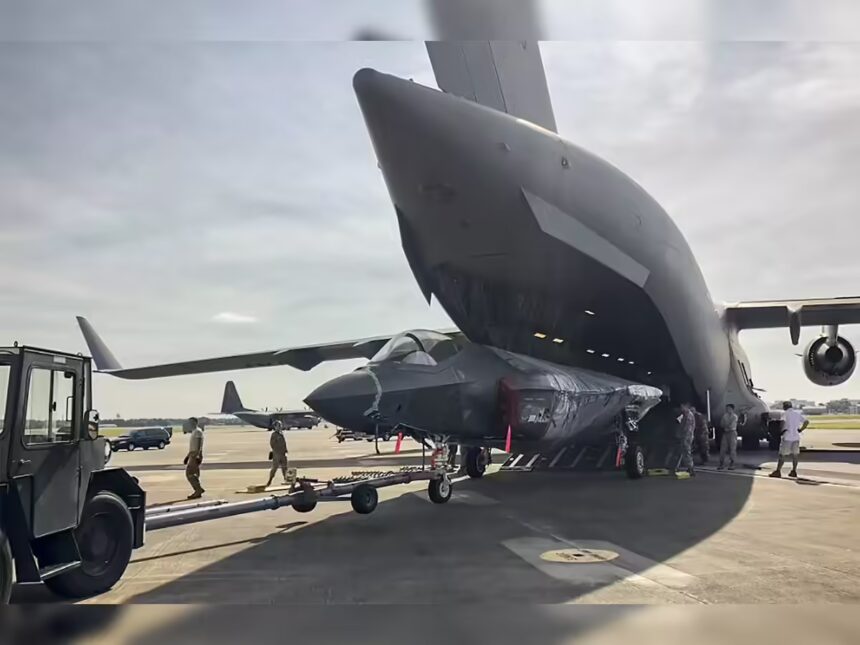
A prized British F-35B Lightning fighter jet, worth over $110 million, has been stranded in Thiruvananthapuram for nearly three weeks following an emergency landing on June 14, prompting the UK to dispatch a 40-member team of aviation engineers on July 5 to repair or retrieve the jet from India. The aircraft, belonging to Britain’s Royal Navy and stationed on the HMS Prince of Wales, may need to be dismantled or flown back using a special transport aircraft if on-ground repairs are insufficient, underscoring the complexities of managing high-value defence assets abroad.
Emergency Landing Amid Fuel Shortage and Weather Challenges
The F-35B Lightning, a fifth-generation stealth fighter manufactured by Lockheed Martin, was forced to make an emergency landing at Thiruvananthapuram International Airport on June 14 due to adverse weather conditions and low fuel while on a routine exercise after taking off from the HMS Prince of Wales, which has been operating near the Singapore Strait. The Indian Air Force (IAF) tracked and guided the aircraft safely, confirming the incident via a statement on X, noting that it is providing all necessary support for the “rectification and subsequent return of the aircraft.” The pilot was airlifted back to the carrier the following day, but the aircraft developed a technical snag while parked, leaving it under the watch of a six-member team from the HMS Prince of Wales as plans for recovery were arranged.
Complex Recovery Plans Underway
Initially, the British team was scheduled to arrive on July 2 to begin repairs, but the visit was postponed for unspecified reasons, with the 40-member team now confirmed to arrive on July 5 aboard a special flight to Kerala. The engineers will assess whether the F-35B can be repaired and flown out or if it will need dismantling for shipment back to the UK, potentially using a C-17 Globemaster transport aircraft.
The F-35B Lightning, powered by a Pratt & Whitney F135 engine, is renowned for its short take-off and vertical landing (STOVL) capabilities, allowing it to operate from smaller naval decks and ships while achieving speeds up to 1.6 times the speed of sound. As a critical part of the UK’s naval strike capabilities, the jet’s grounding in India has drawn significant attention, especially given the complexity and cost associated with recovering advanced military equipment from foreign soil.
The HMS Prince of Wales Carrier Strike Group had earlier conducted joint military exercises with the Indian Navy in June, underscoring the growing defence cooperation between India and the UK in the Indo-Pacific region. The incident highlights the operational challenges faced by advanced military platforms when dealing with unforeseen emergencies in foreign territories, even as bilateral cooperation ensures a coordinated approach to resolving the situation efficiently.