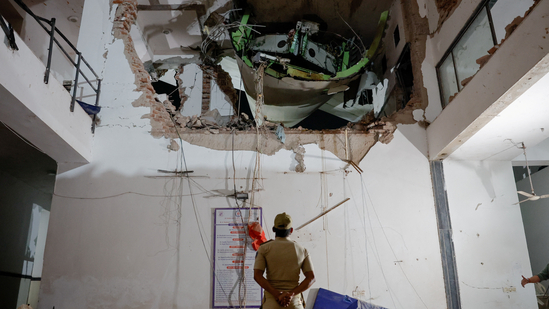
Investigators have recovered both black boxes from the wreckage of Air India Flight 171, which crashed shortly after takeoff in Ahmedabad, killing all 241 people on board. The recovery of these devices has given investigators a clearer pathway to determine what happened in the critical 33 seconds after liftoff, as early signs suggest a combination of human error and technical fault may have contributed to India’s worst aviation tragedy in decades.
One of the flight data recorders was found on the rooftop of a hostel near BJ Medical College, while the second was located later the same day. Both are now undergoing analysis. Aviation experts have pointed to possible misconfiguration of the aircraft for takeoff, with a focus on flap settings, landing gear position, and overall engine performance.
Key areas under investigation
The Aircraft Accident Investigation Bureau (AAIB), along with a team from Boeing, is closely examining the General Electric GEnx engines, parts of which are being sent to the US for further inspection. Authorities have stated that the plane’s landing gear was still extended during ascent — a serious anomaly — and flap components were scattered across nearby roads, indicating potential configuration failures.
The Directorate General of Civil Aviation (DGCA) has ordered targeted inspections across all Air India Boeing 787-8 and 787-9 aircraft, focusing on fuel flow systems, engine control electronics, takeoff performance parameters, and hydraulic systems. Aviation analyst Amit Singh believes the regulator’s specific focus suggests early suspicions about mechanical or procedural lapses.
Black box data crucial for determining cause
Experts like Jeff Guzzetti, a former US crash investigator, say the black boxes will help determine whether the engines lost thrust, if takeoff settings were incorrectly entered, or if weight distribution and environmental factors were poorly calculated. The flight data recorder will log critical system inputs, while the cockpit voice recorder may reveal the crew’s discussions and decisions in real time.
John M. Cox, a former pilot and aviation safety expert, noted visual evidence indicating a lack of lift, with the aircraft nose-up but continuing to descend. He pointed out that trailing edge flaps did not appear to be in the expected position, though he cautioned against premature conclusions based on imagery alone.
Sources familiar with the probe confirmed that bird strikes have been ruled out, while thrust settings, maintenance records, and pilot inputs are under detailed scrutiny.