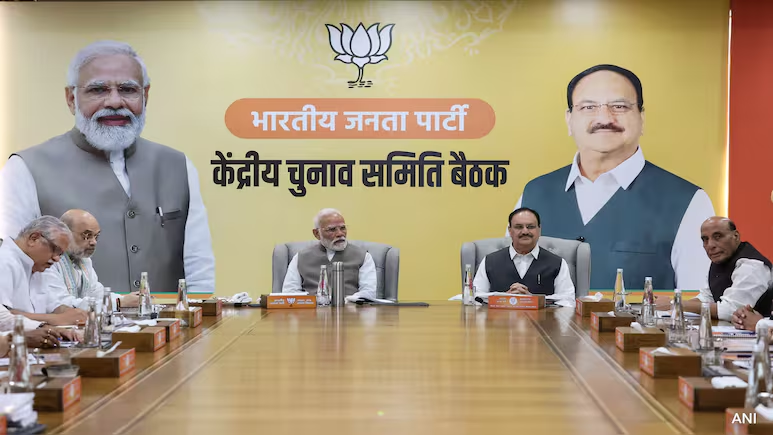
As Bihar gears up for next month’s Assembly elections, the Bharatiya Janata Party has launched an unprecedented, high-intensity campaign under the banner of “Mission Bihar.” The party is deploying its top national leaders across strategic constituencies to counter anti-incumbency sentiment, consolidate its vote base, and galvanize supporters from the West Champaran border to the politically sensitive Kosi region. Analysts and political observers note that this massive campaign effort reflects both the BJP’s determination to maintain its stronghold in the state and the party’s broader electoral strategy that combines grassroots mobilisation, star campaigners, and targeted messaging to influence voter behaviour.
BJP’s Star-Studded Campaign and Leadership Deployment
The central feature of the NDA’s campaign is the extensive involvement of senior leaders, ensuring that Bihar witnesses one of the most significant mobilisations in recent electoral history. Union Home Minister Amit Shah, the BJP’s chief strategist, is spearheading the campaign with plans to hold more than 35 rallies across the state. According to party insiders, Shah’s presence aims to strengthen the alliance’s cohesion at the grassroots level while mitigating any anti-incumbency sentiment in constituencies where the BJP had performed strongly in the 2020 Assembly elections. Shah’s campaign begins on October 17, following his arrival in Patna on October 16 for a three-day visit. He will address rallies in constituencies including Korha, Darbhanga, Keoti, Gopalganj, Paroo in Muzaffarpur, Bettiah, Motihari, and Katihar. Alongside public events, Shah is scheduled to hold closed-door meetings with state leaders to finalise strategies, candidate selection, and seat-sharing arrangements.
Uttar Pradesh Chief Minister Yogi Adityanath, renowned for his mass appeal and grassroots connection, will campaign in over two dozen constituencies, particularly focusing on North and Central Bihar. Analysts believe that his influence will significantly boost voter mobilisation in these regions. Recognising the cultural and linguistic affinities between North Bihar and Eastern Uttar Pradesh, his campaign itinerary covers constituencies in Mithilanchal, including Dhaka, Riga, Khajauli, Bisfi, Darbhanga, and Jale, as well as Seemanchal areas such as Farbisganj, Purnia, Katihar, and Pranpur. He will also address rallies in the western belt, covering Chanpatia, Govindganj, and Gopalganj, ensuring a comprehensive outreach to key voter demographics.
Defence Minister Rajnath Singh is taking a cross-regional approach, covering Saran, Mithilanchal, Seemanchal, and Central-Western plains, while targeting constituencies such as Hajipur, Buxar, Chiraiya, Bathnaha, Goreakothi, Chapra, Rajnagar, Katihar, and Banka. Health Minister and BJP national president JP Nadda is primarily focused on cadre mobilisation, appearing at selected rallies in Ramnagar (Bagaha), Jale (Darbhanga), and Lauriya.
Prime Minister Narendra Modi is expected to focus his outreach on regions where the NDA’s influence is relatively weaker but where his personal appeal can sway voters. Each of Modi’s rallies and roadshows will be strategically planned to cover 15 to 20 Assembly segments, with live telecasts to maximise engagement in rural areas. The BJP has also announced a roster of 40 star campaigners, including prominent Union Ministers, Chief Ministers, and influential leaders such as Nitin Gadkari, Shivraj Singh Chouhan, Dharmendra Pradhan, Giriraj Singh, Devendra Fadnavis, Himanta Biswa Sarma, Smriti Irani, Keshav Prasad Maurya, and Ravi Kishan, among others, ensuring comprehensive coverage of constituencies across Bihar.
The NDA has coordinated a meticulous strategy for candidate nominations, dividing Bihar into multiple zones for filing from October 15 to 18, with senior leaders present in each district during these critical days. More than a dozen BJP-ruled state Chief Ministers and several Union Ministers are expected to participate in the filing process, signalling the importance of the Bihar Assembly elections for the NDA’s national strategy.
Strategic Considerations and Regional Focus
The NDA’s “Mission Bihar” campaign is not merely a show of strength but a calculated effort to consolidate voter support, counter anti-incumbency, and address emerging challenges from opposition parties. Analysts highlight that the strategy extends beyond conventional political campaigning and incorporates targeted messaging, grassroots mobilisation, and influential star campaigners to optimise the party’s electoral prospects. The campaign’s design reflects an understanding of Bihar’s complex political landscape, which includes diverse regional identities, caste-based dynamics, and local issues that shape voting behaviour.
Amit Shah’s extensive rally schedule is intended to create a sense of momentum and unity within the NDA, demonstrating the alliance’s organisational capacity to voters. Shah’s presence is expected to reinforce the party’s narrative of stability and effective governance while energising grassroots workers and local leaders. Similarly, Yogi Adityanath’s campaign is strategically focused on regions with cultural and linguistic overlaps with Uttar Pradesh, enabling the BJP to leverage shared socio-cultural identities to enhance voter engagement and turnout.
The inclusion of Defence Minister Rajnath Singh and national president JP Nadda in strategic constituencies further strengthens the campaign’s multi-layered approach. By assigning responsibilities based on regional influence and political experience, the NDA ensures comprehensive coverage of key areas. The focus on constituencies such as Hajipur, Buxar, and Katihar demonstrates an emphasis on politically sensitive regions where even minor shifts in voter behaviour can influence overall electoral outcomes.
Prime Minister Narendra Modi’s involvement is designed to counter perceived weaknesses and maximise the impact of high-profile rallies. By targeting segments where the NDA’s influence is comparatively lower, the campaign aims to convert undecided or swing voters while energising the party base. The use of live telecasts ensures that Modi’s messaging reaches a broad audience, particularly in rural areas where access to news and political information may be limited.
BJP’s campaign also incorporates demographic considerations, caste dynamics, and community engagement. Observers note that constituencies with significant Patidar, Yadav, or minority populations receive targeted attention, reflecting the party’s nuanced understanding of voter segmentation. By combining grassroots mobilisation, star leadership, and media coverage, the NDA seeks to maintain its dominance in Bihar’s electoral landscape and mitigate the risk of anti-incumbency.
The coordinated strategy also includes meticulous planning for nomination filings, ensuring that party leaders are present during critical procedural stages. This not only reinforces organisational discipline but also signals the NDA’s commitment to transparency and preparedness. With over 243 Assembly seats contested in two phases on November 6 and 11, and counting scheduled for November 14, the NDA’s campaign strategy is designed to optimise performance across both phases, leaving minimal room for complacency or oversight.
The “Mission Bihar” campaign exemplifies the integration of strategic planning, leadership deployment, and voter engagement. By deploying top national leaders across critical constituencies, the BJP is sending a clear message of intent and organisational strength. Analysts argue that such campaigns are essential in politically competitive states like Bihar, where regional variations, local issues, and electoral sentiment play a pivotal role in shaping outcomes.
The combination of public rallies, closed-door strategy meetings, and media engagement ensures that the campaign maintains both visibility and operational coherence. This dual approach allows the BJP to address both voter perception and internal party coordination, creating a unified narrative ahead of the Assembly elections.
Additionally, the party’s focus on star campaigners is designed to build momentum and create aspirational appeal. Leaders such as Narendra Modi, Amit Shah, Yogi Adityanath, and Rajnath Singh act as vote magnets, reinforcing the NDA’s image as a credible and effective political alliance capable of delivering governance and development. The presence of regional leaders and influential state figures ensures that localised issues are addressed while maintaining alignment with the broader national strategy.
The BJP’s emphasis on integrating grassroots mobilisation with high-profile leadership engagement reflects a broader trend in contemporary electoral politics, where direct voter interaction, media visibility, and strategic messaging are critical components of campaign success. By covering constituencies across West Champaran, Mithilanchal, Seemanchal, the Kosi heartland, and central Bihar, the party aims to saturate the state with its narrative, leaving minimal opportunity for opposition parties to influence undecided voters.
Through meticulous planning, coordinated leadership deployment, and intensive voter outreach, the NDA’s “Mission Bihar” demonstrates the party’s ability to operate as a disciplined and strategically-minded organisation. Analysts note that such campaigns not only influence voter behaviour but also reinforce internal party cohesion, enabling the BJP to project strength and unity in high-stakes elections.
Overall, the campaign underscores the BJP’s recognition of Bihar’s political significance, the necessity of strategic leadership deployment, and the importance of integrating regional, demographic, and electoral considerations into a cohesive electoral strategy. The party’s comprehensive approach ensures that every constituency receives attention, every voter is engaged, and every opportunity is maximised to maintain the NDA’s stronghold in Bihar’s political landscape.