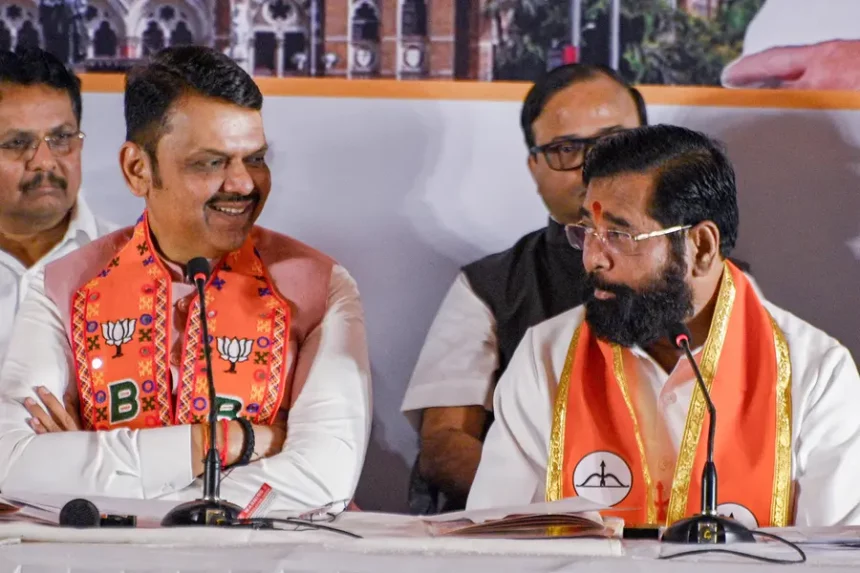
The Bharatiya Janata Party has registered a sweeping victory in the Maharashtra municipal corporation elections, emerging as the single largest force across the state’s urban local bodies and marking a decisive shift in local politics. Winning control of 17 out of 29 municipal corporations on its own, and leading an alliance that secured 25 corporations in total, the BJP has firmly consolidated its position in Maharashtra’s cities. The most symbolic outcome of the results is the end of the Thackeray family’s nearly 30-year dominance over the Brihanmumbai Municipal Corporation, with the BJP set to have a mayor in Mumbai for the first time in the city’s history.
The results, declared by the State Election Commission, underline the scale of the BJP’s performance not only in Mumbai but also in key urban centres such as Pune, Nagpur, Nashik and Thane. The elections have redrawn the political map of urban Maharashtra, weakening traditional power centres and altering alliance equations. While the BJP and its allies celebrated a decisive mandate, opposition parties, including the Shiv Sena factions, Congress and the Maharashtra Navnirman Sena, were left to reflect on significant losses and shifting voter preferences.
BJP-led alliance dominates municipal corporations, secures historic victory in Mumbai
According to the final tally, the BJP and its allies won 1,425 of the 2,869 seats across 29 municipal corporations in Maharashtra. The BJP alone secured control of 17 corporations, while the BJP-led grand alliance captured a total of 25, leaving only four corporations outside its reach. This commanding performance has translated into mayoral control in most major cities, giving the party unprecedented influence over urban governance in the state.
The most closely watched contest was the Brihanmumbai Municipal Corporation, long regarded as the political stronghold of the Thackeray family. For nearly three decades, the undivided Shiv Sena and later the Uddhav Thackeray-led faction had dominated the civic body, which governs India’s financial capital. This time, the BJP-Shiv Sena (Shinde) alliance wrested control of the BMC, effectively ending the Thackeray era in Mumbai’s civic politics.
In the 227-member BMC, the BJP emerged as the largest party with 89 seats, while its ally, the Shiv Sena led by Chief Minister Eknath Shinde, won 29 seats. Uddhav Thackeray’s Shiv Sena faction managed 65 seats, significantly short of a majority. The Maharashtra Navnirman Sena won six seats, while the Congress-Vanchit Bahujan Aghadi alliance secured 24 seats. AIMIM won eight seats, the Nationalist Congress Party three, the Samajwadi Party two, and the Sharad Pawar-led NCP faction just one seat. With the BJP-led alliance comfortably crossing the majority mark, the party is poised to have a mayor in Mumbai for the first time.
The celebrations following the BMC victory reflected its symbolic importance. Chief Minister Devendra Fadnavis was congratulated by his wife Amrita with a ceremonial tilak, and he later visited his mother in Nagpur, where he sought her blessings. These moments were widely shared as visual representations of the political milestone achieved by the BJP in Maharashtra.
Beyond Mumbai, the BJP’s dominance was evident across other major cities. In Pune, the party delivered a major blow to the Pawar family’s influence by winning 119 seats in the municipal corporation. The Ajit Pawar-led NCP finished a distant second with 27 seats, while the Sharad Pawar-led faction won only three. The Congress managed 15 seats, highlighting the BJP’s overwhelming advantage in one of the state’s most politically significant urban centres.
In Nagpur, the BJP achieved a landslide, winning 102 seats in the 151-member municipal corporation, well above the majority mark. The Congress secured only 34 seats, underscoring the saffron party’s continued dominance in the city, which has long been considered a BJP stronghold. In Nashik, the BJP emerged as the largest party with 76 seats, ahead of Shiv Sena’s 29 and the Uddhav Thackeray-led faction’s 15, while the NCP and Congress won just three seats each.
Thane presented a slightly different picture within the alliance framework. While the BJP won 28 seats, its ally Shiv Sena (Shinde) secured a commanding 75 seats, ensuring that the mayor will be from the Shinde faction. Ajit Pawar’s NCP managed nine seats, while the Thackeray brothers’ alliance was reduced to just one seat. The Congress failed to open its account in Thane, reflecting its continued decline in urban Maharashtra.
Opposition suffers setbacks as leaders react to results and shifting urban voter mood
The results marked a significant setback for the opposition, particularly for Uddhav Thackeray’s Shiv Sena faction, which lost its long-held grip on Mumbai and underperformed in several other cities. Across all 29 municipal corporations, Shiv Sena won 399 seats, while the Uddhav Thackeray-led faction secured 155 seats. The Congress won 324 seats, the NCP 167, and the Sharad Pawar-led NCP faction just 36 seats. Smaller parties and independents also made limited gains, with unrecognised parties winning 196 seats and independents 19.
The Maharashtra Navnirman Sena, led by Raj Thackeray, won only 13 seats across the corporations, far below expectations. Reacting to the results, Raj Thackeray acknowledged the disappointment but struck a defiant note. He said that while the MNS did not achieve the success it had hoped for, the party would not give up. Emphasising his long-standing agenda, he said the MNS’s fight was for the Marathi people, the Marathi language, Marathi identity and a prosperous Maharashtra, and that such struggles were long-term battles for existence.
Uddhav Thackeray also responded to the defeat with a message of resolve rather than concession. The former chief minister said that the fight was not over and would continue until Marathi people received the respect they deserved. His statement reflected an attempt to frame the electoral setback as part of a broader political and cultural struggle, even as his party faces the challenge of rebuilding after losing control of its most important civic bastion.
The Congress, which has steadily lost ground in urban Maharashtra over the years, found little solace in the results. Despite winning 324 seats statewide, the party failed to make a decisive impact in any major municipal corporation and drew particular attention for failing to win a single seat in Thane. Analysts see this as further evidence of the party’s struggle to connect with urban voters amid changing political narratives.
The election outcomes suggest a clear shift in urban voter sentiment towards the BJP, driven by factors such as leadership, organisation, and a focus on governance and development narratives. The party’s ability to convert its state-level and national dominance into local body victories has strengthened its control over urban administration, giving it greater influence over civic infrastructure, services and policy implementation.
At the same time, the results have highlighted fragmentation within the opposition, particularly among the Shiv Sena factions and the NCP split. With votes divided and alliances weakened, the opposition faces an uphill task in presenting a cohesive challenge to the BJP in future elections.
The Maharashtra municipal corporation elections have thus emerged as a turning point in the state’s political history. By ending the Thackeray family’s three-decade reign in Mumbai and establishing itself as the dominant force across urban Maharashtra, the BJP has not only secured immediate administrative control but also reshaped the narrative of power in the state’s cities.