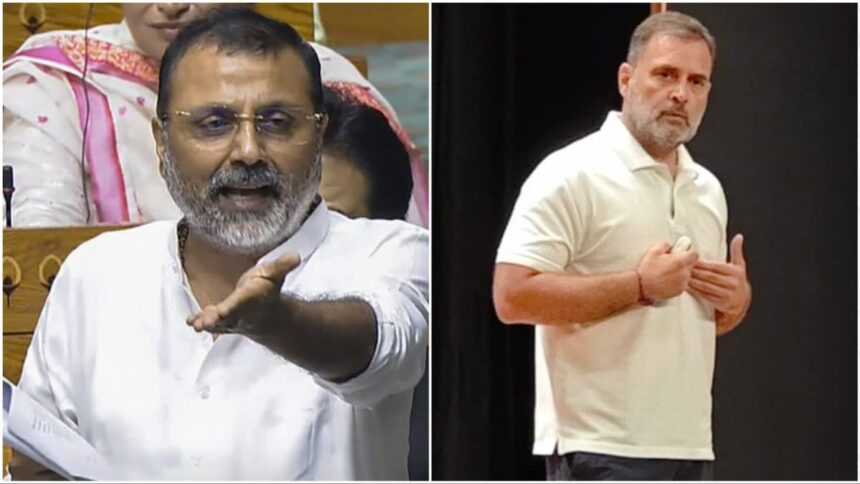
The political debate over India’s youth and their role in shaping democracy has intensified after Congress leader Rahul Gandhi praised Gen Z as the defenders of the Constitution and champions of democratic values. Gandhi’s remarks, made through a social media post, emphasized that the country’s young generation would play a decisive role in safeguarding democratic institutions and ensuring electoral integrity, positioning himself as a supporter of their activism. However, BJP leaders, led by Nishikant Dubey, responded sharply, questioning Gandhi’s credibility, accusing him of misrepresenting the values and priorities of India’s youth, and highlighting the generational opposition to dynastic politics and corruption. The exchange marks yet another chapter in the ongoing tussle between India’s two major political parties over youth engagement, governance credibility, and the broader narrative surrounding the role of young citizens in India’s democratic framework.
BJP Criticism and the Gen Z Debate
Nishikant Dubey’s response to Rahul Gandhi came immediately after the Congress leader posted on X (formerly Twitter) celebrating the youth of India as the country’s defenders against undemocratic practices and electoral malpractices. Dubey condemned Gandhi’s assertion, stating that Gen Z is inherently opposed to dynastic politics, nepotism, and corruption, and argued that it was unlikely for young Indians to align themselves with a family-dominated political system. “Gen Z is against nepotism and dynastic rule. Why will Gen Z tolerate Rahul ji after Nehru ji, Indira ji, Rajiv ji, Sonia ji?” Dubey asked, questioning the logic of Gandhi’s appeal to youth while simultaneously representing a political lineage that has dominated the Congress Party for decades.
Dubey further highlighted that the young generation stands for accountability and ethical governance, making them intolerant of political corruption. He posed a rhetorical challenge to Gandhi, asking why young Indians would not reject leaders who have been associated with systemic political malpractices. In his statement, he went on to emphasize the youth’s growing awareness and willingness to question established power structures, signaling a clear generational shift in political engagement. The BJP MP also made a provocative remark about the ideological vision of India’s youth, suggesting that while Gen Z in neighboring countries may lean toward defining religious identities for national purposes, Indian youth are increasingly inclined toward ethical governance and anti-corruption values, which runs contrary to Gandhi’s dynastic positioning.
Rahul Gandhi, in his social media post, positioned himself as an ally of Gen Z, asserting that the youth of India will play a critical role in defending the Constitution, protecting democracy, and addressing vote manipulation or “vote theft” allegations. Gandhi claimed that his support for young citizens stems from a shared commitment to democratic integrity and accountability, framing himself as a mentor and advocate for youth activism. This positioning aligns with his broader political strategy of appealing to first-time voters and young citizens by highlighting systemic concerns, including alleged electoral irregularities, governance failures, and the need for democratic vigilance.
The Congress leader’s stance found support from other political figures, such as Samajwadi Party leader IP Singh, who echoed the need for a Gen Z revolution to protect democratic principles. Singh argued that the youth of India are awakening to their rights and responsibilities and must take active measures to hold institutions accountable. He also criticized the lavish spending during Prime Minister Narendra Modi’s 75th birthday celebrations, framing it as a misuse of public funds under the watch of unemployed youth. Singh’s statements highlighted a broader narrative linking youth empowerment with accountability, governance reform, and the monitoring of political actions, creating a shared ideological platform with Gandhi’s messaging.
Electoral Allegations and Institutional Responses
The debate around youth activism was further intensified by Rahul Gandhi’s fresh allegations concerning voter deletion in Karnataka’s Aland constituency. Gandhi claimed that over 6,000 voters’ names had been removed in an attempt to manipulate electoral outcomes, raising concerns about the integrity of democratic processes at the local level. However, the Election Commission of India promptly dismissed these claims as “incorrect and baseless,” asserting that no deletions could occur without providing the affected individuals an opportunity to be heard.
The BJP seized on Gandhi’s repeated charges against constitutional institutions, arguing that they reflect both Gandhi’s and the Congress Party’s lack of faith in the democratic system. BJP leaders emphasized that unsubstantiated allegations against regulatory bodies undermine public confidence in governance and highlight a political tendency to challenge institutions for partisan advantage rather than through procedural or judicial mechanisms. The party’s response underscores its strategy of framing the Congress leader’s remarks as a misrepresentation of both youth intentions and democratic principles.
Gandhi, however, continued his offensive, targeting the Election Commission by demanding that it take action against alleged “vote chors” and provide information requested by the Karnataka CID regarding the voter deletion claims. He warned that failure to act would implicate the commission in what he described as a “murder of the Constitution,” framing the issue as a constitutional crisis and positioning himself as a defender of democratic norms. This escalation reflects the high-stakes political environment surrounding electoral integrity, youth engagement, and the legitimacy of institutional authority in India, and highlights the ways in which both parties seek to mobilize public sentiment through claims of accountability and justice.
The clash between BJP and Congress over Gen Z’s role in politics and democracy illustrates the larger battle over shaping the political consciousness of young citizens. While Gandhi positions himself as a champion of youth-led reform and guardianship of constitutional principles, BJP leaders counter by asserting that the values of young Indians inherently reject corruption, dynastic politics, and family-dominated party structures. The debate is not only about political ideology but also about credibility, representation, and the narrative control over how youth engagement is framed in national discourse.
Beyond the rhetoric, the political exchange also sheds light on how social media platforms are increasingly used as instruments for political messaging and mobilization. Gandhi’s X post was intended to reach a large, digitally active demographic, reinforcing his image as a progressive, youth-focused leader. Meanwhile, BJP’s counter-narrative, delivered through senior MPs like Nishikant Dubey, is designed to challenge that framing, using the same platforms to contest ideological claims and assert the party’s alignment with young citizens’ ethical and anti-nepotism priorities. This digital battleground amplifies the visibility of political debates and underscores the strategic importance of online narratives in shaping public perception, especially among first-time voters and young constituents.
The ideological tension also extends to questions of accountability and civic engagement. While Congress emphasizes activism against perceived electoral irregularities and governance failures, the BJP focuses on framing youth awareness as naturally aligned with anti-corruption and meritocratic values, positioning the party as the guardian of ethical governance. Both narratives aim to capture the imagination of Gen Z, who represent a growing segment of India’s electorate, yet the interpretations of their priorities and values remain contested between the parties.
Additionally, the dispute highlights generational expectations regarding political leadership and systemic reforms. India’s youth increasingly demand transparency, fairness, and meritocracy, and political parties are compelled to either align with these demands or risk criticism for misreading the electorate. The debate over Rahul Gandhi’s post and BJP’s response underscores the strategic calculus involved in appealing to young voters, balancing claims of institutional defense, anti-corruption advocacy, and generational representation.
Ultimately, the exchange between Rahul Gandhi and Nishikant Dubey over Gen Z is emblematic of the broader political discourse in India, where issues of youth participation, electoral integrity, and democratic values intersect with party rivalry, ideological positioning, and social media engagement. It reflects a complex interplay between leadership narratives, generational expectations, and institutional accountability, while also signaling the importance of youth as a transformative force within the Indian political system. Both parties continue to vie for the attention, support, and trust of Gen Z, framing the debate in ways that reflect their respective ideological priorities and strategic ambitions.
The discussions sparked by Gandhi’s post, including critiques from the BJP and endorsements from other political figures, also suggest that Gen Z is becoming a central factor in shaping policy debates, electoral strategies, and public discourse in India. Whether through activism, social media campaigns, or political participation, young citizens are being positioned as both the beneficiaries and enforcers of democratic accountability, with their values and preferences increasingly scrutinized and contested by political leaders across the spectrum.
The ongoing controversy, which encompasses claims of vote deletion, challenges to institutional authority, and debates about youth priorities, highlights the increasingly politicized nature of generational engagement. It also underscores the need for political parties to articulate clear, credible narratives that resonate with young citizens who are both observers and participants in India’s evolving democratic landscape. In this context, the BJP’s response to Gandhi’s post is not merely reactive but part of a broader strategy to assert moral and ideological authority over the political values of Gen Z.
As the conversation continues, the focus remains on how political leaders interpret the priorities and ethics of India’s youth, how they frame generational agency, and how young citizens themselves respond to competing narratives. The intersection of social media activism, institutional critique, and political messaging illustrates the multi-layered nature of contemporary political engagement in India, with Gen Z at the center of debates over governance, leadership, and democratic legitimacy.
The dispute also brings into focus the broader question of how dynastic politics is perceived by young citizens. While Congress relies on its historical legacy and lineage to establish credibility, BJP emphasizes that meritocracy, accountability, and anti-corruption principles resonate more authentically with India’s youth. The narrative battle over Gen Z, therefore, is not only a commentary on party politics but also on evolving political culture, expectations from leadership, and the transformative potential of youth participation in shaping India’s democratic future.
Both parties continue to actively seek support from this demographic, engaging in social media campaigns, public statements, and political positioning to define their alignment with youth values. The exchanges between Rahul Gandhi and BJP leaders reflect the high stakes involved in framing the identity, ethics, and political consciousness of Gen Z, with implications for both national policy debates and electoral outcomes.
The conversation surrounding Gen Z also underscores the broader societal shifts, including changing attitudes toward nepotism, corruption, and governance ethics. As India’s young generation increasingly asserts its influence, political leaders must navigate these expectations carefully, ensuring that their messaging aligns with the aspirations and principles of a demographic poised to shape the country’s democratic trajectory for decades to come.
Through the confrontation over social media statements, institutional credibility, and generational values, the debate demonstrates the evolving nature of political discourse in India. It reveals how leaders seek to construct narratives that resonate with young citizens while also defending their political legacies and challenging opposition claims. This dynamic reflects the growing importance of youth in political processes and the strategic attention parties must devote to understanding and engaging with Gen Z effectively.
The BJP’s strong reaction to Rahul Gandhi’s characterization of Gen Z, coupled with Gandhi’s insistence on framing youth as defenders of democracy, represents a defining moment in India’s contemporary political narrative. The clash illustrates how generational identity, political messaging, and institutional critique intersect, and how social media platforms have become central to influencing public perception and mobilizing young voters.
By emphasizing anti-corruption, meritocracy, and rejection of dynastic politics, the BJP seeks to frame Gen Z as naturally aligned with its ideology, countering Gandhi’s narrative of youth-led constitutional defense. This ongoing discourse underscores the competitive landscape of Indian politics, the centrality of young voters in shaping outcomes, and the ideological contest over defining the priorities and values of the next generation.
The political engagement surrounding Gen Z reflects both the opportunities and challenges of contemporary democratic participation, highlighting the influence of youth in electoral and governance matters. The debate between Congress and BJP, particularly in the context of Rahul Gandhi’s post, demonstrates the strategic importance of youth perceptions, social media discourse, and institutional credibility in India’s evolving political environment.