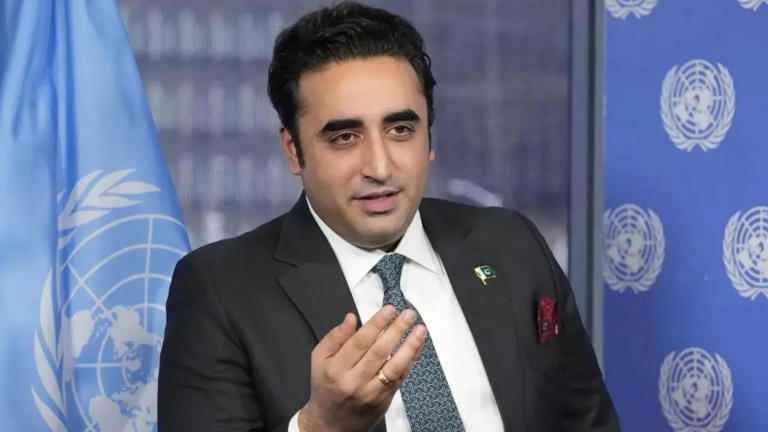
In a significant escalation of rhetoric against India, former Pakistani foreign minister Bilawal Bhutto Zardari has threatened war if India proceeds with any changes to the Indus Waters Treaty. This announcement came just a day after Pakistan Army Chief General Asim Munir issued a fresh nuclear threat targeting India, signaling increasing tensions between the two countries. Speaking at an event organized by the Sindh government’s culture department, Bilawal framed any diversion of the Indus River waters away from Pakistan as a direct assault on the nation’s history, culture, and civilization, especially the Sindh region.
The Indus Waters Treaty, signed in 1960, has been the cornerstone of water sharing between India and Pakistan. However, India put the treaty in abeyance following the April 22 Pahalgam terrorist attack that claimed 26 lives. Since then, Indian leaders, including Union Home Minister Amit Shah, have declared that India would not restore the historic accord.
Bilawal Bhutto warned that if Indian Prime Minister Narendra Modi initiates any moves against the Indus waters, it would be tantamount to attacking Pakistan’s cultural and historical identity. He accused Modi of using the announcement of a water project on the Indus as a veiled threat to curtail Pakistan’s water supply. During his foreign visits, Bilawal claimed to have raised concerns about India’s “aggressive water policy,” which he viewed as retaliation for India’s military successes earlier this year.
“The people of Sindh have always risen to defend the Indus whenever it was threatened,” Bilawal asserted. He further cautioned that the Pakistani people possess the strength to confront Modi in the event of war, hinting that any conflict might lead Pakistan to reclaim all six rivers in the Indus basin.
This heightened rhetoric follows the recent comments made by Pakistan Army Chief General Asim Munir, who stated that Pakistan, as a nuclear-armed nation, is prepared to use its weapons if faced with an existential threat from India. In a speech to the Pakistani diaspora in Tampa, Florida, Munir warned that if Pakistan were to be destroyed, it would take “half the world down with us.” He also vowed to destroy any Indian infrastructure that attempts to block water flow to Pakistan, specifically targeting Indian dam projects on the Indus.
Munir’s statements have drawn sharp criticism from India’s Ministry of External Affairs (MEA), which condemned the nuclear threats and questioned the integrity of Pakistan’s nuclear command and control, especially given the military’s alleged ties with terrorist groups. The MEA emphasized that India would never succumb to nuclear blackmail and would continue to take necessary steps to protect its national security. The ministry also expressed regret that such inflammatory remarks were made on the soil of a “friendly third country,” hinting at the United States, where Munir is currently visiting.
Bilawal’s Earlier Warnings and Pakistan’s Stance on Water Rights
Bilawal Bhutto’s latest threats are consistent with his previous warnings concerning India’s treatment of the Indus Waters Treaty. In June, he declared that Pakistan would be forced into war if India denied it its rightful share of water under the treaty. This statement came shortly after Pakistan’s foreign ministry criticized Indian leaders for disregarding international agreements, particularly the decision to suspend the treaty.
During a parliamentary speech, Bilawal reiterated Pakistan’s determination to secure its share of Indus waters, describing India’s suspension of the treaty as an aggressive and unjust move. His rhetoric reflects widespread concerns in Pakistan over water security, especially in regions like Sindh that heavily depend on the Indus River for agriculture and daily needs.
The water dispute has become a focal point in India-Pakistan relations, adding another layer of complexity to an already tense geopolitical environment. Pakistan sees the Indus River as vital to its survival, and any perceived threat to its flow is met with strong political and military rhetoric.
The recent exchanges between Bilawal Bhutto and General Asim Munir illustrate a unified front from Pakistan’s political and military leadership in opposing Indian policies regarding the Indus Waters Treaty. The combined nuclear and conventional war threats have alarmed observers and further strained the fragile peace between the two nuclear-armed neighbors.
India, on its part, has maintained that its actions are within its sovereign rights and necessary for its national security and development. The Indian government has consistently rejected accusations that it intends to harm Pakistan’s water supply, insisting that the projects on the Indus River and its tributaries comply with the provisions of the treaty.
The situation remains highly volatile, with both countries engaged in a war of words that could escalate into more serious conflict if diplomatic channels fail. The Indus Waters Treaty, despite decades of cooperation, now stands at the center of a broader geopolitical struggle, with Pakistan viewing any changes as an existential threat and India asserting its developmental prerogatives.
The international community continues to watch closely, as any escalation between India and Pakistan holds the potential for destabilizing the entire South Asian region. The recent surge in hostile rhetoric underlines the urgent need for renewed dialogue and confidence-building measures to prevent the water dispute from triggering a larger confrontation.