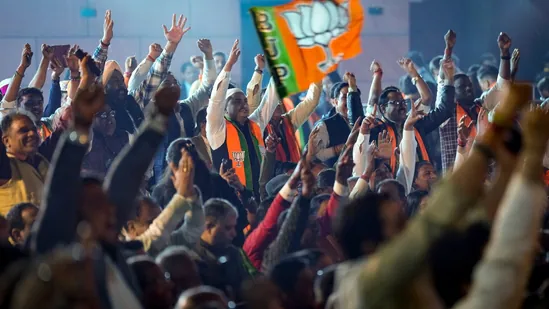
The 2025 Bihar Assembly elections delivered a dramatic verdict on the political landscape of India’s eastern state. While the National Democratic Alliance (NDA) decisively defeated the opposition Mahagathbandhan by winning 202 out of 243 assembly constituencies, the results highlighted an interesting paradox: the Bharatiya Janata Party (BJP) emerged as the single-largest party with 89 seats but did not top the chart in terms of vote share. The Rashtriya Janata Dal (RJD), led by Tejashwi Yadav, despite winning only 25 seats, recorded the highest vote share in the state, signaling a nuanced outcome that reflects voter sentiment in Bihar. This result has triggered political reactions across parties, intensified debates over democratic processes, and set the stage for strategic recalibrations ahead of the next general elections.
NDA’s Commanding Victory and the BJP-JDU Seat Dynamics
The Bihar election results clearly showcased the dominance of the NDA in the state, with the alliance securing a landslide victory over the opposition. The BJP, while emerging as the single-largest party with 89 seats, was closely followed by its coalition partner, the Janata Dal (United) or JDU, which won 85 seats. Together, these two parties consolidated the NDA’s overall tally, demonstrating the effectiveness of their electoral strategy, strong grassroots organization, and popular appeal in a state where governance and development remain central to voters’ decisions.
However, what stood out in these elections was the gap between seat count and vote share. Despite BJP winning the highest number of seats individually, the party accounted for only 20.8 percent of the total votes. The JDU, which had been projected to perform strongly under Chief Minister Nitish Kumar’s leadership, received 19.25 percent of the vote share, indicating that while the alliance was able to convert votes into seats efficiently, their individual popularity among voters was slightly lower than that of the RJD. This discrepancy highlights the complex nature of Bihar’s first-past-the-post electoral system, where regional vote distribution and alliance strategies often matter more than absolute vote percentages.
The NDA’s victory not only reinforced the alliance’s dominance in Bihar but also underscored the continued appeal of its developmental narrative. Promises of infrastructure expansion, job creation, and governance reforms were evidently persuasive for a majority of the electorate. Analysts suggest that the NDA’s ability to blend the popularity of BJP’s national leadership with JDU’s regional influence created a powerful combination, allowing the alliance to secure a significant number of seats even in areas where individual vote shares were not overwhelmingly high.
RJD’s Paradoxical Position and Opposition Reactions
While the NDA celebrated its triumph, the results painted a starkly different picture for the opposition. The Rashtriya Janata Dal, led by Tejashwi Yadav, was expected to be a major contender for forming the government but managed to secure only 25 seats, reflecting a disappointing outcome for the party. Despite this, the RJD recorded the highest vote share at 23 percent, a figure that indicates strong, widespread support among voters but insufficient concentration in specific constituencies to translate into seat wins. Political analysts interpret this as a classic case of vote dilution, where a party’s appeal is broad but not deep enough in key battlegrounds to overcome the NDA’s stronghold.
Other opposition parties struggled to make a significant impact. The Indian National Congress, which has historically played a central role in Bihar politics, received just 8.71 percent of votes, translating to around 43 lakh votes across the state. Despite repeated claims of electoral malpractice and calls for introspection, the Congress’s poor performance reflects its diminishing influence in the state. The Lok Janshakti Party (Ram Vilas), led by Chirag Paswan, fared marginally better with 4.97 percent of votes, while the Communist Party of India (Marxist–Leninist) received 2.84 percent of the total vote share. These figures underscore the challenge facing the opposition in Bihar: while certain parties enjoy voter sympathy, translating that support into tangible legislative power remains a significant hurdle.
The election outcome immediately triggered sharp reactions from the opposition. Lok Sabha Leader of Opposition Rahul Gandhi rejected the results outright, calling the process “unfair from the beginning” and promising that the Congress would continue to fight for the protection of democracy. Similarly, Congress veteran Mallikarjun Kharge stated that a thorough study of the results would be conducted to “understand the reasons for this outcome,” highlighting concerns over electoral trends and performance gaps. Senior party leader Pawan Khera went further, describing the elections as a “robbery in daylight,” implying manipulation and malpractices despite the visible democratic process. Congress spokesperson Jairam Ramesh accused the Prime Minister, the Home Minister, and the Election Commission of orchestrating a “large-scale vote theft,” reflecting the deep frustration and sense of betrayal felt within opposition ranks.
These reactions illuminate a wider debate about the nature of democracy and accountability in Bihar. While the NDA has been credited with effective campaigning and governance narratives that resonated with voters, the opposition’s claims of irregularities indicate persistent mistrust in electoral institutions. Analysts argue that such disputes, though not uncommon in Indian politics, emphasize the need for electoral reforms and transparency measures to ensure that public trust in the democratic process remains intact.
Vote Share Analysis and Political Implications
A closer look at the vote share data reveals interesting dynamics. While the NDA secured a sweeping majority, the RJD’s ability to garner the highest vote share suggests that it retains a significant base of support, particularly among youth and marginalized communities. Tejashwi Yadav’s leadership continues to be a rallying point for voters dissatisfied with the current governance model, which could serve as a foundation for future electoral strategies. The gap between vote share and seat conversion highlights the importance of tactical alliances, constituency-level planning, and the first-past-the-post electoral system’s impact on election outcomes.
The BJP and JDU’s combined vote share, while not topping the chart individually, proved sufficient to translate into a commanding seat majority. Political experts note that this reflects the effectiveness of targeted campaigning, voter mobilization, and constituency-level strategies that leveraged both national and regional narratives. Moreover, the NDA’s success in winning constituencies despite relatively moderate vote shares per party underscores the strategic advantage of coalition politics in Indian elections.
From a broader perspective, the Bihar results also offer insights into the evolving voter mindset. Developmental politics, law and order concerns, and governance narratives appear to have influenced voting patterns more strongly than traditional caste-based or identity-driven politics. This shift suggests that parties across the political spectrum may need to recalibrate their strategies, focusing more on delivery, governance, and policy outcomes rather than relying solely on historical vote banks.
The election also raises important questions for the national political landscape. The NDA’s ability to secure a decisive victory in Bihar, a state with complex socio-political dynamics and historically strong opposition influence, sends a strong signal about its strength and appeal. Conversely, the opposition faces the challenge of introspection and reinvention, as the RJD’s high vote share but low seat conversion illustrates the difficulty of translating popular support into political power without strategic planning and localized focus.