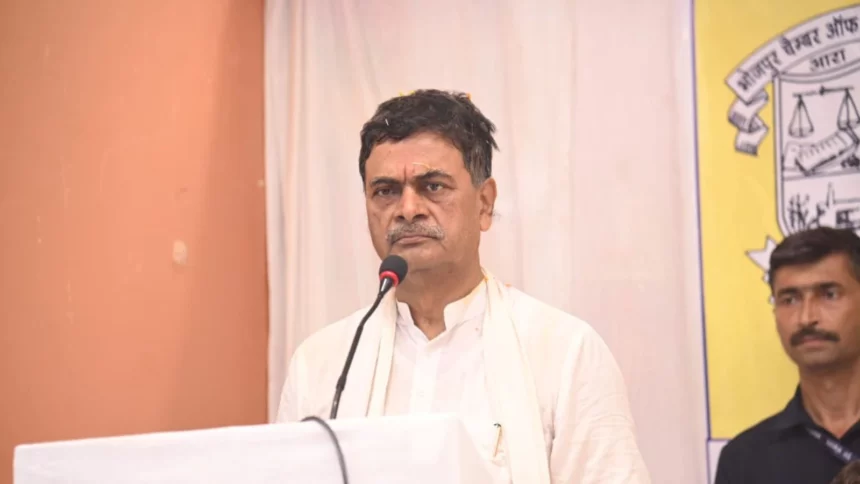
The suspension of former Union Minister RK Singh from the Bharatiya Janata Party has triggered a major political uproar in the aftermath of the Bihar election results, marking one of the most dramatic fallouts involving a senior leader who openly challenged his party, questioned candidate selections, and levelled serious corruption allegations against the Nitish Kumar–led government. The move, which came through an official suspension letter, has intensified debates on internal dissent, accountability, and the complex power dynamics now unfolding within the NDA after its decisive victory in the state. RK Singh’s allegations of a ₹62,000-crore electricity scam and his demand for a CBI probe have not only cast a shadow on the state government’s policies but have also raised difficult questions for the ruling alliance he once represented at the highest levels of government.
Rising Dissent And Public Confrontation Ahead Of Elections
The decision to suspend RK Singh did not come as a sudden development but followed months of escalating tension between him and the party leadership. Once a powerful Union Minister and an influential BJP face from Bihar, Singh repeatedly stepped out of line during the election campaign, openly voicing his dissatisfaction with the NDA’s candidate list and questioning the credibility of several nominees. His criticism went far beyond internal complaints, erupting into a public confrontation that the party could no longer ignore.
Singh accused the Nitish Kumar government of presiding over a massive ₹62,000-crore electricity scam, claiming financial manipulation, inflated pricing, and a deliberate attempt to mislead the public over energy procurement. His accusations targeted the very government that forms a crucial pillar of the BJP-led alliance in Bihar. The intensity of his remarks made it clear that Singh was no longer aligning himself with the party’s strategy or public messaging, creating rifts within the NDA’s election narrative.
In a series of sharp statements, Singh also attacked Deputy Chief Minister Samrat Chaudhary, JDU leader Anant Singh, and RJD’s Surajbhan Singh, calling them murder accused and unfit to contest elections. His rhetoric on social media grew increasingly aggressive, and he appealed to voters to reject certain NDA candidates altogether—an unprecedented act for a serving MP from the ruling party. His comparison of voting for such candidates to “drowning in a handful of water” became a notable flashpoint that embarrassed the party during the campaign.
The BJP’s organisational leadership viewed these remarks as sabotage, especially at a time when the NDA was attempting to project unity, stability, and strong governance in contrast to the Opposition. Singh’s conduct, they argued, weakened the alliance’s electoral messaging. His continued defiance ultimately compelled the BJP leadership to take disciplinary action to restore order and signal that public dissent would not be tolerated, particularly when it undermines the party’s collective interests.
RK Singh’s Allegations Of Massive Irregularities In Bihar’s Power Deal
Even after his suspension, RK Singh continued to target the Bihar government with renewed vigour, demanding a CBI investigation into what he described as a fraudulent electricity purchase agreement signed with the Adani Group. According to him, the agreement was a “direct betrayal of the people of Bihar” and imposed an unnecessary financial burden on consumers for decades to come.
Singh claimed that the state government had committed to buying electricity at ₹6.75 per unit under a 25-year agreement, even though the prevailing market rate was significantly lower. He argued that the terms were inflated and designed to benefit a private company at the cost of public revenue. The former minister asserted that large-scale irregularities had taken place not just in pricing but also in land allocation for the project, alleging that the entire process lacked transparency and accountability.
He went on to revive a key point from Union Finance Minister Nirmala Sitharaman’s earlier budget speech, where she had stated that the power plant would be developed by NTPC, a government enterprise, at an estimated cost of ₹21,400 crore—approximately ₹9 crore per megawatt. Singh emphasized that shifting such a major infrastructure project from a public-sector company to a private one required a clear explanation from state leaders, including senior minister Bijendra Yadav, who oversees the power department. “How this decision was changed later should be explained,” he insisted.
His criticism also drew attention to why a capable government-run company like NTPC, which had the expertise and capacity to build the project at an efficient cost, was replaced by a private company. Singh questioned whether the decision was altered to favour specific corporate interests. His statements have provided fuel to Opposition parties, which have seized upon his remarks as evidence of alleged corruption within the NDA-dominated state government.
In an attempt to support his claims with technical evidence, Singh posted documents on X showing calculations of fixed charges for electricity supply. He stated that the correct fixed charge per unit should have been ₹2.32 but was instead set at ₹4.16. This ₹1.84 hike, according to him, was proof of systematic overpricing and financial misconduct. “This is a huge scam. Corruption and cover-ups cannot go hand in hand. We cannot remain silent on this issue,” he declared.
Singh’s allegations have placed the NDA government in a difficult position at a time when it is attempting to focus on post-election governance. Calls for a CBI investigation from a former Union Minister belonging to the ruling alliance carry significant political weight and may intensify scrutiny on administrative decisions that until now remained shielded under the coalition’s united front.
Political Repercussions And Shifting Dynamics In Bihar And BJP
RK Singh’s suspension has triggered a major debate within political circles about discipline, transparency, and the internal tolerance for dissent within large national parties. His outburst comes at a time when the BJP is navigating transitions both at the national and state levels, preparing for a new leadership structure in the coming years and attempting to maintain cohesion among allies. Singh’s departure from party ranks reflects the narrowing space for vocal critics within the party, particularly those who challenge strategic decisions or raise uncomfortable questions about alliance partners.
Within Bihar, his allegations have reignited a sensitive debate on energy pricing, procurement policies, and the increasing reliance on private partners in major infrastructure projects. The Nitish Kumar government, an essential component of the NDA framework, now faces the burden of defending its record amid rising internal and external critique. RK Singh’s stature as a former Union Power Minister lends credibility to his technical criticism, making it harder for the state government to dismiss his claims as politically motivated.
On the national stage, Singh’s suspension represents a significant rupture between the BJP and one of its longstanding leaders from Bihar. It also throws light on the larger narrative of how the party handles internal contradictions and dissent among its senior ranks. Singh, a former IAS officer and a respected figure in administrative and political circles, served as a bridge between technocratic understanding and political governance. His estrangement may also influence public perceptions regarding bureaucratic leaders in electoral politics and the tension they face in aligning with party ideologies.
At the same time, Singh’s continued campaign for transparency in the power sector highlights the complex intersection of governance, economics, and corporate partnerships. His allegations of inflated electricity rates and mismatched procurement practices have raised questions about the broader energy policy framework, not only in Bihar but across states that rely heavily on long-term purchase agreements with private companies. These debates have implications for regulatory bodies, public-sector units, and consumer rights, extending the impact of this controversy well beyond political boundaries.
The suspension also sets a precedent for how parties may deal with leaders who choose to challenge internal decisions publicly rather than engage through institutional mechanisms. By taking strong action, the BJP has sent a clear message that organisational discipline will be enforced, especially when leaders publicly undermine electoral strategies or question key allies. Yet the political cost of silencing a senior figure who has raised serious corruption allegations remains uncertain. Much will depend on how the investigation demands unfold, how the state government responds, and whether RK Singh’s claims lead to broader institutional review.
As Bihar begins a new political cycle and the NDA works to stabilise governance after the elections, the fallout from RK Singh’s suspension and his explosive corruption allegations will continue to shape political conversations. The situation has evolved into a major test for accountability, intra-party democracy, and alliance management within one of the most politically significant states in the country.