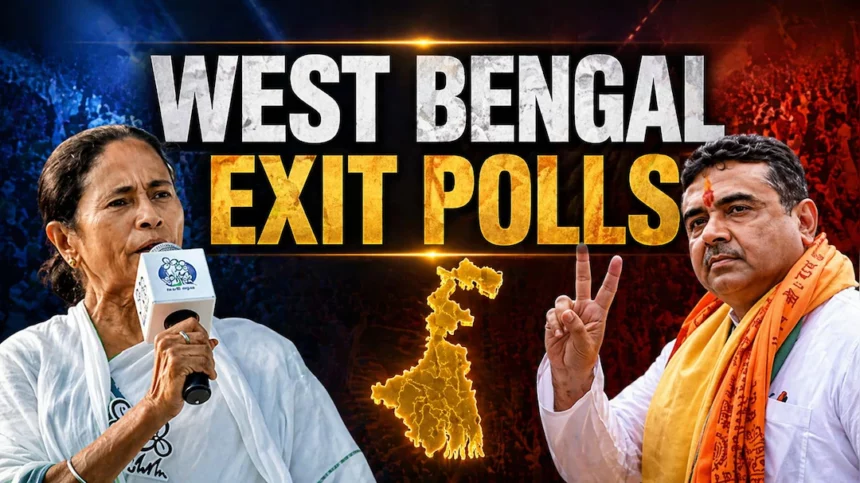
According to the projection, the BJP is expected to win around 192 seats (±11) in the 294-member assembly, while Trinamool Congress led by Mamata Banerjee may drop to nearly 100 seats. If these numbers hold true, it would mark a historic political shift, ending years of Trinamool dominance and giving BJP its first full-scale control of Bengal.
The exit poll estimates BJP’s vote share at 48 percent, significantly ahead of TMC’s projected 38 percent. Other parties are expected to remain marginal players in the state’s electoral landscape.
Such an outcome would not only change governance in Bengal but also have far-reaching national implications. West Bengal has long been a key battleground representing regional identity, federal power balance, and opposition politics. A decisive BJP victory here would strengthen its national narrative ahead of future elections.
Mamata Banerjee has strongly rejected the exit poll projections, expressing confidence that her party will secure more than 226 seats. Her response highlights both political resistance and the high stakes involved in this election.
West Bengal At The Center Of Political Transformation
West Bengal remains the focal point of the 2026 elections, with intense competition between BJP and TMC shaping the political narrative.
The exit poll suggests that BJP may have successfully capitalized on anti-incumbency sentiment, strengthened grassroots networks, and expanded its organizational reach across the state. Several key factors are believed to have contributed to this projected shift:
- Rising anti-incumbency against the ruling government
- Expansion of BJP’s ground-level organizational structure
- Influence of national leadership
- Highly polarized political environment
- Strategic consolidation of voter support
If the projections are accurate, the result would represent not just an electoral win but a structural transformation of Bengal’s political landscape. Analysts believe such a shift could redefine eastern India’s political balance and significantly boost BJP’s regional influence.
Tamil Nadu, Kerala And Assam Show Contrasting Trends
The exit poll also highlights diverse political trends across other key states.
In Tamil Nadu, the Dravida Munnetra Kazhagam led alliance is projected to retain power with around 125 seats in the 234-member assembly. However, a major development is the emergence of actor Vijay’s party, Tamilaga Vettri Kazhagam, which is expected to win approximately 63 seats, signaling a significant political realignment and a potential challenge to traditional opposition forces.
In Kerala, the election appears closely contested. The Indian National Congress led UDF alliance is projected to secure around 69 seats, narrowly ahead of the LDF, which is expected to win about 64 seats. If confirmed, this would indicate a return to Kerala’s traditional pattern of alternating governments.
Meanwhile, Assam appears relatively stable, with the BJP-led NDA projected to secure a strong majority of around 102 seats in the 126-member assembly. The alliance is expected to maintain a vote share close to 50 percent, reflecting continued voter support.
National Political Implications
The broader implications of these projections are significant. A strong BJP performance in West Bengal, combined with its continued dominance in Assam, would expand its influence across eastern and northeastern India.
Such outcomes could reinforce perceptions of BJP’s organizational strength, electoral adaptability, and national momentum. It would also reshape opposition strategies, especially if key regional strongholds weaken.
For Trinamool Congress, a major setback in Bengal could impact its role in national opposition politics and future coalition strategies. Similarly, evolving political dynamics in Tamil Nadu and Kerala may lead to leadership and strategic recalibrations among regional parties.
Exit Polls And The Element Of Uncertainty
Despite the strong projections, exit polls are not definitive results. Factors such as voter secrecy, last-minute swings, and methodological limitations can influence accuracy.
West Bengal, in particular, has a history of complex and unpredictable electoral behavior, making final outcomes difficult to predict solely based on exit polls.
Political analysts emphasize that while exit polls provide useful insights into trends, the actual counting of votes remains the ultimate determinant.
Conclusion
As India awaits the official results, the 2026 Assembly elections are shaping up to be a potentially transformative moment in the country’s political landscape.
Whether or not the projections materialize, the exit poll has already intensified political discourse and heightened anticipation. The final results will determine not only the future of state governments but also the direction of national politics in the years ahead.